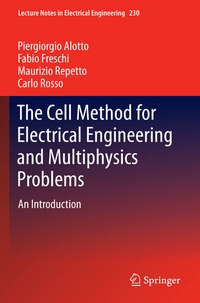
The Cell Method for Electrical Engineering and Multiphysics Problems
Description

This book presents a numerical scheme for the solution of field problems governed by partial differential equations: the cell method. The technique lends itself naturally to the solution of multiphysics problems with several interacting phenomena. The Cell Method, based on a space-time tessellation, is intimately related to the work of Tonti and to his ideas of classification diagrams or, as they are nowadays called, Tonti diagrams: a graphical representation of the problem's equations made possible by a suitable selection of a space-time framework relating physical variables to each other. The main features of the cell method are presented and links with many other discrete numerical methods (finite integration techniques, finite difference time domain, finite volumes, mimetic finite differences, etc.) are discussed. After outlining the theoretical basis of the method, a set of physical problems which have been solved with the cell method is described. These single and multiphysics problems stem from the authors' research experience in the fields of electromagnetism, elasticity, thermo-elasticity and others. Finally, the implementation of the numerical technique is described in all its main components: space-time discretization, problem formulation, solution and representation of the resulting physical fields.
Reviews / Votes
From the reviews:
"The book under review introduces the cell method, which is a numerical scheme for the solution of field problems governed by partial differential equations. . This book may be of interest to engineers and mathematicians who want to investigate the cell method further and see how it can interplay with other numerical methods, including the finite element method and the finite volume method." (Teodora-Liliana Radulescu, zbMATH, Vol. 1280, 2014)
"The book under review introduces the so-called 'cell method' (CM) developed by the authors for solving various partial differential equations (PDEs). . authors attempt to introduce the CM without a high level of mathematics and hope that the readers can implement the CM for practical engineering problems. . this book may be interesting to those mathematicians who want to investigate the cell method further and see how it competes with other well-studied numerical methods such as the finite element method and the finite volume method." (JiChun Li, Mathematical Reviews, October, 2013)More details
Other editions
Additional editions