

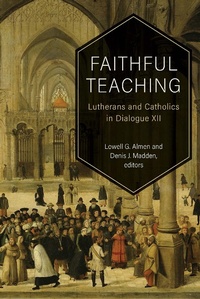
Faithful Teaching
Description

For more than fifty years, Lutherans and Catholics in the United States have listened to the word of God in dialogue with one another. The conversation has borne great fruit in overcoming past misunderstandings, prejudices, and even at times enmity between the two communions. It has fostered mutual appreciation, respect, and significant agreement on what were once thought to be irreconcilable doctrinal differences. But as major changes in church and society accelerate, the process by which communions make judgments and teach them to the faithful is of vital importance. Faithful Teaching is the twelfth dialogue of the U.S. Lutheran-Catholic Dialogue. It seeks greater mutual understanding of the two communions' respective processes of faithful teaching. It is offered in the hope that such understanding will contribute to our common efforts to witness more faithfully to the gospel of Jesus Christ in the world. In challenging times, the call to continue to preach and teach the gospel together resounds with new urgency.
More details
Other editions
Additional editions
Persons
Content
- Cover Page
- Title Page
- Copyright Page
- Contents
- Abbreviations
- Preface
- Part One
- Introduction
- 0.1 Call to Teach Faithfully
- 0.2 Summary of Important Agreements, Differences, and Implications
- 0.3 Faithfully Teaching Together
- Part Two
- Chapter 1. Teaching in the Triune Name
- 1.1 The Trinity as Source and Goal of Christian Teaching
- 1.2 The Form of the Trinity's Teaching
- 1.3 The Transmission of the Trinity's Teaching in the Church
- 1.4 Summary
- 1.4.1 Important Agreements
- 1.4.2 Implications for Unity
- Chapter 2. The Church as Taught and Teaching
- 2.1 The Church as Taught
- 2.2 The Church as Teacher
- 2.3 The Church as Teaching
- 2.3.1 Teaching as Proclaiming the Gospel
- 2.3.2 Teaching as Handing on the Faith
- 2.3.2.1 Catechesis and Faith Formation
- 2.3.2.2 The Formative Role of the Eucharistic Celebration
- 2.3.2.3 The Christian Witness of the Whole People of God
- 2.4 Summary
- 2.4.1 Important Agreements
- 2.4.2 Important Differences
- 2.4.3 Implications for Unity
- Chapter 3. Who Teaches? The Christian Faithful, Theologians, Apostolic Office
- 3.1 Introduction
- 3.2 Common History of Teaching Offices
- 3.2.1 The Apostolic Office
- 3.2.2 Bishops
- 3.2.3 The Bishop of Rome
- 3.2.4 Theologians
- 3.2.5 Other Teachers
- 3.3 Post-Reformation Developments
- 3.3.1 Catholic Distinctives
- 3.3.1.1 Theology of the Episcopate
- 3.3.1.2 Teaching Offices in the Catholic Church
- 3.3.1.2.1 Individual Bishops
- 3.3.1.2.2 Groups of Bishops
- 3.3.1.2.3 The Whole College of Bishops
- 3.3.1.2.4 The Bishop of Rome
- 3.3.2 Lutheran Distinctives
- 3.3.2.1 Theology of Teaching
- 3.3.2.1.1 The Role of the Lutheran Confessions
- 3.3.2.1.2 Bishops
- 3.3.2.1.3 Theological Faculties and Other Teachers
- 3.3.2.2 Teaching Offices in the ELCA
- 3.3.2.2.1 Pastors and Deacons
- 3.3.2.2.2 Individual Synodical Bishops
- 3.3.2.2.3 The Conference of Bishops
- 3.3.2.2.4 The Office of Presiding Bishop
- 3.4 Continuing Common Concerns
- 3.4.1 The Role of an Official Teaching Ministry
- 3.4.2 The Apostolicity of the Church
- 3.4.3 The Role of the Whole People of God in Teaching
- 3.4.4 Common Heritage and Divergent Claims
- 3.5 Summary
- 3.5.1 Important Agreements
- 3.5.2 Important Differences
- 3.5.3 Implications for Unity
- Chapter 4. How Do Churches Teach? Structures and Processes
- 4.1 Introduction
- 4.2 Synodality as a Shared Value
- 4.3 Lutheran Processes for Faithful Teaching
- 4.3.1 Development of Teaching Processes
- 4.3.1.1 Historical Antecedents
- 4.3.1.2 North American Lutheranism
- 4.3.2 Teaching Processes in the Evangelical Lutheran Church in America
- 4.3.2.1 Synod Assemblies and Churchwide Assemblies
- 4.3.2.2 Levels of Teaching in the ELCA
- 4.3.2.3 The Global Communion of Lutheran Churches
- 4.4 Catholic Processes for Faithful Teaching
- 4.4.1 Development of Teaching Processes
- 4.4.2 Teaching Processes in the Roman Catholic Church
- 4.4.2.1 Individual Bishops
- 4.4.2.2 Groups of Bishops
- 4.4.2.3 The Whole College of Bishops
- 4.4.2.4 The Bishop of Rome
- 4.5 Summary
- 4.5.1 Important Agreements
- 4.5.2 Important Differences
- 4.5.3 Implications for Unity
- Chapter 5. What is Taught? Scripture, Tradition, and Church Doctrine
- 5.1 Introduction
- 5.2 Lutheran Perspectives
- 5.2.1 The Role of Confessing the Faith
- 5.2.2 Law and Gospel
- 5.2.3 The Two Regiments
- 5.3 Catholic Perspectives
- 5.3.1 The Hierarchy of Truths in Catholic Doctrine
- 5.3.2 Different Levels of Teaching
- 5.3.3 Faith and Morals
- 5.3.4 Natural Law
- 5.4 Summary
- 5.4.1 Important Agreements
- 5.4.2 Important Differences
- 5.4.3 Implications for Unity
- Chapter 6. How is Teaching Received? Reception in the Life and Mission of the Church
- 6.1 Introduction
- 6.2 Catholic Perspectives on the Reception of Faithful Teaching
- 6.2.1 Reception in the Life of the Church
- 6.2.1.1 Personal Faith and Ecclesial Faith
- 6.2.1.2 The Sense of the Faithful
- 6.2.2 Reception in the Life of the Individual Believer
- 6.2.2.1 The Response to Definitive Dogma
- 6.2.2.2 The Response to Definitive Doctrine
- 6.2.2.3 The Response to Non-Definitive Authoritative Doctrine
- 6.2.2.4 The Response to Prudential Judgments and Applications of Doctrine
- 6.2.3 The Role of Conscience
- 6.2.4 The Role of Reception in Validating Faithful Teaching
- 6.3 Lutheran Perspectives on the Ecclesial Reception of Faithful Teaching
- 6.3.1 Reception in the Life of the Church
- 6.3.2 Reception in the Life of the Individual Believer
- 6.3.3 Non-reception of Teaching: Disagreement and Dissent
- 6.4 Summary
- 6.4.1 Important Agreements
- 6.4.2 Important Differences
- 6.4.3 Implications for Unity
- Appendix 1: Members of Round XII of US Lutheran-Catholic Dialogue
- Appendix 2: Papers for Round XII of US Lutheran-Catholic Dialogue
- Appendix 3: US and International Lutheran-Catholic Dialogues
