

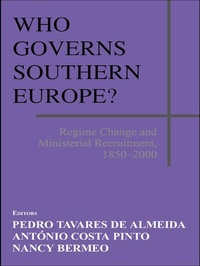
Who Governs Southern Europe?
Regime Change and Ministerial Recruitment, 1850-2000
Published on 2. August 2004
242 pages
978-1-135-76323-7 (ISBN)
Description

In modern politics, cabinet ministers are major actors in the arena of power as they occupy a strategic locus of command from which vital, authoritative decisions flow continuously. Who are these uppermost policy-makers? What are their background characteristics and credentials? How are they selected and which career paths do they travel in their ascent to power?
This set of research issues has guided this collection, a comprehensive, empirical account of the composition and patterns of recruitment of ministerial elites in Southern Europe throughout the last 150 years, thus encompassing different historical circumstances and political settings - liberal, authoritarian and democratic. With original, comparative data from the 19th century to the present, it provides valuable material for debates about how regime change and economic development affect who governs.
First published in 2003 by Frank Cass / Reprinted in 2012 by Routledge
This set of research issues has guided this collection, a comprehensive, empirical account of the composition and patterns of recruitment of ministerial elites in Southern Europe throughout the last 150 years, thus encompassing different historical circumstances and political settings - liberal, authoritarian and democratic. With original, comparative data from the 19th century to the present, it provides valuable material for debates about how regime change and economic development affect who governs.
First published in 2003 by Frank Cass / Reprinted in 2012 by Routledge
Reviews / Votes
'A gap has at last been filled in our knowledge of West European Governments. Who Governs Southern Europe? is a fascinating analysis of the way the cabinets of the countries of Southern Europe have gradually ceased to be 'exceptions' and become 'normal' within the Western European family. Must be read by all those interested in the evolution of governments.'- Jean Blondel, European University Institute, Florence and University of Siena
'This is a theoretically acute, empirically exhaustive study of top-level political elites in the four countries of Southern Europe over the past 150 years. Combining deep historical knowledge with extensive data, the book is a fundamental contribution to our knowledge of elite circulation and political regime change during the modern historical period.'
- John Higley, Chair of the IPSA Research Committee on Political Elites
'This book fills an important gap in our knowledge of political elites. Its unique focus on cabinet ministers in four contemporary societies of Southern Europe yelds a rich trove of empirical data that offer much food for thought. It raises significant substantive questions and prompts us to ponder their impact for a world forging new forms of political alliances and institutions across national boundaries'
- Suzanne Keller, Princeton University
'This excellent set of original analyses provides a lot of good food for thought and goes a long way in providing a portrait of the continuities and the transformations of Southern European politics'
- Gianfranco Pasquino, West European Politics, 27 (5), 2004
'The conclusions reached by this book (...) mark an important step forward in our efforts to understand the political development of Southern Europe.'
- Giulio Sapelli, Journal of Southern Europe and the Balkans, 6 (3), 2004
'There can be little doubt this work will prove be a starting point for future research - whether by the scale of the work undertaken (both in the revision of specialist literature and in the production of empirical data) or via the debate the theses and hypotheses presented in these pages may stimulate.'
- Francisco Javier Luque Castillo, Revista Espanola de Ciencia Politica, 17, 2007
More details
Series
Language
English
Place of publication
London
United Kingdom
Publishing group
Taylor & Francis Ltd
Target group
College/higher education
Professional and scholarly
File size
4,04 MB
ISBN-13
978-1-135-76323-7 (9781135763237)
Copyright in bibliographic data and cover images is held by Nielsen Book Services Limited or by the publishers or by their respective licensors: all rights reserved.
Schweitzer Classification
Other editions
Additional editions
Pedro Tavares de Almeida | Nancy Bermeo | Antonio Costa Pinto
Who Governs Southern Europe?
Regime Change and Ministerial Recruitment, 1850-2000
Book
08/2003
Frank Cass Publishers
€178.56
Withdrawn from sale

Pedro Tavares de Almeida | Nancy Bermeo | Antonio Costa Pinto
Who Governs Southern Europe?
Regime Change and Ministerial Recruitment, 1850-2000
Book
08/2003
Routledge
€76.10
Shipment within 10-20 days
Persons
Pedro Tavares de Almeida, Nancy Bermeo, Antonio Costa Pinto
Content
Portuguese ministers, 1851-1999 - social background and paths to power, Pedro Tavares de Almeida and Antonio Costa Pinto; ministers and regimes in Spain -from the first to the second restoration, 1874-2002, Juan J. Linz et al; ministers in Italy - notables, party men, technocrats and media men, Maurizio Cotta and Luca Verzichelli; ministerial elites in Greece, 1843-2001 - a synthesis of old sources and new data, Dimitri A. Sotiropoulos and Dimitris Bourikos; ministerial elites in southern Europe - continuities, changes and comparisons, Nancy Bermeo.
