

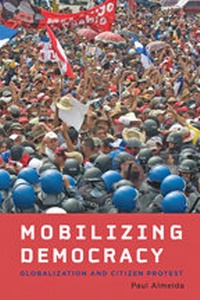
Mobilizing Democracy
Globalization and Citizen Protest
Published on 26. September 2014
216 pages
978-1-4214-1410-2 (ISBN)
Description

What are the conditions and factors that drive people to protest against government economic policies in the developing world?
Distinguished Scholarship Award of the Pacific Sociological Association (2015)
Paul Almeida's comparative study of the largest social movement campaigns that existed between 1980 and 2013 in every Central American country (Costa Rica, El Salvador, Guatemala, Honduras, Nicaragua, and Panama) provides a granular examination of the forces that spark mass mobilizations against state economic policy, whether those factors are electricity rate hikes or water and health care privatization. Many scholars have explained connections between global economic changes and local economic conditions, but most of the research has remained at the macro level. Mobilizing Democracy contributes to our knowledge about the protest groups "on the ground" and what makes some localities successful at mobilizing and others less successful. His work enhances our understanding of what ingredients contribute to effective protest movements as well as how multiple protagonists-labor unions, students, teachers, indigenous groups, nongovernmental organizations, women's groups, environmental organizations, and oppositional political parties-coalesce to make protest more likely to win major concessions.
Based on extensive field research, archival data of thousands of protest events, and interviews with dozens of Central American activists, Mobilizing Democracy brings the international consequences of privatization, trade liberalization, and welfare-state downsizing in the global South into focus and shows how persistent activism and network building are reactivated in these social movements. Almeida enables our comprehension of global and local politics and policy by answering the question, "If all politics is local, then how do the politics of globalization manifest themselves?" Detailed graphs and maps provide a synthesis of the quantitative and qualitative data in this important study. Written in clear, accessible prose, this book will be invaluable for students and scholars in the fields of political science, social movements, anthropology, Latin American studies, and labor studies.
Distinguished Scholarship Award of the Pacific Sociological Association (2015)
Paul Almeida's comparative study of the largest social movement campaigns that existed between 1980 and 2013 in every Central American country (Costa Rica, El Salvador, Guatemala, Honduras, Nicaragua, and Panama) provides a granular examination of the forces that spark mass mobilizations against state economic policy, whether those factors are electricity rate hikes or water and health care privatization. Many scholars have explained connections between global economic changes and local economic conditions, but most of the research has remained at the macro level. Mobilizing Democracy contributes to our knowledge about the protest groups "on the ground" and what makes some localities successful at mobilizing and others less successful. His work enhances our understanding of what ingredients contribute to effective protest movements as well as how multiple protagonists-labor unions, students, teachers, indigenous groups, nongovernmental organizations, women's groups, environmental organizations, and oppositional political parties-coalesce to make protest more likely to win major concessions.
Based on extensive field research, archival data of thousands of protest events, and interviews with dozens of Central American activists, Mobilizing Democracy brings the international consequences of privatization, trade liberalization, and welfare-state downsizing in the global South into focus and shows how persistent activism and network building are reactivated in these social movements. Almeida enables our comprehension of global and local politics and policy by answering the question, "If all politics is local, then how do the politics of globalization manifest themselves?" Detailed graphs and maps provide a synthesis of the quantitative and qualitative data in this important study. Written in clear, accessible prose, this book will be invaluable for students and scholars in the fields of political science, social movements, anthropology, Latin American studies, and labor studies.
More details
Series
Language
English
Place of publication
Baltimore
United States
Target group
College/higher education
Illustrations
20 s/w Zeichnungen
20 Line drawings, black and white
File size
5,59 MB
ISBN-13
978-1-4214-1410-2 (9781421414102)
DOI
10.1353/book.72106
Copyright in bibliographic data and cover images is held by Nielsen Book Services Limited or by the publishers or by their respective licensors: all rights reserved.
Schweitzer Classification
Other editions
Additional editions
Book
09/2014
Johns Hopkins University Press
€32.00
Article not available at the moment
Book
09/2014
Johns Hopkins University Press
€64.00
Shipment within 10-20 days
Person
Paul Almeida is an associate professor of sociology at the University of California, Merced, and the author of Waves of Protest: Popular Struggle in El Salvador, 1925-2005.
Content
List of Figures and Tables
Acknowledgments
Abbreviations
1. Introduction: Globalization and Citizen Protest
2. A Theory of Local Opposition to Globalization
3. Costa Rica: The Prototype for Mobilization against Globalization
4. El Salvador: Opposition Party and Protest Campaigns
5. Panama: The Legacy of Military Populism
6. Nicaragua: Third World Revolution Confronts Globalization
7. Guatemala and Honduras: Anti-Neoliberal Resistance
8. Conclusion: State-Led Development Legacies in the Era of Global Capital
Notes
Bibliography
Index
Acknowledgments
Abbreviations
1. Introduction: Globalization and Citizen Protest
2. A Theory of Local Opposition to Globalization
3. Costa Rica: The Prototype for Mobilization against Globalization
4. El Salvador: Opposition Party and Protest Campaigns
5. Panama: The Legacy of Military Populism
6. Nicaragua: Third World Revolution Confronts Globalization
7. Guatemala and Honduras: Anti-Neoliberal Resistance
8. Conclusion: State-Led Development Legacies in the Era of Global Capital
Notes
Bibliography
Index
