

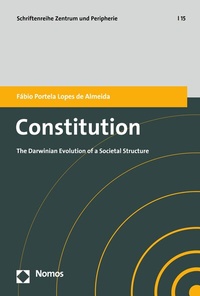
Constitution
The Darwinian Evolution of a Societal Structure
1st Edition
Published on 30. September 2020
489 pages
978-3-7489-0554-7 (ISBN)
Description

Der Band diskutiert die Rolle und Wichtigkeit von Verfassungen in modernen Gesellschaften. Aus interdisziplinärer Perspektive wird aufgezeigt, wie sich Verfassungen trotz großer Vielfalt innerhalb der Gesellschaft entwickeln konnten und wie sie dabei helfen, ein gemeinsames Moralsystem zu schaffen. Der Mensch ist die einzige Spezies, die in großen Gemeinschaften leben kann, obwohl ihre Mitglieder genetisch unabhängige Individuen sind. Diese Vielfalt macht die Rolle von Verfassungen besonders komplex. Die Arbeit beleuchtet, wie der Konstitutionalismus zur Etablierung eines einheitlichen Moralsystems beiträgt.
More details
Other editions
Additional editions
Book
09/2020
1st Edition
Nomos
€99.00
Shipment within 7-9 days
Content
- Cover
- Acknowledgments
- Introduction
- 1. Constitutionalism, Evolution and Social Theory: the Need of an Integrated Approach
- 1.1. Legal Theory and Evolution: A Historical Background
- 1.2. Do We Need an Evolutionary Approach to Constitutionalism?
- 1.2.1. The Darwinian Challenge to Social and Legal Scholarship
- 1.2.2. Evolutionary Theory Offers a Consilient Approach to Constitutional Theory
- 1.2.3. Shedding New Lights on Old Problems
- 1.2.4. Constitutionalism as a Cooperation-Enhancing Evolved Structure
- 2. From Hierarchical Primates to an Egalitarian Species: Understanding the Origins of Human Cooperation
- 2.1. Gene-centered Mechanisms of Cooperation
- 2.1.1. Kin Selection
- 2.1.2. Direct Reciprocity
- 2.2. Gene-culture Coevolutionary Foundations of Human Pro-social Behavior
- 2.2.1. The Role of Indirect Reciprocity
- 2.2.2. The Emergence of Culture and Cultural Evolution as Preconditions to Cooperation among Humans
- 2.2.3. The Evolution of a Normative Mind: Gene-culture Coevolution and the Cognitive Foundations of Large-scale Altruism
- 2.2.3.1. Moralistic Punishment and Imitation Strengthen Cultural Group Selection
- 2.2.3.2. The Moral Grammar Wired in the Normative Mind
- 2.2.4. Multilevel Selection Foundations of Human Normative Behavior and Cooperation in Large-Scale Societies
- 3. Darwinian Populations and Social Theory
- 3.1. What is a Darwinian population?
- 3.1.1. The Parameters of a Darwinian Population in Godfrey-Smith's Perspective
- 3.1.2. Reproduction and Collective Entities according to Godfrey-Smith
- 3.1.3. Levels, Transitions and Multilevel Selection
- 3.2. Sociocultural Darwinian Populations
- 3.2.1. The problem of Emergence in Sociology
- 3.2.2. Luhmann's Theory as a Bridge between Sociology and Psychology
- 3.2.2.1. The Biological Constraints of Cultural Evolution
- 3.2.2.2. Systems Theory and Microsociological Evolution
- 3.2.2.3. Systems Theory Must Take Multilevel Selection Processes into Account
- 3.2.2.4. Luhmann's Darwin: Reconciling Autopoiesis and Evolution
- 3.2.3. Human Societies as Darwinian Individuals
- 4. The Function of Law in an Evolutionary Theory of Stratification
- 4.1. Functionalism and Sociology
- 4.1.1. Sociological Functionalism Revisited
- 4.1.2. The Concept of Function in Biology
- 4.1.3. Function: An Abstract Concept of Evolutionary Thought
- 4.2. The Function(s) of Law
- 4.2.1. Macro-dynamic (and Meso-dynamic?) level: Law as Structure of Society
- 4.2.2. Micro-dynamic level: Law Promotes Cooperation
- 4.2.3. The Natural Law Roots of All Legal Systems
- 4.3. From Egalitarian Foragers to Stratified Empires: Hierarchy Strikes Back
- 4.3.1. Breaking down the Egalitarian Logic: An Anthropological Perspective
- 4.3.2. The Adaptive Function of Stratification and the Law of Pre-Modern High Cultures
- 5. Constitutionalism as an Evolved Adaptation
- 5.1. The Sociological Preconditions of the Constitutional State: Hauke Brunkhorst's Critical Theory of Legal Revolutions
- 5.2 The Multilevel Selection of Constitutional Societies
- 5.3. Constitutional Societies as Darwinian Individuals
- 5.4. Egalitarianism Strikes Back: Inclusion and Exclusion in Constitutional Societies
- 5.5. The Psychological Foundations of Constitutionalism
- Concluding Remarks
- References
