

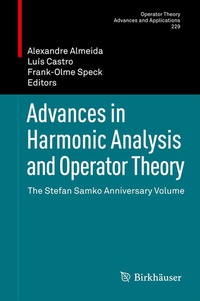
Advances in Harmonic Analysis and Operator Theory
The Stefan Samko Anniversary Volume
1st Edition
Published on 31. January 2013
VIII, 392 pages
978-3-0348-0516-2 (ISBN)
Description

This volume is dedicated to Professor Stefan Samko on the occasion of his seventieth birthday. The contributions display the range of his scientific interests in harmonic analysis and operator theory. Particular attention is paid to fractional integrals and derivatives, singular, hypersingular and potential operators in variable exponent spaces, pseudodifferential operators in various modern function and distribution spaces, as well as related applications, to mention but a few. Most contributions were firstly presented in two conferences at Lisbon and Aveiro, Portugal, in June-July 2011.
More details
Other editions
Additional editions
Alexandre Almeida | Luís Castro | Frank-Olme Speck
Advances in Harmonic Analysis and Operator Theory
The Stefan Samko Anniversary Volume
Book
07/2015
Birkhäuser
€139.09
Shipment within 10-15 days
Alexandre Almeida | Luís Castro | Frank-Olme Speck
Advances in Harmonic Analysis and Operator Theory
The Stefan Samko Anniversary Volume
Book
01/2013
1st Edition
Birkhäuser
€139.09
Shipment within 10-15 days
Content
- Intro
- Advances in Harmonic Analysis and Operator Theory
- The Stefan Samko Anniversary Volume
- Contents
- Preface
- Stefan G. Samko - Mathematician, Teacher and Man
- 1. Introduction
- 2. Scientific origin from BVP and SIE, 1965-1974
- 3. Research in Fractional Calculus (FC), 1967-1996
- 3.1. One-dimensional Fractional Calculus
- 3.1.1. Relations between left- and right-hand sided fractional integration
- 3.1.2. Estimates of moduli of continuity
- 3.1.3. In collaboration with Bertram Ross
- 3.1.4. Other
- 3.2. Multidimensional FC
- 4. Equations with involutive operators, 1970-1977
- 5. Function spaces of fractional smoothness, influence of Steklov Mathematical Institute
- 5.1. Hypersingular integrals and spaces of the type of Riesz potentials
- 5.2. Potential type operators with homogeneous kernels
- 5.3. Spherical HSI and potentials
- 6. Portugal period
- after 1995
- 6.1. FC continued
- constant exponents
- 6.1.1. Approximative inverses for the fractional type operators
- 6.1.2. Local nature of Riesz potential operators
- 6.1.3. Miscellaneous
- 6.2. Equations with involutive operators, continued
- 6.3. Variable Exponent Analysis: 1993-2003
- 6.4. Variable Exponent Analysis in collaboration with V. Kokilashvili, 2001-present
- 6.5. Variable Exponent Analysis, continued: 2004-present
- 6.5.1. More on weighted estimates of potential operators
- 6.5.2. Studies related to HSI and the range Ia() (Lp()) in case of variable exponents
- 6.5.3. Morrey and Campanato spaces
- 6.5.4. PDO in variable exponent setting
- 6.5.5. Miscellaneous in variable exponent analysis
- 7. Miscellaneous
- References
- The Role of S.G. Samko in the Establishing and Development of the Theory of Fractional Differential Equations and Related Integral Operators
- 1. Main aspects of the modern theory of fractional differential equations
- 1.1. Elements of the classification
- Ordinary fractional differential equations
- Fractional partial differential equations
- 1.2. Methods of investigation
- Treating problems:
- Types of solutions:
- Methods of solution:
- 2. Basic components of investigations related to fractional differential equations
- 2.1. Development of fractional calculus
- 2.2. Development of the theory of first-order integral equations
- 2.3. Development of methods of integral transforms
- 2.4. Development of the theory of special functions
- 2.5. Development of multidimensional fractional calculus
- 3. The role of Professor S.G. Samko in the creation and development of the theory of fractional differential equations
- 3.1. Singular integral equations and boundary value problems
- 3.2. Abel integral equations and their generalizations
- 3.3. Integral equations with weak singularities
- 3.4. Convolution type integral equations
- 3.5. Fractional integro-differentiation
- 3.6. Fractional powers of operators
- 3.7. The theory of (one- and multidimensional) potential type operators
- 4. Conclusion
- Acknowledgment
- References
- Energy Flow Above the Threshold of Tunnel Effect
- 1. Introduction
- 2. A solution formula
- 3. L8-time decay
- 4. Energy flow
- References
- Some New Hardy-type Integral Inequalities on Cones of Monotone Functions
- 1. Introduction
- 2. Preliminaries
- 3. The main results
- 4. Proofs
- 5. The non-decreasing case
- Acknowledgment
- References
- On a Boundary Value Problem for a Class of Generalized Analytic Functions
- 1. Introduction
- 2. Differential operators for pseudoanalytic functions
- 3. Boundary value problems and Bauer operators
- 4. Poly-pseudoanalytic functions
- Acknowledgement
- References
- The Factorization Problem: Some Known Results and Open Questions
- 1. Introduction
- 2. Wiener-Hopf factorization
- 3. AP factorization
- 4. Factorization on compact abelian groups
- References
- A Class of Sub-elliptic Equations on the Heisenberg Group and Related Interpolation Inequalities
- 1. Introduction
- 2. Existence of least energy solutions of (1.7)
- 3. Sharp estimate of CH
- 4. Further remarks on CH
- 5. Extensions to quasilinear equations
- Appendix
- References
- New Types of Solutions of Non-linear Fractional Differential Equations
- 1. Introduction
- 2. Basic equations
- 3. Fractional attractors
- 3.1. Standard map: Fixed and periodic points
- 3.2. Phase space at low K (stable (0,0) fixed point)
- 3.3. Phase space at Kc1 & K & Kc21 (stable T = 2 antisymmetric trajectory)
- Remarks
- 3.4. Phase space at K & Kc2
- 3.5. Cascade of bifurcations type trajectories
- 3.6. More FSM's attractors
- 3.7. The fractional dissipative standard map (FDSM)
- 4. Conclusion
- Acknowledgment
- References
- Stability, Structural Stability and Numerical Methods for Fractional Boundary Value Problems
- 1. Introduction
- 2. Existence and uniqueness of the solution
- 3. Dependence on the problem parameters
- 4. Numerical examples
- 5. Conclusions
- Acknowledgment
- References
- On the Boundedness of the Fractional Maximal Operator, Riesz Potential and Their Commutators in Generalized Morrey Spaces
- 1. Introduction
- 2. Morrey spaces
- 3. Generalized Morrey spaces
- 4. Boundedness of the fractional maximal operator in generalized Morrey spaces
- 4.1. Spanne type result
- 4.2. Adams type result
- 5. Riesz potential operator in the spaces Mp,f
- 5.1. Spanne type result
- 5.2. Adams type result
- 6. Commutators of fractional maximal operatorsin the spaces Mp,f
- 6.1. Spanne type result
- 6.2. Adams type result
- 7. Commutators of Riesz potential operators in the spaces Mp,f
- 7.1. Spanne type result
- 7.2. Adams type result
- 8. Some applications
- 8.1. Marcinkiewicz operator
- 8.2. Fractional powers of the some analytic semigroups
- Acknowledgment
- References
- Existence of Solutions of a Class of Nonlinear Singular Equations in Lorentz Spaces
- 1. Introduction
- 2. Preliminaries results
- 3. Proof of Theorem 1.1
- 3.1. Existence
- 3.2. Estimate for the solution
- References
- Growth of Schrödingerian SubharmonicFunctions Admitting Certain Lower Bounds
- 1. Introduction and statement of results
- 2. Proofs
- References
- The Riemann and Dirichlet Problems with Data from the Grand Lebesgue Spaces
- 1. The Riemann boundary value problem for analytic functions
- 1.1. The class Lp),? (G
- ?)
- 1.2. The classes Wp),? (G) and Kp),? (G)
- 1.3. One property of the operator SG
- 1.4. Problem (1) in the class Kp),),? (G) for continuous G
- 1.5. On a weight function from Wp),? (G)
- 1.6. Problem (1) with a piecewise-continuous coefficient G(t) and geLp),? (G)
- 2. The Dirichlet problem
- Acknowledgement
- References
- Overview of Fractional h-difference Operators
- 1. Introduction
- 2. Preliminaries
- 3. Power rule formulas
- 4. Properties of the operators
- 5. Initial value problems and exponentials
- 6. Summary
- Acknowledgment
- References
- A Singularly Perturbed Dirichlet Problem for the Poisson Equation in a Periodically Perforated Domain. A Functional Analytic Approach
- 1. Introduction
- 2. Notation and preliminaries
- 3. Formulation and analysis of an auxiliary problem
- 4. A functional analytic representation theorem for the solution of problem (1.1)
- Appendix A. A real analyticity result for a composition operator
- Acknowledgment
- References
- Fractional Variational Calculus of Variable Order
- 1. Introduction
- 2. Preliminaries
- 3. Main results
- 3.1. Boundedness
- 3.2. Integration by parts formulas
- 3.3. A fundamental variational problem of variable fractional order
- 4. Illustrative examples
- Acknowledgment
- References
- Improving Bounds for Singular Operators via Sharp Reverse Holder Inequality for A8
- 1. Introduction
- 2. Main results
- 2.1. Coifman-Fefferman inequalities
- 2.2. Mixed A1-A strong and weak norm inequalities for commutators
- 3. Background and preliminaries
- 3.1. Rearrangement type estimates
- 3.2. Pointwise inequalities
- 3.3. Building A1 weights from duality
- 4. About the proofs
- 4.1. Coifman-Fefferman inequalities
- 4.1.1. Proof of the key rearrangement estimate
- 4.2. Mixed A1-A8 strong and weak norm inequalities for commutators
- Acknowledgement
- References
- Potential Type Operators on Weighted Variable Exponent Lebesgue Spaces
- 1. Introduction
- 2. Pseudodifferential operators
- 2.1. Pseudodifferential operators on R
- 2.2. Mellin pseudodifferential operators
- 3. Operators on slowly oscillating curves
- 3.1. Curves, weights, coefficients
- 3.2. Simonenko local principle
- 4. Potential type operators in Lp() (G, w)
- 4.1. Operators of the double-layer potentials type
- 4.2. Fredholm property and essential spectrum of operators of double-layer potentials type
- 4.2.1. Fredholm property
- 4.2.2. Essential spectrum of the operator Dg,G
- 4.3. Integral operators of the Dirichlet problem
- 4.4. Integral operators of the Neumann problem
- References
- A Note on Boundedness of Operators in Grand Grand Morrey Spaces
- 1. Introduction
- Notation
- 2. Preliminaries
- 2.1. Grand Lebesgue spaces
- 2.2. Morrey spaces
- 3. Grand grand Morrey spaces and the reduction lemma
- 4. On boundedness of operators in the grand grand Morrey spaces
- 4.1. Maximal operator in grand grand Morrey spaces
- 4.2. Singular integral operators in grand grand Morrey spaces
- Acknowledgment
- References
- Operational Calculus for Bessel's Fractional Equation
- 1. Introduction
- 2. Preliminaries
- 2.1. The Mellin transform of fractional derivatives
- 2.2. Fractional calculus
- 3. Fractional Bessel equation
- 3.1. Recurrence relation for the coefficients of the series solution
- 3.2. The Mellin transform method for solving the fractional Bessel equation
- 4. Existence and uniqueness of solutions
- Acknowledgment
- References
- The Dirichlet Problem for Elliptic Equations with VMO Coefficients in Generalized Morrey Spaces
- 1. Introduction
- 2. Definitions and preliminary results
- 3. Nonsingular integrals in generalized Morrey spaces
- 4. The Dirichlet problem
- Acknowledgment
- References
- Riesz-Thorin-Stein-Weiss Interpolation Theorem in a Lebesgue-Morrey Setting
- 1. Introduction
- 2. Preliminaries
- 3. Riesz-Thorin-Stein-Weiss theorem for Morrey spaces
- Acknowledgment
- References
