

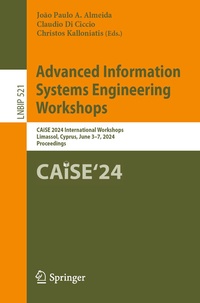
Advanced Information Systems Engineering Workshops
Description

This book constitutes the thoroughly refereed proceedings of the international workshops associated with the 36th International Conference on Advanced Information Systems Engineering, CAiSE 2024, which was held in Limassol, Cyprus, during June 2024.
The total of 25 full and 5 short papers included in these proceedings were carefully reviewed and selected from 60 submissions. They stem from the following workshops:
- International Workshop on Blockchain for Information Systems (BC4IS24) and Blockchain for Trusted Data Sharing (B4TDS);
- 2nd International Workshop on Hybrid Artificial Intelligence and Enterprise Modelling for Intelligent Information Systems (HybridAIMS);
- 2nd International Workshop on Knowledge Graphs for Semantics-driven Systems Engineering (KG4SDSE);
- 16th International Workshop on Enterprise & Organizational Modeling and Simulation (EOMAS);
- International Workshop on Digital Transformation with Business Process Mining (DigPro).
More details
Other editions
Additional editions
Content
- Intro
- Preface
- Organization
- Contents
- BC4IS+B4TDS
- International Workshop on Blockchain for Information Systems (BC4IS) and Blockchain for Trusted Data Sharing (B4TDS)
- Organization
- BC4IS Workshop Co-chairs
- BC4IS Workshop Program Committee
- B4TDS Workshop Co-chairs
- B4TDS Workshop Program Committee
- Blockchain in E-Learning Platform to Enhance Trustworthy and Sharing of Micro-credentials
- 1 Introduction
- 2 Background, Related Work and Contribution
- 2.1 Micro-credentials
- 2.2 Blockchain
- 2.3 Related Work
- 2.4 Contribution
- 3 E-Learning Platform and Micro-credentials
- 4 Consortium Blockchain Within E-Learning Platforms
- 4.1 Institutions and Candidates Actions
- 5 Discussion
- 6 Conclusion
- References
- A Conceptual Model for Blockchain-Based Trust in Digital Ecosystems (Short Paper)
- 1 Introduction
- 2 Related Work
- 3 Conceptual model
- 3.1 N7: Running Example
- 3.2 Ontology of Trust in Digital ecosystems
- 3.3 The Problems of Third Parties and How Blockchain Can help
- 3.4 The Need for Capabilities Manifestation For Blockchain
- 4 Conclusion and Future work
- References
- High-Performance Confidentiality-Preserving Blockchain via GPU-Accelerated Fully Homomorphic Encryption
- 1 Introduction
- 2 Related Work
- 2.1 Confidentiality-Preserving Blockchains
- 2.2 GPU-Accelerated Fully Homomorphic Encryption
- 3 Overview
- 3.1 System Model
- 3.2 Threat Model
- 3.3 Gafe's Workflow Overview
- 4 Workflow Description
- 4.1 Client Key Generation
- 4.2 GPU-Accelerated Transaction Execution
- 5 Evaluation
- 5.1 Settings
- 5.2 End-to-End Performance
- 6 Conclusion
- References
- A Blockchain-Based Approach for Model Card Accountability and Regulatory Compliance
- 1 Introduction
- 2 Background
- 2.1 Model Cards
- 2.2 Tokenization of Model Cards
- 2.3 Motivating Scenario
- 3 Proposed Approach: m-LUCE
- 3.1 Approach Overview
- 3.2 Modeling State Parameterization for Model Cards
- 4 Evaluation and Discussion
- 4.1 Functional Testing
- 4.2 Discussion
- 5 Conclusions and Future Work
- References
- HybridAIMS
- 2nd International Workshop on Hybrid Artificial Intelligence and Enterprise Modelling for Intelligent Information Systems (HybridAIMS 2024)
- Organization
- Workshop Chairs
- Program Committee
- A Hierarchical Knowledge Framework for Digital Twins of Buildings and Their Energy Systems (Position Paper)
- 1 Introduction
- 2 BIM, BMS and EMS and Digital Twins
- 3 Physics-Based Simulation and Artificial Intelligence
- 4 From Data to Wisdom, a Paradigm for Digital Twins
- 4.1 The NEST Demonstrator
- 4.2 An Implementation of the DIKW for Buildings and Energy Systems
- 4.3 Analysis of a Specific Application
- 5 Conclusion and Outlook
- References
- Integrating Generative Artificial Intelligence into Supply Chain Management Education Using the SCOR Model
- 1 Introduction
- 2 Background
- 3 Case Study: A SCM University Course
- 3.1 Generative AI Course Companion Requirements and Goals
- 3.2 Introduction to Vertex AI Search
- 3.3 Setting up the Vertex AI Search
- 3.4 Evaluation
- 3.5 Results
- 3.6 Enhancement Strategies
- 4 Implications and Further Research
- References
- An Explanation User Interface for a Knowledge Graph-Based XAI Approach to Process Analysis
- 1 Research Background and Objective
- 2 Basics of Human Interactions for XAI
- 3 Design Catalog for Explanation User Interfaces
- 4 Demonstration and Evaluation of an XUI
- 4.1 Current State of KBXAI-PA
- 4.2 Designing and Demonstrating of an XUI for KBXAI-PA
- 4.3 Evaluating the XUI for KBXAI-PA Through Expert Interviews
- 5 Key Findings, Research Perspectives and Implications
- References
- Enhancing Research Clarity: Ontology-Based Modeling of Argumentation in RPML
- 1 Introduction
- 2 Literature Review
- 2.1 Identification of a Research-Worthy Problem
- 2.2 Conceptual Modeling for Visualization of Research Problems
- 3 Methodology
- 4 An Ontological Metamodel for Research
- 5 Application of the Modelling Language
- 6 Conclusion
- References
- Student Performance Prediction Model Based on Course Description and Student Similarity
- 1 Introduction
- 2 Related Work
- 3 Methodology
- 4 Data Set from Student Enrolment Process
- 5 Design and Development of the Prototypes
- 5.1 Course Description Similarity
- 5.2 Course Performance Similarity
- 5.3 Performance Prediction
- 6 Evaluation
- 7 Conclusion
- References
- Towards Explainable Public Sector AI: An Exploration of Neuro-Symbolic AI and Enterprise Modeling (Short Paper)
- 1 Introduction
- 2 XAI: The Imperative for Explainability in the Public Sector
- 3 Neuro-Symbolic AI (NSAI) for Enhanced Explainability
- 4 Enterprise Modeling (EM): Discovering Rules for the Symbolic AI
- 5 Integration: Exploring the Synergy of XAI, NSAI, and EM
- 6 Conclusion and Future Work
- References
- A Survey to Evaluate the Completeness and Correctness of a Morphological Box for AI Solutions
- 1 Introduction
- 2 Theoretical Background
- 2.1 Morphological Box for AI Solutions
- 2.2 Taxonomy Development
- 3 Research and Survey Design
- 4 Analysis of the Survey Results
- 4.1 Participants
- 4.2 Statistical Evaluation
- 4.3 Feature Analysis
- 4.4 Value Analysis
- 5 Discussion
- 5.1 Possible New Features
- 5.2 Possible New Values
- 5.3 Possible Reorganization of the Values
- 6 Summary and Future Research
- References
- KG4SDSE
- Preface: 2nd Workshop on Knowledge Graphs for Semantics-Driven Systems Engineering (KG4SDSE 2024)
- Organization
- Workshop Chairs
- Web Chair
- Program Committee
- Understanding the Semantic SQL Transducer
- 1 Introduction
- 2 The Role of a Semantic SQL Transducer
- 3 Inside the Semantic SQL Transducer
- 4 Designing the Semantic SQL Transducer
- 5 Conclusions
- References
- Enhancing Complex Linguistic Tasks Resolution Through Fine-Tuning LLMs, RAG and Knowledge Graphs (Short Paper)
- 1 Introduction
- 2 Related Work
- 3 Proposed Pipeline
- 3.1 Enhancing LLMs with RAG and KGs
- 3.2 KGs Construction via Prompt Engineering
- 3.3 Guide Complex Tasks Resolution via Fine-Tuning
- 4 Conclusions and Future Work
- References
- Improving the Service Quality in Fitness Industry by Using a Knowledge Graph Based Modeling Toolkit
- 1 Introduction
- 2 Storytelling with Modeling Tools
- 3 Research Problem
- 3.1 Who
- 3.2 What
- 3.3 Why
- 3.4 How
- 3.5 Where
- 4 Conclusions
- References
- LLMs for Knowledge-Graphs Enhanced Task-Oriented Dialogue Systems: Challenges and Opportunities
- 1 Introduction
- 2 Related Work
- 3 Methodology
- 3.1 Preliminary Questions for ChatGPT
- 3.2 Ontology
- 3.3 Setup Format
- 3.4 Prompting Techniques and Examples
- 4 Results and Discussion
- 4.1 ChatGPT on the Static KGC Task
- 4.2 ChatGPT on the Temporal KGC Task
- 4.3 ChatGPT on the KGR Task
- 5 Conclusion
- References
- Property Graphs at Scale: A Roadmap and Vision for the Future (Short Paper)
- 1 Introduction
- 2 Roadmap to the Future
- 2.1 Establishing a Declarative Query Language for PGs
- 2.2 Data Integration
- 2.3 Scalable Data Processing
- 3 Conclusions
- References
- Knowledge Graph for Reusing Research Knowledge on Related Work in Data Analytics
- 1 Introduction
- 2 Research Method
- 3 Analytics Project Ontology
- 4 Real Estate Analytics Knowledge Graph
- 5 Using Knowledge Graph Based Web Application
- 6 Conclusion
- References
- An Ontology-Based Meta-modelling Approach for Semantic-Driven Building Management Systems
- 1 Introduction
- 2 Related Work
- 3 Methodology
- 3.1 Focus Group Findings
- 4 The Ontology-Based Meta-modelling Approach for Building Management Systems
- 4.1 The Ontology Architecture
- 4.2 The Ontology-Based PID Language
- 5 Evaluation
- 6 Findings and Discussion
- 7 Conclusion
- References
- EOMAS
- 20 years of the EOMAS workshop
- Organization
- Steering Committee
- Customizing a Generic Digital Transformation Objectives Model onto a Telecommunication Company
- 1 Introduction
- 2 Research Approach and Method
- 3 Results
- 3.1 Preliminary Interview Round: Domain Knowledge Collection
- 3.2 Instantiated DT Strategic Objectives Representation
- 3.3 Post Interview Round: Evaluation and Validation of the Instantiated DT Objectives Representation
- 4 Discussion
- 5 Conclusion
- References
- Analyzing Customer Sentiments: A Comparative Evaluation of Large Language Models for Enhanced Business Intelligence
- 1 Introduction
- 2 Related Work
- 2.1 Customer Sentiment Analysis
- 2.2 Methods for Sentiment Analysis
- 2.3 Using Large Language Models for Sentiment Analysis
- 3 Methodology
- 3.1 Research Question Statement
- 3.2 Selection of Large Language Models
- 3.3 Dataset Preparation
- 3.4 Exploratory Phase
- 3.5 Focused Experiments
- 3.6 Observations Analysis
- 4 Observation Analysis
- 5 Discussion
- 6 Conclusions and Future Work
- References
- Conceptual Data Normalisation from the Practical View of Using Graph Databases
- 1 Introduction
- 2 Motivation
- 3 Attempts to Overcome the Limitations of Relational Databases
- 4 Object Class Normalisation - Ambler's Approach
- 5 Frisendal's Approach to the Graph Normalisation
- 6 Our Approach to the Graph Database Normalisation
- 7 Conclusion
- References
- Deriving Object Oriented Normalisation from Conceptual Normalisation
- 1 Introduction
- 2 Motivation and Problem Statement
- 3 Presumptions and Our Approach
- 3.1 Conceptual Normal Forms (CNFs)
- 4 Object Normal Forms (ONFs)
- 4.1 Zero Object Normal Form (0ONF)
- 4.2 First Object Normal Form (1ONF)
- 4.3 Second Object Normal Form (2ONF)
- 4.4 Third Object Normal Form (3ONF)
- 5 Results
- 6 Conclusion and Future Works
- References
- BPMN for Displaying the Progression of Musical Harmony and Chords - Case Study
- 1 Introduction
- 1.1 Origin of Music
- 1.2 Music Research History
- 1.3 Current Notation
- 1.4 Types of Notes According to Their Length
- 1.5 Chords Progression
- 1.6 Representation of Hamonic Relations Using the Model of Applied Informatics
- 1.7 Summary of the Introduction
- 2 Material and Methods
- 2.1 Research Question
- 2.2 Chord Types and Their Model
- 2.3 BPMN for Music Progression Expression
- 2.4 Results
- 3 Discussion
- 4 Conclusion
- References
- Process-Specific Extensions for Enhanced Recommender Systems in Business Process Management
- 1 Introduction
- 2 Background
- 2.1 Business Process Management
- 2.2 Process Perspectives
- 2.3 Recommender Systems
- 3 Related Work
- 4 Running Example
- 5 Requirements Analysis
- 6 Extension of Framework
- 6.1 Extending the Input Data
- 6.2 Framework Enhancement
- 7 Demonstration and Evaluation
- 8 Conclusion and Future Work
- References
- Comparing Process Models Beyond Structural Equivalence
- 1 Introduction
- 2 Basic Terminology
- 2.1 Business Process Management and Process Models
- 2.2 Process Perspectives
- 2.3 Language-Independent Approach: Clarifying Foundations
- 2.4 Equality of Process Models
- 3 Related Work
- 4 Model Comparison
- 4.1 Comparison of the Organizational Perspective
- 4.2 Comparison of the Operational Perspective
- 4.3 Comparison of Data and Dataflow Perspective
- 5 Methodology and Practical Application
- 5.1 Methodology
- 5.2 Practical Example
- 6 Conclusion and Future Work
- References
- A Meta-Design Method for Modeling Customer Value
- 1 Introduction
- 2 Methodology
- 3 Meta-Design Modeling Method
- 3.1 Theoretical Knowledge Base
- 3.2 Design
- 4 Case Study Demonstration
- 4.1 Organizational Context
- 4.2 Meta-Design Modeling Method
- 5 Evaluation
- 5.1 Meta-Design Modeling Method
- 5.2 Customer Value Models
- 6 Related Work
- 7 Discussion and Conclusion
- References
- DigPro
- 1st Workshop on Digital Transformation with Business Process Mining (DigPro)
- Organization
- Program Chairs
- Program Committee
- Empirical Insights into Context-Aware Process Predictions: Model Selection and Context Integration
- 1 Introduction
- 2 Research Background
- 2.1 Recent Trends in Neural Network Designs for Process Prediction
- 2.2 Usage of Static and Dynamic Process Context Information
- 3 Research Method
- 4 Design and Development
- 4.1 Recurrent Neural Networks
- 4.2 Input Encoding
- 4.3 Models Without Context and Sequentialized Dynamic Context
- 4.4 Models with Static and Dynamic Context
- 5 Experimental Evaluation
- 5.1 Preprocessing and Splitting
- 5.2 Performance Metrics
- 5.3 Evaluation Results
- 5.4 Insights and Contributions
- 6 Conclusion and Future Research
- References
- Online Next Activity Prediction Under Concept Drifts
- 1 Introduction
- 2 Preliminaries and Literature Review
- 3 Methods
- 3.1 Developing the Dynamic Framework
- 3.2 Drift Recovery Formula and Setting of Algorithm Parameters
- 4 Experimental Evaluation
- 4.1 Parameter Settings, System Specifications and Baselines
- 4.2 Results and Discussion
- 5 Conclusions and Future Directions
- References
- Overstock Problems in a Purchase-to-Pay Process: An Object-Centric Process Mining Case Study
- 1 Introduction
- 2 Related Work
- 3 Preparation
- 3.1 Definition of Objectives
- 3.2 Conceptualization
- 4 Extraction and Transformation of Source Data
- 5 Analysis
- 6 Improvement
- 7 Conclusion
- References
- Exploring Object Centric Process Mining with MIMIC IV: Unlocking Insights in Healthcare
- 1 Introduction
- 2 Related Work
- 3 Event Log Extraction from MIMIC IV
- 3.1 The Dataset
- 3.2 Event Log Generation
- 3.3 Process Discovery and Conformance Checking
- 4 Unlocking Patient Journeys with Object-Centric Process Mining in MIMIC IV
- 4.1 Selection of Object from Traditional Event Log of MIMIC IV Datasets
- 4.2 Finding the Relation Between the Objects
- 4.3 Visualization of Divergence and Convergence
- 4.4 Conversion from XES to OCEL
- 4.5 Discovery with Petri Net
- 4.6 Analysis
- 5 Conclusion and Future Work
- References
- Author Index
