

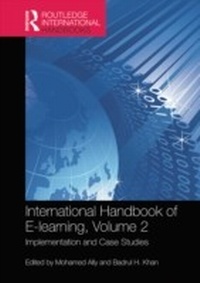
International Handbook of E-Learning Volume 2
Implementation and Case Studies
1st Edition
Published on 20. February 2015
386 pages
978-1-317-64357-9 (ISBN)
Description

The International Handbook of e-Learning, Volume 2 provides a comprehensive compendium of implementation and practice in all aspects of e-learning, one of the most significant ongoing global developments in the entire field of education. Covering the integration, challenges, implications, and context-appropriate use of open education networks, blended learning, mobile technologies, social media, and other platforms in a variety of unique international settings, these thirty contributions illustrate the wide-ranging applications and solutions made possible by this rapidly growing new paradigm. Case studies are driven by empirical research and attention to cultural specificity, while future research needs are discussed in relation to both confirmed practice and recent changes in the field. The book will be of interest to anyone seeking to create and sustain meaningful, supportive learning environments within today's anytime, anywhere framework, from teachers, administrators, and policy makers to corporate and government trainers.
More details
Series
Language
English
Place of publication
London
United Kingdom
Publishing group
Taylor & Francis Ltd
Target group
College/higher education
Illustrations
38 s/w Tabellen
38 Tables, black and white
File size
3,91 MB
ISBN-13
978-1-317-64357-9 (9781317643579)
Copyright in bibliographic data and cover images is held by Nielsen Book Services Limited or by the publishers or by their respective licensors: all rights reserved.
Schweitzer Classification
Other editions
Additional editions
Mohamed Ally | Badrul H. Khan
International Handbook of E-Learning Volume 2
Implementation and Case Studies
Book
10/2017
1st Edition
Routledge
€130.72
Shipment within 15-20 days
Mohamed Ally | Badrul H. Khan
International Handbook of E-Learning Volume 2
Implementation and Case Studies
Book
03/2015
1st Edition
Routledge
€434.50
Shipment within 10-20 days
Persons
Dr. Mohamed Ally is Professor in the Centre for Distance Education and Researcher in the Technology Enhanced Knowledge Research Institute (TEKRI) at Athabasca University, Canada. He previously served as Director of the Centre of Distance Education at Athabasca University, Canada's Open University. He is Past-President of the International Federation of Training and Development Organizations (IFTDO) and a Founding Director of the International Association of Mobile Learning (IamLearn).
Dr. Badrul Khan is the founder of McWeadon Education, a professional development institution. He previously served as Founding Director of the Educational Technology Leadership (ETL) graduate cohort program at The George Washington University, Founding Director of the Educational Technology (ET) graduate program at the University of Texas, Brownsville, and Instructional Designer and Evaluation Specialist in the School of Medicine at Indiana University, Indianapolis. Professor Khan has the credit of first coining the phrase Web-based instruction and popularizing the concept through his bestselling 1997 book Web-Based Instruction, which paved the way for the new field of e-learning.
Dr. Badrul Khan is the founder of McWeadon Education, a professional development institution. He previously served as Founding Director of the Educational Technology Leadership (ETL) graduate cohort program at The George Washington University, Founding Director of the Educational Technology (ET) graduate program at the University of Texas, Brownsville, and Instructional Designer and Evaluation Specialist in the School of Medicine at Indiana University, Indianapolis. Professor Khan has the credit of first coining the phrase Web-based instruction and popularizing the concept through his bestselling 1997 book Web-Based Instruction, which paved the way for the new field of e-learning.
Content
Preface
Forward
Acknowledgements
About the Editors
Contributing Authors
Chapter 1: Opening Digital Learning for Deeper Inquiry, Jon Mason and Hitendra Pillay
Chapter 2: Using Social Media in the Online Classroom, Lisa Marie Blaschke and Jane Brindley
Chapter 3: The integration of educational technology in education and in the workplace: An organizational perspective, Claude Martel
Chapter 4: Mobile learning in higher education: Current status and future possibilities, Yasemin Gulbahar, Carolyne Jacobs, and Koenig Andreas
Chapter 5: Media-Based Learning Methodology: Stories, Games, and Emotions, Prof. Dr. habil. Hans W. Giessen
Chapter 6: A Case of Distance Education through Social Network Sites, Giovanni Farias
Chapter 7: Multimedia production projects: relevant issues and possible models for mobile learning, Izabel de Moraes Sarmento Rego, Joni de Almeida Amorim, and Per M. Gustavsson
Chapter 8: Learners of Digital Era (LoDE): What's true, and what's just hype about the so-called digital natives, Emanuele Rapetti and Lorenzo Cantoni
Chapter 9: Blended Learning in Higher Education, Fayiz M. Aldhafeeri
Chapter 10: ePortfolio Development and the Potential Relationship to Learning Theories, Anthony Ralston
Chapter 11: Development of a context appropriate E-learning site, Tanim Ashraf, Shekh Mohammad Mahbubul Kadir, and Sanjib Saha
Chapter 12: Education's Second Life: Virtual Learning in Higher Education, Shelagh McGarth and Carlo M. Trentadue
Chapter 13: Lifelong Learners and Teachers' Time Management Competency in E-learning, M. Romero and E. Barbera
Chapter 14: Library Support for Online Learners, Katherine M. Tyler
Chapter 15: 2D and 3D virtual environments: communication potentialities for E-learning education, Tatiana Stofella Sodre Rossini and Edmea Oliveira dos Santos
Chapter 16: Open and Virtual Universities Worldwide, Susan Bainbridge and Mohamed Ally
Chapter 17: E-learning and mobile learning development in the State of Qatar, Martha Robinson, Mohamed Ally, and Mohammed Samaka
Chapter 18: Implementing Mobile Learning Devices into Tertiary Classrooms: A UAE Case Study, Troy Priest and Kevin Schoepp
Chapter 19: E-learning Implementation at an Open University: The case of Universitas Terbuka (The Indonesia Open University), Dewi Padmo and Sri Harijati
Chapter 20: Maximizing Study Hours with Cloud and Mobile Based E-learning: A case study at a full-online university in Japan, Hiroshi Kawahara, Miwako Nogimori, and Sayaka Matsumoto
Chapter 21: E learning in India, Ramesh C. Sharma and Sanjaya Mishra
Chapter 22: Using mobile phones for teacher professional development in Bangladesh: Views of secondary school teachers and teacher facilitators, Robina Shaheen and Ashok Paul Kumar
Chapter 23: Managing the change during E-learning integration in Higher Education: A case study from Saudi Arabia, Khalid Alshahrani and Len Cairns
Chapter 24: Issues and Implications of Integrating E-learning at Arab Universities, Ali Al-Musawi and Mary Lane-Kelso
Chapter 25: E-learning for Continuing and Professional Development, Angela Kwan and Mary Wilson
Chapter 26: Using the Unified Theory of Acceptance and Use of Technology and Dewey's Theory of Experience to Interpret Faculty Experience of E-learning at One School of Public Health, Terry Kidd and Jean Madsen
Chapter 27: A Blended Learning Approach to Team-Oriented Work in Large Classes: A Facebook Case Study, Salys Sultan
Chapter 28: Mobile Learning BYOD implementation in an Intensive English Program, Rasha Alokaily
Chapter 29: Blended Learning and Teaching - a Panacea for Students with Learning Disabilities, Edith Gotesman
Chapter 30: Supporting student engagement in E-learning in a resource constrained institution: experiences from Makerere university, Michael Walimbwa
Index
Forward
Acknowledgements
About the Editors
Contributing Authors
Chapter 1: Opening Digital Learning for Deeper Inquiry, Jon Mason and Hitendra Pillay
Chapter 2: Using Social Media in the Online Classroom, Lisa Marie Blaschke and Jane Brindley
Chapter 3: The integration of educational technology in education and in the workplace: An organizational perspective, Claude Martel
Chapter 4: Mobile learning in higher education: Current status and future possibilities, Yasemin Gulbahar, Carolyne Jacobs, and Koenig Andreas
Chapter 5: Media-Based Learning Methodology: Stories, Games, and Emotions, Prof. Dr. habil. Hans W. Giessen
Chapter 6: A Case of Distance Education through Social Network Sites, Giovanni Farias
Chapter 7: Multimedia production projects: relevant issues and possible models for mobile learning, Izabel de Moraes Sarmento Rego, Joni de Almeida Amorim, and Per M. Gustavsson
Chapter 8: Learners of Digital Era (LoDE): What's true, and what's just hype about the so-called digital natives, Emanuele Rapetti and Lorenzo Cantoni
Chapter 9: Blended Learning in Higher Education, Fayiz M. Aldhafeeri
Chapter 10: ePortfolio Development and the Potential Relationship to Learning Theories, Anthony Ralston
Chapter 11: Development of a context appropriate E-learning site, Tanim Ashraf, Shekh Mohammad Mahbubul Kadir, and Sanjib Saha
Chapter 12: Education's Second Life: Virtual Learning in Higher Education, Shelagh McGarth and Carlo M. Trentadue
Chapter 13: Lifelong Learners and Teachers' Time Management Competency in E-learning, M. Romero and E. Barbera
Chapter 14: Library Support for Online Learners, Katherine M. Tyler
Chapter 15: 2D and 3D virtual environments: communication potentialities for E-learning education, Tatiana Stofella Sodre Rossini and Edmea Oliveira dos Santos
Chapter 16: Open and Virtual Universities Worldwide, Susan Bainbridge and Mohamed Ally
Chapter 17: E-learning and mobile learning development in the State of Qatar, Martha Robinson, Mohamed Ally, and Mohammed Samaka
Chapter 18: Implementing Mobile Learning Devices into Tertiary Classrooms: A UAE Case Study, Troy Priest and Kevin Schoepp
Chapter 19: E-learning Implementation at an Open University: The case of Universitas Terbuka (The Indonesia Open University), Dewi Padmo and Sri Harijati
Chapter 20: Maximizing Study Hours with Cloud and Mobile Based E-learning: A case study at a full-online university in Japan, Hiroshi Kawahara, Miwako Nogimori, and Sayaka Matsumoto
Chapter 21: E learning in India, Ramesh C. Sharma and Sanjaya Mishra
Chapter 22: Using mobile phones for teacher professional development in Bangladesh: Views of secondary school teachers and teacher facilitators, Robina Shaheen and Ashok Paul Kumar
Chapter 23: Managing the change during E-learning integration in Higher Education: A case study from Saudi Arabia, Khalid Alshahrani and Len Cairns
Chapter 24: Issues and Implications of Integrating E-learning at Arab Universities, Ali Al-Musawi and Mary Lane-Kelso
Chapter 25: E-learning for Continuing and Professional Development, Angela Kwan and Mary Wilson
Chapter 26: Using the Unified Theory of Acceptance and Use of Technology and Dewey's Theory of Experience to Interpret Faculty Experience of E-learning at One School of Public Health, Terry Kidd and Jean Madsen
Chapter 27: A Blended Learning Approach to Team-Oriented Work in Large Classes: A Facebook Case Study, Salys Sultan
Chapter 28: Mobile Learning BYOD implementation in an Intensive English Program, Rasha Alokaily
Chapter 29: Blended Learning and Teaching - a Panacea for Students with Learning Disabilities, Edith Gotesman
Chapter 30: Supporting student engagement in E-learning in a resource constrained institution: experiences from Makerere university, Michael Walimbwa
Index
