

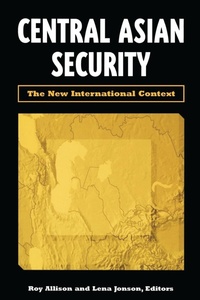
Central Asian Security
The New International Context
1st Edition
Published on 13. May 2004
296 pages
978-0-8157-9853-8 (ISBN)
Description

A Brookings Institution Press and Chatham House publication
This volume is the first comprehensive scholarly analysis of the strategic reconfiguration of Central Asia as Russia has become more disengaged from the nations in the region and as these nations have developed new relations to the south, east, and west. The international implications are enormous because of the rich energy sources¿oil and natural gas¿located in the Caspian Sea area.
The authors assess a variety of internal security policy challenges confronting these states¿for example, the potential for conflict arising from such factors as a mixed ethnic population, resource scarcity, particularly in relation to water management, and an Islamic revival. They also examine the security policy content of relations between the Central Asian states and regional and international powers¿specifically the stakes, interests, and policies of Russia, China, Iran, Turkey, and the United States.
These internal challenges and the evolution of relations with external powers may result in new cooperative relationships, but they may also lead to destabilizing rivalry and interstate enmity in Central Asia. It is important to identify new patterns of relevance for future security cooperation in the region, but the potential for a new security system or for new institutions to manage security in the region remains uncertain. These issues are explored by a team of prominent specialists from Western Europe, the United States, Russia and China.
More details
Edition
1. Auflage
Language
English
Place of publication
New York
United States
Publishing group
Bloomsbury Publishing Plc
ISBN-13
978-0-8157-9853-8 (9780815798538)
DOI
10.5771/9780815798538
Copyright in bibliographic data and cover images is held by Nielsen Book Services Limited or by the publishers or by their respective licensors: all rights reserved.
Schweitzer Classification
Other editions
Additional editions
Book
04/2001
Brookings Institution
€50.94
Article exhausted; check different version
Persons
Roy Allison is head of the Russia and Eurasia Programme at the Royal Institute of International Affairs in London: He is the coeditor of Security Dilemmas in Russia and Eurasia (RIIA, 1998), the editor of Challenges for the Former Soviet South, (Brookings /RIIA, 1996), and coauthor of Internal Factors in Russian Foreign Policy, (Oxford University Press, 1996.) Lena Jonson is a senior research fellow at the Swedish Institute of International Affairs. She is the author of Keeping the Peace in the CIS: The Evolution of Russian Policy (RIIA Discussion Paper, 1999), Russia and Central Asia: a New Web of Relations (RIIA, 1998), and coeditor of Peacekeeping and the Role of Russia in Eurasia (Westview Press, 1996.)
Content
- Front Cover
- Title Page
- Copyright Information
- Table of Contents
- Acknowledgments
- Acronyms
- About the Authors
- Central Asian Security: Internal and External Dynamics
- Central Asia: Common Legacies and Conflicts
- Islam in Central Asia
- Water in Central Asia: Regional Cooperation or Conflict?
- Russia and Central Asia
- The United States and Central Asia
- China and Central Asia
- Iran and Central Asia
- Turkey and Central Asia
- Structures and Frameworks for Security Policy Cooperation in Central Asia
- Conclusion: Central Asian Security in the Regional and International Context
- Index
- Back Cover
