

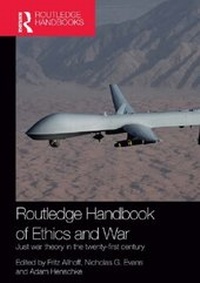
Routledge Handbook of Ethics and War
Just War Theory in the 21st Century
1st Edition
Published on 26. June 2013
432 pages
978-1-136-26100-8 (ISBN)
Description

This new Handbook offers a comprehensive overview of contemporary extensions and alternatives to the just war tradition in the field of the ethics of war.
The modern history of just war has typically assumed the primacy of four particular elements: jus ad bellum, jus in bello, the state actor, and the solider. This book will put these four elements under close scrutiny, and will explore how they fare given the following challenges:
* What role do the traditional elements of jus ad bellum and jus in bello-and the constituent principles that follow from this distinction-play in modern warfare? Do they adequately account for a normative theory of war?
* What is the role of the state in warfare? Is it or should it be the primary actor in just war theory?
* Can a just war be understood simply as a response to territorial aggression between state actors, or should other actions be accommodated under legitimate recourse to armed conflict?
* Is the idea of combatant qua state-employed soldier a valid ethical characterization of actors in modern warfare?
* What role does the technological backdrop of modern warfare play in understanding and realizing just war theories?
Over the course of three key sections, the contributors examine these challenges to the just war tradition in a way that invigorates existing discussions and generates new debate on topical and prospective issues in just war theory.
This book will be of great interest to students of just war theory, war and ethics, peace and conflict studies, philosophy and security studies.
The modern history of just war has typically assumed the primacy of four particular elements: jus ad bellum, jus in bello, the state actor, and the solider. This book will put these four elements under close scrutiny, and will explore how they fare given the following challenges:
* What role do the traditional elements of jus ad bellum and jus in bello-and the constituent principles that follow from this distinction-play in modern warfare? Do they adequately account for a normative theory of war?
* What is the role of the state in warfare? Is it or should it be the primary actor in just war theory?
* Can a just war be understood simply as a response to territorial aggression between state actors, or should other actions be accommodated under legitimate recourse to armed conflict?
* Is the idea of combatant qua state-employed soldier a valid ethical characterization of actors in modern warfare?
* What role does the technological backdrop of modern warfare play in understanding and realizing just war theories?
Over the course of three key sections, the contributors examine these challenges to the just war tradition in a way that invigorates existing discussions and generates new debate on topical and prospective issues in just war theory.
This book will be of great interest to students of just war theory, war and ethics, peace and conflict studies, philosophy and security studies.
Reviews / Votes
'...the book as a whole covers contemporary just war thinking with a philosophical breadth rarely found in ethics of war treatments. Highly Recommended.'CHOICE Review February 2014More details
Series
Language
English
Place of publication
London
United Kingdom
Publishing group
Taylor & Francis Ltd
Target group
College/higher education
Professional and scholarly
Illustrations
1 Line drawings, black and white
File size
4,30 MB
ISBN-13
978-1-136-26100-8 (9781136261008)
Copyright in bibliographic data and cover images is held by Nielsen Book Services Limited or by the publishers or by their respective licensors: all rights reserved.
Schweitzer Classification
Other editions
Additional editions
Fritz Allhoff | Nicholas G. Evans | Adam Henschke
Routledge Handbook of Ethics and War
Just War Theory in the 21st Century
Book
07/2015
1st Edition
Routledge
€70.50
Shipment within 10-20 days
Fritz Allhoff | Nicholas G. Evans | Adam Henschke
Routledge Handbook of Ethics and War
Just War Theory in the 21st Century
Book
07/2013
1st Edition
Routledge
€357.50
Shipment within 15-20 days
Persons
Fritz Allhoff is Associate Professor of Philosophy at Western Michigan University and a Senior Research Fellow in the Centre for Applied Philosophy and Public Ethics at Charles Sturt University, Canberra.
Nicholas G. Evans is a doctoral candidate at the Australian National University and an Adjunct Research Associate at Charles Sturt University, Canberra.
Adam Henschke is a researcher in the Centre for Applied Philosophy and Public Ethics at Charles Sturt University, Canberra.
Nicholas G. Evans is a doctoral candidate at the Australian National University and an Adjunct Research Associate at Charles Sturt University, Canberra.
Adam Henschke is a researcher in the Centre for Applied Philosophy and Public Ethics at Charles Sturt University, Canberra.
Content
Introduction: Not Just Wars: Expansions and Alternatives to the Just War Tradition Fritz Allhoff, Nicholas G. Evans and Adam Henschke Part I: Theories of War: Revisiting the Just War Tradition Jus Ad Bellum 1. Can Soldiers be Expected to Know Whether Their War is Just? Jeff McMahan 2. Is Just War Theory Obsolete? Jeff Whitman 3. Just War Theory: Going to War and Collective Self-Deception Richard Werner Jus In Bello 4. The Moral Foundations of the Jus Ad Bellum/Jus In Bello Distinction Steve Viner 5. Jus Ad Vim and the Just Use of Lethal Force-Short-Of-War S. Brandt Ford 6. Revisionist Just War Theory and the Real World: A Cautiously Optimistic Proposal Bradley Jay Strawser Jus Post Bellum 7. The Place of Jus Post Bellum in Just War Considerations Emily Pollard 8. Jus Post Bellum: War Closure in the 21st Century Richard M. O'Meara 9. Reasonable Chance of Success: Analyzing the Postwar Requirements of Jus Ad Bellum Todd Burkhardt 10. Post-War Policy: Lessons for Iraq, Afghanistan, and Beyond Brian Orend Part II: Faces of War: Beyond States and Soldiers Irregular Wars 11. Soft Power and Jus In Bello: What Tactics are Effective and Necessary? Michael Gross 12. Rethinking Legitimate Authority: Who Meets the Criteria? Anne Schwenkenbecker 13. Fighting the Humanitarian War: Justifications and Limitations Jennifer Ang 14. Peacekeeper Violence: Managing the Use of Force Daniel Levine Terrorism and Counterterrorism 15. The War on Terror and the Ethics of Exceptionalism Fritz Allhoff 16. Just War Theory and Counterterrorism Seumas Miller 17. Punitive Warfare, Counterterrorism, and Jus Ad Bellum Shawn Kaplan Warfighters and Moral Agency 18. Re-evaluating the Moral Status of Civilians in Just War Theory and Terrorism Jason P. Blahuta 19. Endangering Soldiers and the Problem of Private Military Contractors Ned Dobos 20. The Agency of Child Soldiers: Rethinking the Principle of Discrimination Tor Arne Berntsen and Bard Maeland Part III: Technologies of War: The Future of Fighting Technology and Just War Theory 21. Emerging Technologies and Just War Theory Braden Allenby 22. Minimizing Harm to Combatants: Nonlethal Weapons, Combatants' Rights, and State Responsibility Christopher Mayer 23. Educational Implications of the Potential for Hostile Applications of Advances in Neuroscience Malcolm Dando Uninhabited and Autonomous Military Systems 24. Unmanned Drones and the Ethics of War Christian Enemark 25. Autonomous Robots and the Future of Just War Theory Keith Abney 26. Killing in War: Responsibility, Liability, and Lethal Autonomous Robots Heather M. Roff Cyberwarfare 27. Jus in Silico: Moral Restrictions on the Use of Cyberwarfare George Lucas 28. Understanding Just Cause in Cyberwarfare Leonard Kahn 29. Friend or Foe? Perfidy in Cyberwarfare Neil Rowe
