

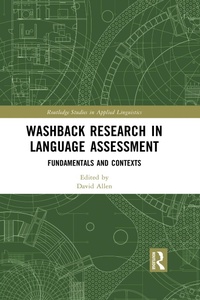
Washback Research in Language Assessment
Fundamentals and Contexts
Published on 13. August 2025
226 pages
978-1-040-40002-9 (ISBN)
Description

Washback is understood as the effect tests have on teaching and learning, with positive washback producing intended outcomes and negative washback generating unintended effects. By surveying the latest developments in the field and charting future directions, this collection offers a comprehensive treatment of research on washback in the field of language assessment.
The book contains chapters exploring fundamental aspects of washback, including the impact-by-design approach, theoretical models, validity frameworks, research designs, and methods. Additional chapters examine washback across various assessment contexts, covering migration-related proficiency tests, formative and standards-based assessments, multilingual and professional language assessments, and the role of technology, including computer-based testing and AI. The book also surveys washback research in primary, secondary, and higher mainstream education, and shadow education, with a focus on English learning in Asian contexts.
This book will be of interest to scholars and stakeholders in language testing and assessment, educational measurement, and applied linguistics.
The book contains chapters exploring fundamental aspects of washback, including the impact-by-design approach, theoretical models, validity frameworks, research designs, and methods. Additional chapters examine washback across various assessment contexts, covering migration-related proficiency tests, formative and standards-based assessments, multilingual and professional language assessments, and the role of technology, including computer-based testing and AI. The book also surveys washback research in primary, secondary, and higher mainstream education, and shadow education, with a focus on English learning in Asian contexts.
This book will be of interest to scholars and stakeholders in language testing and assessment, educational measurement, and applied linguistics.
Reviews / Votes
"A timely book and contemporary statement on the next steps concerning washback research. In this edited volume, David Allen makes a valuable case for the need to pursue the evolving research on washback in language assessment settings. Research of the last 30 years in a variety of contexts has set the stage for a better understanding of assessment consequences and answered initial questions, but we now must strive to gain knowledge in ways to generate positive washback; that is, to employ low stakes and high stakes assessments that enhance teaching and learning, and to integrate positive washback into the design, development, and implementation stages of these assessments. By providing washback fundamentals and current exemplary research contexts, this volume (which includes issues such as fast-paced technological developments) takes a refreshing view on capitalizing on past research, identifying gaps, and proposing a way forward to ensure our language assessments generate positive washback towards the end goal of promoting language learning. A significant contribution to the field of language assessment."- Carolyn E. Turner, McGill University, Quebec, Canada
More details
Series
Language
English
Place of publication
London
United Kingdom
Publishing group
Taylor & Francis Ltd
Target group
College/higher education
Professional and scholarly
Illustrations
7 Tables, black and white; 7 Line drawings, black and white; 7 Illustrations, black and white
File size
3,92 MB
ISBN-13
978-1-040-40002-9 (9781040400029)
Copyright in bibliographic data and cover images is held by Nielsen Book Services Limited or by the publishers or by their respective licensors: all rights reserved.
Schweitzer Classification
Other editions
Additional editions
Book
08/2025
1st Edition
Routledge
€207.50
Shipment within 10-20 days
Person
David Allen is an Associate Professor at Ochanomizu University in Tokyo, Japan, where he teaches English, teaching, and applied linguistics-related courses at both undergraduate and graduate levels.
Content
List of Figures
List of Contributors
Foreword
Yoshinori Watanabe
Part 1: Washback Fundamentals
1. Introduction
David Allen
2. Washback, impact and consequences
Nick Saville, Brigita Seguis
3. Theories and models of washback
Anthony Green
4. Washback in test validation
Barry O'Sullivan
5. Washback research designs
David Allen
6. Data collection and analysis in washback research
Takanori Sato
Part 2: Washback Contexts
7. Washback and proficiency tests
Johanna Motteram, David Allen
8. Washback of formative/alternative assessment
Rie Koizumi, Yusuke Kubo, Yo In'nami, David Allen
9. Washback of standards-based assessment with school-age language learners
Alison L. Bailey
10. Washback of multilingual assessment
Dina Tsagari, Karin Vogt, Lucilla Lopriore
11. Washback in primary/secondary K-12 contexts: Lessons learned from research in Asia
Yuko Goto Butler
12. Washback in Asian higher education: Current status and future directions
Qin Xie
13. Washback on language learning in shadow education
Yaqing Shi, Kevin Wai Ho Yung
14. Washback in language for professional purposes testing: A case of pilot-air traffic controller radiotelephony communication
Hyejeong Kim, Eric Friginal
15. Technological developments in language assessment: Implications for washback
Brigita Seguis, Tony Clark
16. Conclusion: Revisiting some fundamental issues in washback research
David Allen
Index
List of Contributors
Foreword
Yoshinori Watanabe
Part 1: Washback Fundamentals
1. Introduction
David Allen
2. Washback, impact and consequences
Nick Saville, Brigita Seguis
3. Theories and models of washback
Anthony Green
4. Washback in test validation
Barry O'Sullivan
5. Washback research designs
David Allen
6. Data collection and analysis in washback research
Takanori Sato
Part 2: Washback Contexts
7. Washback and proficiency tests
Johanna Motteram, David Allen
8. Washback of formative/alternative assessment
Rie Koizumi, Yusuke Kubo, Yo In'nami, David Allen
9. Washback of standards-based assessment with school-age language learners
Alison L. Bailey
10. Washback of multilingual assessment
Dina Tsagari, Karin Vogt, Lucilla Lopriore
11. Washback in primary/secondary K-12 contexts: Lessons learned from research in Asia
Yuko Goto Butler
12. Washback in Asian higher education: Current status and future directions
Qin Xie
13. Washback on language learning in shadow education
Yaqing Shi, Kevin Wai Ho Yung
14. Washback in language for professional purposes testing: A case of pilot-air traffic controller radiotelephony communication
Hyejeong Kim, Eric Friginal
15. Technological developments in language assessment: Implications for washback
Brigita Seguis, Tony Clark
16. Conclusion: Revisiting some fundamental issues in washback research
David Allen
Index
