

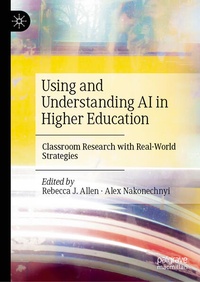
Using and Understanding AI in Higher Education
Description

This book explores how artificial intelligence (AI) is reshaping higher education through practical, real-world strategies and grounded research. It begins with accessible introductions to key concepts-such as generative AI, machine learning, and natural language processing-before progressing to theoretical frameworks and empirical studies of how students, faculty, and institutions are responding to these technologies. Topics include ethics, AI literacy, digital equity, technology integration in teaching and learning, and student-led efforts like the AI Café. Drawing from participatory research, institutional case studies, and global AI policy analysis, the book provides actionable insights for faculty, instructional designers, academic leaders, and researchers. Emphasizing inclusive and culturally responsive approaches, this book is an essential resource for advancing faculty development, enhancing student engagement, and navigating the evolving role of AI in academic life.
More details
Other editions
Additional editions
Persons
Rebecca Allen is Chair of Computer Science and Mathematics and Research Director at the Center for IT Engagement at Mount St. Joseph University, USA. Her work bridges linguistics and computer science, using natural language processing to explore patient outcomes and advancing AI literacy through participatory approaches to education and community engagement.
Alex Nakonechnyi is an expert at translating human needs into technological solutions both in higher education and industry. He has an educational background in computer science, business, and quantitative research methodologies. He serves as Associate Provost for Campus Technology at Mount St. Joseph University, USA.
Content
Chapter 1: Finding Our Voices in the Maze of AI.- Chapter 2: Beyond ChatGPT: What is Artificial Intelligence and How does it Work?.- Chapter 3: From Frankenstein to Facebook: The History, Ethics, and Regulation of AI.- Chapter 4: Understanding AI Resistance and Adoption: A Theoretical Roadmap.- Chapter 5: Listening First: A University Campus-Based Participatory Survey of Generative AI Literacy Needs.- Chapter 6: Developing Researcher and Writer Identities in the Age of AI: A Case Study of a University Undergraduate Research Program.- Chapter 7: Researchers' Perspectives on AI in Higher Education: A Focus Group Study.- Chapter 8: Cicada Safari: Mapping Insects with Citizen Science and AI.- Chapter 9: Patterns that Matter:AI-Driven Insights into College Attendance and Student Achievement.- Chapter 10: Conclusion: Shaping AI with Purpose-Reflections and Next Steps for Collaborative Practice.
