

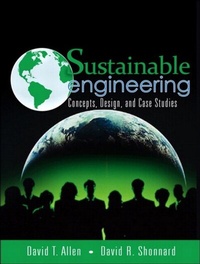
Sustainable Engineering
Concepts, Design and Case Studies
1st Edition
Published on 28. December 2011
240 pages
978-0-13-275658-7 (ISBN)
Description

Assessing Engineering Designs for Environmental, Economic, and Social Impact Engineers will play a central role in addressing one of the twenty-first century's key challenges: the development of new technologies that address societal needs and wants within the constraints imposed by limited natural resources and the need to protect environmental systems.
To create tomorrow's sustainable products, engineers must carefully consider environmental, economic, and social factors in evaluating their designs. Fortunately, quantitative tools for incorporating sustainability concepts into engineering designs and performance metrics are now emerging. Sustainable Engineering introduces these tools and shows how to apply them.
Building on widely accepted principles they first introduced in Green Engineering, David T. Allen and David R. Shonnard discuss key aspects of designing sustainable systems in any engineering discipline. Their powerful, unified approach integrates essential engineering and quantitative design skills, industry perspectives, and case studies, enabling engineering professionals, educators, and students to incorporate sustainability throughout their work. Coverage includes
A concise review of the natural resource and environmental challenges engineers face when designing for sustainability
Analysis and legislative frameworks for addressing environmental issues and sustainability
Methods for identifying green and sustainable materials
Principles for improving the sustainability of engineering designs
Tools for evaluating sustainable designs and monetizing their benefits
To create tomorrow's sustainable products, engineers must carefully consider environmental, economic, and social factors in evaluating their designs. Fortunately, quantitative tools for incorporating sustainability concepts into engineering designs and performance metrics are now emerging. Sustainable Engineering introduces these tools and shows how to apply them.
Building on widely accepted principles they first introduced in Green Engineering, David T. Allen and David R. Shonnard discuss key aspects of designing sustainable systems in any engineering discipline. Their powerful, unified approach integrates essential engineering and quantitative design skills, industry perspectives, and case studies, enabling engineering professionals, educators, and students to incorporate sustainability throughout their work. Coverage includes
A concise review of the natural resource and environmental challenges engineers face when designing for sustainability
Analysis and legislative frameworks for addressing environmental issues and sustainability
Methods for identifying green and sustainable materials
Principles for improving the sustainability of engineering designs
Tools for evaluating sustainable designs and monetizing their benefits
More details
Language
English
Place of publication
Hoboken
United States
Publishing group
Pearson Education (US)
Target group
College/higher education
ISBN-13
978-0-13-275658-7 (9780132756587)
Copyright in bibliographic data and cover images is held by Nielsen Book Services Limited or by the publishers or by their respective licensors: all rights reserved.
Schweitzer Classification
Other editions
Additional editions
David Allen | David R. Shonnard
Sustainable Engineering: Concepts, Design and Case Studies
Concepts, Design and Case Studies
Book
01/2012
1st Edition
Pearson
€63.49
Shipment within 15-20 days
Persons
Dr. David T. Allen is the Gertz Regents Professor of Chemical Engineering, and the director of the Center for Energy and Environmental Resources, at the University of Texas at Austin. He is the author of multiple books and hundreds of scientific papers in areas ranging from coal liquefaction and heavy oil chemistry to the chemistry of urban atmospheres. The quality of his work has been recognized by research awards from the National Science Foundation, the AT&T Foundation, the American Institute of Chemical Engineers, the Association of Environmental Engineering and Science Professors, and the State of Texas. The findings from his research have been used to guide air quality policy development, and he has served on the U.S. EPA's Science Advisory Board and the National Research Council's Board on Environmental Studies and Toxicology, addressing issues at the interface between science, engineering, and public policy. For the past two decades, his work has also focused on the development of materials for environmental education, including coauthoring the textbook Green Engineering: Environmentally Conscious Design of Chemical Processes. He has won teaching awards at the University of Texas and UCLA. Dr. Allen received his B.S. in chemical engineering, with distinction, from Cornell University in 1979. His M.S. and Ph.D. degrees in chemical engineering were awarded by the California Institute of Technology in 1981 and 1983. He has held visiting faculty appointments at the California Institute of Technology, the University of California, Santa Barbara, and the Department of Energy.
Dr. David R. Shonnard is Robbins Professor in the Department of Chemical Engineering at Michigan Technological University and director of the Sustainable Futures Institute. He received a B.S. in chemical/metallurgical engineering from the University of Nevada, Reno, in 1983; an M.S. in chemical engineering from the University of California, Davis, in 1985; a Ph.D. from the University of California, Davis, in 1991; postdoctoral training in bioengineering at the Lawrence Livermore National Laboratory from 1990 to 1993; and he was a visiting instructor at the University of California at Berkeley in 2003. His experiences in life-cycle assessment (LCA) methods and applications include a one-year sabbatical at the Eco-efficiency Analysis Group at BASF AG in Ludwigshafen, Germany. He has been on the faculty in the Department of Chemical Engineering at Michigan Technological University since 1993. Dr. Shonnard has more than twenty years of academic experience in sustainability issues in the chemical industry and Green Engineering. He is coauthor of the textbook Green Engineering: Environmentally Conscious Design of Chemical Processes, published by Prentice Hall in 2002. His current research interests focus on investigations of new forest-based biorefinery processes for production of transportation fuels, such as cellulosic ethanol and pyrolysis-based biofuels, from woody biomass using recombinant DNA and other approaches. Another active research area is LCA of biofuels and other biorefinery products to determine greenhouse gas emissions and net energy balances. He has contributed to National Academy of Sciences publications on green chemistry/engineering/sustainability in the chemical industry. Dr. Shonnard has coauthored 70 peer-reviewed publications and received numerous honors and awards for teaching and research into environmental issues of the chemical industry, including the Ray W. Fahien Award from ASEE (2003). He is a recipient of the NSF/Lucent Technologies Foundation Industrial Ecology Research Fellowship (1998) for research that integrates environmental impact assessment with process design.
Dr. David R. Shonnard is Robbins Professor in the Department of Chemical Engineering at Michigan Technological University and director of the Sustainable Futures Institute. He received a B.S. in chemical/metallurgical engineering from the University of Nevada, Reno, in 1983; an M.S. in chemical engineering from the University of California, Davis, in 1985; a Ph.D. from the University of California, Davis, in 1991; postdoctoral training in bioengineering at the Lawrence Livermore National Laboratory from 1990 to 1993; and he was a visiting instructor at the University of California at Berkeley in 2003. His experiences in life-cycle assessment (LCA) methods and applications include a one-year sabbatical at the Eco-efficiency Analysis Group at BASF AG in Ludwigshafen, Germany. He has been on the faculty in the Department of Chemical Engineering at Michigan Technological University since 1993. Dr. Shonnard has more than twenty years of academic experience in sustainability issues in the chemical industry and Green Engineering. He is coauthor of the textbook Green Engineering: Environmentally Conscious Design of Chemical Processes, published by Prentice Hall in 2002. His current research interests focus on investigations of new forest-based biorefinery processes for production of transportation fuels, such as cellulosic ethanol and pyrolysis-based biofuels, from woody biomass using recombinant DNA and other approaches. Another active research area is LCA of biofuels and other biorefinery products to determine greenhouse gas emissions and net energy balances. He has contributed to National Academy of Sciences publications on green chemistry/engineering/sustainability in the chemical industry. Dr. Shonnard has coauthored 70 peer-reviewed publications and received numerous honors and awards for teaching and research into environmental issues of the chemical industry, including the Ray W. Fahien Award from ASEE (2003). He is a recipient of the NSF/Lucent Technologies Foundation Industrial Ecology Research Fellowship (1998) for research that integrates environmental impact assessment with process design.
Content
Chapter 1: An Introduction to Sustainability
Chapter 2: Risk and Life-Cycle Frameworks for Sustainability
Chapter 3: Environmental Law and Regulation
Chapter 4: Green, Sustainable Materials
Chapter 5: Design for Sustainability: Economic, Environmental, and Social Indicators
Chapter 6: Case Studies
Index
Chapter 2: Risk and Life-Cycle Frameworks for Sustainability
Chapter 3: Environmental Law and Regulation
Chapter 4: Green, Sustainable Materials
Chapter 5: Design for Sustainability: Economic, Environmental, and Social Indicators
Chapter 6: Case Studies
Index
