

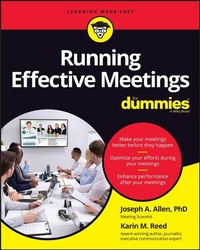
Running Effective Meetings For Dummies
Description

Brainstorming meetings. Team meetings. Stakeholder meetings. Zoom meetings. Hybrid meetings. Most of us are part of more meetings than we can even count. And how many of these meetings are actually productive and valuable?
Running Effective Meetings For Dummies shows you how to plan, guide, and run a great meeting, whether you're doing it face-to-face, fully virtual, or a combination of both. Authors Dr. Joseph Allen, industrial and organizational psychologist, and Emmy-award winning communications expert Karin Reed team up to walk you through the steps you need to take to make your next meeting your best one yet.
You'll learn about:
* The different kinds of meetings and what each is supposed to accomplish
* How to prep for a great meeting and set the expectations of all the participants
* How to be an effective leader by guiding discussion during the actual meeting itself
* Effective follow-up and evaluation to keep your momentum and continually improve your meetings
Stop enduring meeting-fatigue and start making meetings the fun, productive, and engaging events they're supposed to be. Grab a copy of Running Effective Meetings For Dummies today!
More details
Other editions
Additional editions
Persons
Karin M. Reed is CEO of Speaker Dynamics, a corporate communications training firm. She is an Emmy award-winning broadcast journalist.
Content
Part 1: Understanding the Role of Meeting in Business. 5
Chapter 1: Making Meetings More Effective. 7
Chapter 2: Matching the Meeting Style with the Meeting Goal. 19
Chapter 3: Understanding the Full Meeting Continuum. 33
Chapter 4: Choosing How You Should Meet. 45
Chapter 5: Using Video in Virtual or Hybrid Meetings. 59
Chapter 6: Meeting with Global Participants. 73
Part 2: Setting Up for Success -- What to do Before a Meeting 87
Chapter 7: Determining if You Even Need a Meeting. 89
Chapter 8: Designing the Meeting to Match Your Goals. 95
Chapter 9: Setting Meeting Expectations. 117
Part 3: Facilitating an Effective Meeting -- What to do During a Meeting 141
Chapter 10: Starting a Meeting. 143
Chapter 11: Managing the Conversation Flow. 167
Chapter 12: Pulling Out Even Participation 185
Chapter 13: Delivering Your Messages Effectively 201
Chapter 14: Stifling Bad Meeting Behaviors. 229
Part 4: Making a Meeting Worthwhile -- What to do after a Meeting. 241
Chapter 15: Following Up Effectively. 243
Chapter 16: Evaluating Your Meeting Effectiveness. 253
Part 5: The Part of Tens. 263
Chapter 17: Ten Things to Say to Move a Meeting Along 265
Chapter 18: Ten Alternatives to Meeting in a Conference Room. 271
Chapter 19: Ten Ways to Bolster Participation 277
Index. 283
Chapter 1
Making Meetings More Effective
IN THIS CHAPTER
Figuring out why meetings matter
Defining the kind of meeting featured in this book
Describing the seismic shifts in the way we now meet
So be honest with us: Were you given this book as a gag gift by your team who thought it would be hilarious to give you a book about running effective meetings . for dummies?
When we first heard the proposed title, we thought it might lend itself to that kind of purchase. No worries, regardless of how this book made its way to you, we're glad you're here, and we think you will be too. Why? Because when it comes to running meetings well, there's a lot to learn whether you are a newbie to the task or have been leading meetings for decades.
Some meetings are well run and result in employees and team members being inspired, encouraged, and ready to perform at a high level. Many meetings are not run so well. They suffer from a lack of focus, a constraining of participation, and result in people leaving confused, misdirected, or simply just annoyed.
Our promise to you is that following the guidance in this book will make the meetings you lead be well run. The tips and tricks, the best practices, and the prioritized processes contained herein are tried and true. In other words, they are science-based practice. What does that mean?
Science-based practice means that every recommendation we make and tip we give you has emerged from the scientific community that studies workplace meetings. In fact, the vast majority of these recommendations come directly from the science of meetings that Joe studies and the practice of meetings that Karin leads. You can proceed to implement any of the things we suggest with complete confidence that they will indeed change your meeting experiences for the better.
Gone are the days where you lead a meeting and leave it feeling like you didn't accomplish the goals you had for the meeting. Follow the steps in this book and you can enjoy countless good meetings, and get this . even see some free time open up on your calendar. How is this possible?
Our data tells us one bad meeting results in three more meetings, meetings that are needed to clean up the mess of the original one. Think about it this way, if you have fewer bad meetings, you'll have fewer meetings overall!
And if that's not reason enough to read this book, let's give you just one more reason. You don't have to run meetings to use many of the tips and recommendations provided in this book. In fact, a good meeting attendee has a powerful influence on the effectiveness of the meetings they attend. Sure, you may not be able to replace the meeting leader, but you can help replace the bad behavior that sometimes permeates the meetings you attend. (If you want more detail, check out Chapter 14 that provides ways to stifle those bad behaviors.)
There's indeed hope for a brighter meeting future and we're here to help you achieve it.
Understanding Why Meetings are Important
This is the ages-old question that Joe tries to answer in every paper or book he writes, "Who cares?". More specifically, why should we care about meetings? We all have them. They are kind of "meh," and they do essentially all that we need them to do, albeit not as well as we might generally like.
Well, let's review a few facts:
- According to some amazing survey work by Elise Keith at Lucid Meetings, there were at least 55 million meetings per day in the United States in 2015. But that was before COVID-19 hit, and there was an explosion in the number of meetings that we were having. In fact, it's estimated that the number of meetings increased by 252 percent during the pandemic and have not come back down. So, doing a little math here, that means we're at somewhere around 139 million meetings a day. That's a lot of meetings.
- Fifty-one percent of meetings in the U.S. are rated as poor. Not so-so. Not okay. Poor! That means more than half of those 139 million meetings are just plain lousy. They're awful, uninspiring, time-sucks that drain the energy and life out of people. It's no wonder that we commiserate at the water cooler after a long day of meetings (or more likely the pub on Fridays).
- In larger organizations, managers spend 75 percent of their time on meeting-related activities. That is, the vast majority of their time is spent preparing for, attending, and leading meetings. If you're a manager in a larger organization, you're probably yelling at the book right now. We hear you and we feel your pain! We've lived that painful narrative ourselves, and that's why the science and practice of meetings is coming together to give you this book.
Meetings are everywhere. They fill up our calendars. But, they do not have to be terrible. They can and should be better and we can help!
Now, just because we do something a lot doesn't make it important. So, we repeat, "Who cares?" Well, where are all the important business decisions made? How are scarce resources in an organization divided up? Where do we both bond with our colleagues and lend them support at the same time? Where are strategies for the future born? Where are products moved from idea to reality? We could go on, but the answer is meetings. For more on the many purposes of meetings, flick through to Chapter 7.
Meetings are a highly customizable and adaptable collaboration environment where three or more people come together to discuss something. They are typically more formal than a quick chat, but less formal than an organized lecture or convention. Meetings are where people make many of the decisions that manage organizational life and are also where communities, cultures, and social connections are initiated, maintained, and sometimes ended.
In sum, meetings are everywhere and they can do many things. But, the people in them are just people. We all make mistakes. We all have flaws. And we carry those issues with us into our collaborative environments. Good meeting practices are intuitive and can help us collaborate effectively regardless of our mistakes, flaws, and issues. But, we have to choose to do follow them.
Discovering Why Better Meetings Benefit Everyone
We all have a ton of meetings and they can do a lot of good things for us, but will it really benefit you if you put more effort into each one? Yes! And there's really good scientific evidence to back up this emphatic claim.
In 2008, Joe started working with his mentor Steven Rogelberg on a study looking at how meetings might relate to job satisfaction. Specifically, we were trying to provide evidence that human resources managers and others should care about meetings, how they are run, and how they impact employees. Steven's idea around this was to see if meeting satisfaction related to job satisfaction. In the first study, we decided to statistically control for the facets of job satisfaction. These include satisfaction with one's pay, coworkers, the work itself, promotion opportunities, and the boss. Once you account for those five things, there's not a whole lot left that could relate to job satisfaction. In fact, what are meetings? Gatherings of coworkers and often the boss. Our hope was that meetings are more than just being around coworkers and the boss, but something more core to employees' ability to do their work. To our surprise and wonder, meeting satisfaction still related to job satisfaction even after we accounted for all five of these things! That meant that there's something interesting about meetings that's more than just wrapped up in our relationship with and satisfaction with our coworkers and bosses.
This led to a series of studies looking at the positive impact and negative impact of meetings, including how meetings can help or hurt overall employee health and well-being. Here's what we concluded:
- Good meetings positively relate to overall employee satisfaction with their job, their level of employee engagement, and their performance on the job. In other words, good meetings make for happier, harder working employees that actually get the job done.
- Bad meetings lead to more dissatisfaction, disengagement, and lower job performance. However, it doesn't stop there. Bad meetings also relate to employee stress, reductions in overall health, and increases in burnout. In other words, bad meetings actually make people less well and are a major driver of burnout and turnover in organizations.
And maybe we shouldn't be all that surprised. Given how prevalent they are, for a lot of people, meetings are their work. We know from a long history of workforce research that when people are happy in their jobs, they are generally happy with life. If your meetings are miserable and you have a lot of meetings, you probably aren't that happy with your job. To find out more on how to evaluate your meetings, check out Chapter 16.
Good meetings lead to good outcomes. Bad meetings lead to bad outcomes. And we are all about helping you and everyone else have more good meetings, and fewer bad meetings.
Knowing What Kind of Meetings this Book is About
Given the range and flexibility of meetings, it may come as no surprise that there are a number of different meeting types:
- There are small meetings among team...
