

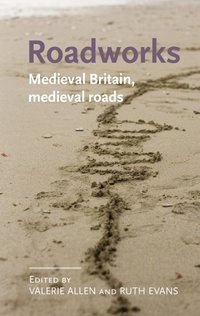
Roadworks
Medieval Britain, Medieval Roads
Published on 1. January 2016
384 pages
978-1-78499-608-6 (ISBN)
Description

Roadworks: Medieval Britain, medieval roads is a groundbreaking interdisciplinary study of roads and wayfinding in medieval England, Wales and Scotland. It looks afresh at the relationship between the road as a material condition of daily life and the formation of local and national communities, arguing that the business of road maintenance, road travel and wayfinding constitutes social bonds. It challenges the long-held picture of a medieval Britain lacking in technological sophistication, passively inheriting Roman roads and never engineering any of its own.
Previous studies of medieval infrastructure tend to be discipline-specific and technical. This accessible collection draws out the imaginative, symbolic, and cultural significance of the road. The key audience for this book is scholars of medieval Britain (early and late) in all disciplines. Its theoretical foundations will also ensure an audience among scholars of cultural studies, especially those in urban studies, transport studies, and economic history. -- .
Previous studies of medieval infrastructure tend to be discipline-specific and technical. This accessible collection draws out the imaginative, symbolic, and cultural significance of the road. The key audience for this book is scholars of medieval Britain (early and late) in all disciplines. Its theoretical foundations will also ensure an audience among scholars of cultural studies, especially those in urban studies, transport studies, and economic history. -- .
Reviews / Votes
'The editors are to be congratulated on the strength of the essays and the way they complement each other despite the diversity of approaches taken by their authors. The reader also benefits from the clarity and uniformity of presentation, and the generally very high standard of copy editing. More illustrations would have been welcome for a subject that cries out for maps, but this is a small gripe about a book that offers so much to all of those interested in a topic that unites different disciplines.'The Journal of transport history vol 37 (2), Stephen Mileson, Victoria County History, Oxfordshire
''Roadworks' represents a major contribution to our understanding of roads in the medieval period. Its thirteen chapters cover a wide range of sources and methodologies, and - considering that much of the major literature on the subject is very old - its revisionist position is very welcome.'
Owen Davies, University of Hertfordshire, Landscapes, June 2017
'It falls beyond the scope of this review to rehearse the specific arguments made by each of these thirteen fine essays, but each and every one of them sheds important light on British roads (and rivers, bridges, forests and coastlines) and how they 'inscribe the wayfarer as homo viator in ways often more fundamental than how human technology imposes meaning on roads' (p.3). Collectively they thus make an important contribution to the emerging field of medieval infrastructures and demonstrate its relevance to numerous subfields and medieval studies more broadly.'
Guy Geltner, Universiteit van Amsterdam, JRG, Vol 131, No 2, 2018 -- .
More details
Other editions
Additional editions
Book
01/2016
Manchester University Press
€135.10
Shipment within 15-20 days
Persons
Valerie Allen is Professor of English at John Jay College of Criminal Justice, CUNY Ruth Evans is Professor of English at Saint Louis University
Content
Introduction: Roads and writing - Valerie Allen and Ruth Evans
1. Sources for the English medieval road system - Paul Hindle
2. Once a highway, always a highway: roads and English law, c.1150-1300 - Alan Cooper
3. When things break: mending roads, being social - Valerie Allen
4. The word on the street: Chaucer and the regulation of nuisance in post-plague London - Sarah Rees Jones
5. Getting there: wayfinding in the Middle Ages - Ruth Evans
6. The function of material and spiritual roads in the English eremitic tradition - Michelle M. Sauer
7. The Royal Itinerary and roads in England under Edward I - Michael Prestwich
8. The pilgrimage road in late medieval literature Shayne - Aaron Legassie
9. The romance of the road in Athelston and two late medieval Robin Hood ballads - Chris Chism
10. London: the hub of an English river transport network, 1250-1550 - Claire Martin
11. Conquest, roads and resistance in medieval Wales - Dylan Foster Evans
12. Trackless, impenetrable and under-developed? Roads, colonisation and environmental transformation in the Anglo-Scottish border zone c.1100 to c.1300 - Richard Oram
Index
1. Sources for the English medieval road system - Paul Hindle
2. Once a highway, always a highway: roads and English law, c.1150-1300 - Alan Cooper
3. When things break: mending roads, being social - Valerie Allen
4. The word on the street: Chaucer and the regulation of nuisance in post-plague London - Sarah Rees Jones
5. Getting there: wayfinding in the Middle Ages - Ruth Evans
6. The function of material and spiritual roads in the English eremitic tradition - Michelle M. Sauer
7. The Royal Itinerary and roads in England under Edward I - Michael Prestwich
8. The pilgrimage road in late medieval literature Shayne - Aaron Legassie
9. The romance of the road in Athelston and two late medieval Robin Hood ballads - Chris Chism
10. London: the hub of an English river transport network, 1250-1550 - Claire Martin
11. Conquest, roads and resistance in medieval Wales - Dylan Foster Evans
12. Trackless, impenetrable and under-developed? Roads, colonisation and environmental transformation in the Anglo-Scottish border zone c.1100 to c.1300 - Richard Oram
Index
