

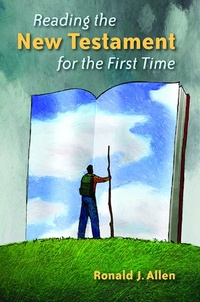
Reading the New Testament for the First Time
Published on 9. July 2012
153 pages
978-1-4674-3614-4 (ISBN)
Description

The purpose of this book is to introduce the New Testament to those who have never read it. Ronald Allen offers a truly elementary guide to the New Testament's world, its story, and its message. Reading the New Testament for the First Time walks readers through the New Testament, covering key topics like these: how to find one's way around the New Testamenthow and when the New Testament was writtenimportant characters like Jesus, Paul, and the twelve disciplesbig ideas found in the New Testament such as love, righteousness, and the realm of Godhow to apply the New Testament to our lives todayand much more!
More details
Other editions
Additional editions
Ronald J. Allen
Reading the New Testament for the First Time
Book
06/2012
William B Eerdmans Publishing Co
€27.40
Shipment within 15-20 days
Person
RONALD J. ALLEN is professor of preaching and NewTestament at Christian Theological Seminary, Indianapolis,where he has taught since 1982. He is the author of almostforty books, including the popular lay study guide AFaith of Your Own: Naming What You Really Believe.,
Content
- Intro
- Title Page
- Copyright
- Contents
- Introduction
- This Book is for People Brand New to the New Testament
- Why Did I Write This Book?
- An Informal Tone
- Just the Facts, Ma'am
- What Will You Find in Reading the New Testament for the First Time?
- This Book Unfolds like a Spiral
- Bible Study Can Be Life-Giving
- 1. What Will I Find When I Open the Bible?
- Basic Facts
- Where Can I Get a Copy of the New Testament?
- What Does the Phrase "Holy Bible" Mean?
- The Parts of the Bible: Small and Large
- The Small Parts of the Bible: Books, Chapters, and Verses
- The Large Parts of the Bible: Old and New Testaments
- What is in the New Testament?
- How We Got the New Testament
- How the Individual Books of the New Testament Came to Be Written
- How the Books of the New Testament Came to Be Regarded as Sacred
- Ancient Technology and the New Testament
- Take Your New Testament with You
- 2. The World of the New Testament
- A Little History of the Jewish People
- The Creation of the World, Life in Paradise, and the Fall
- The Beginnings of the People Israel (the Jewish People)
- From Sarah and Abraham to Jesus
- Jewish Life between the Testaments
- Life in the Roman Empire
- The Jewish People in Judea at the Time of the New Testament
- Jewish People outside of Judea
- Leaving Behind Negative Pictures of the Jewish People
- 3. The Content of the New Testament: Two Mini-Surveys
- Mini-Survey: The Events of the New Testament in the Order They Happened
- The Birth of Jesus (4 B.C.E.)
- John the Baptist (25-30 C.E.)
- The Ministry of Jesus (27 to 30 C.E.)
- Resurrection and Ascension (30 C.E.)
- The Second Coming (A Hope for the Future)
- Pentecost (30 C.E.)
- Earliest Followers of Jesus in Jerusalem (30-70 C.E.)
- The Call of Paul (33 C.E.) and His Early Ministry
- The Jerusalem Council (47 C.E.)
- Paul's Later Ministry (47-62 C.E.)
- Two Generations of Paul's Students (65-110 C.E.)
- The Destruction of the Temple (70 C.E.)
- Jesus' Followers Cast out of a Small Group of Synagogues (90 C.E.)
- Other Writings and Events (80 C.E. to 100 C.E.)
- Mini-Survey: The Books of the New Testament in the Order They Were Written
- A Sign of Hope: Written for Questioning, Struggling People
- 4. The Story of Jesus
- The Big Idea in the Background of Jesus' Ministry: The Realm of God
- John the Baptist Prepared the Way
- The Preaching of Jesus Announced the Realm of God
- The Teaching of Jesus Explained the Realm and How to Live in Light of It
- The Miracles of Jesus Demonstrated the Presence of the Realm
- Jesus in Discussion and Debate with His Contemporaries
- The Death of Jesus
- The Resurrection and Ascension of Jesus
- 5. The Early Church before Paul
- The Twelve Apostles: Core Leaders
- The Followers of Jesus in Jerusalem: A Group within Judaism
- The Message and Mission of the Early Followers of Jesus
- The Holy Spirit Energized the Mission
- The Life of the Early Community
- "They Had All Things in Common"
- Jesus' Followers Were Soon Called the "Church," and Later "Christians"
- 6. Paul: Apostle to the Gentiles
- Two Pictures of Paul in the New Testament
- Paul's Background: Persecutor
- Paul: Apostle to the Gentiles
- The Coming Realm of God: The Center of Paul's Message
- Paul's Missionary Activity
- The End of Paul's Life in Rome
- 7. The Letters of Paul
- The Form of Letters in the Ancient World
- Some Common Themes
- 1 Thessalonians
- Galatians
- 1 and 2 Corinthians
- Philippians
- Philemon
- Romans
- 8. The Four Gospels
- Names, Dates, and Family Grouping among the Gospels
- The Destruction of the Temple: A Key Event
- Mark
- Matthew
- Luke-Acts
- John
- 9. The Letters of Paul's Disciples (?)
- Disciples Writing in the Name of a Teacher
- Arguments for and against Paul's Authorship
- Developments in the Pauline Tradition
- Colossians
- Ephesians
- 2 Thessalonians
- 1 and 2 Timothy and Titus
- 10. Other New Testament Writings
- Hebrews
- 1, 2, and 3 John
- James
- 1 Peter
- Jude and 2 Peter
- The Book of Revelation
- 11. Some Big Ideas in and around the New Testament
- A Shift in Perspective from Individual to Community and Cosmos
- Communal Identity
- Faith
- Grace
- Titles for Jesus
- Mercy
- Predestination (Election)
- Salvation: Limited or Universal?
- Sin
- 12. Some of the Most Famous Passages in the New Testament
- John Three Sixteen: John 3:16
- The Love Chapter: 1 Corinthians 13
- The Golden Rule: Matthew 7:12
- The Lord's Prayer: Matthew 6:9-13
- The Faith Chapter: Hebrews 11:1-40
- The Good Samaritan: Luke 10:29-37
- The Prodigal Son: Luke 15:11-32
- The Great Commandment: Mark 12:28-34
- In My Father's House are Many Rooms: John 14:1-3
- The Beatitudes: Matthew 5:1-12
- I Pray That They May All Be One: John 17:1-26
- The New Heaven and the New Earth: Revelation 21:1-22:5
- 13. Using the New Testament in the Church Today
- Two Ways of Using the New Testament in the Church Today: Multiple Voice and Single Voice
- Similarities and Differences in the Two Perspectives
- First Way: Multiple Voices in Conversation with Other Authorities
- Strengths and Weaknesses
- A Second Way: The Single Voice Speaking Authoritatively
- Strengths and Weaknesses
- Many Christians are in the Middle
- How Do I Know Where I Fit?
- A Benediction of Love
- Appendix A: Choosing a Translation of the New Testament
- Appendix B: Resources for Further Study
- Introduction to the New Testament
- Concordance
- Study Bible
- Bible Dictionary
- Bible Commentary
- Appendix C: Three Plans for Reading through the Entire New Testament
- Plan 1: Reading the Books of the New Testament in Their Present Order
- Plan 2: Reading the Books in the Order in Which They Were Written
- Plan 3: Reading the New Testament in the Order of the Chronology of Events
- Appendix D: The Names "Old Testament" and "New Testament"
