

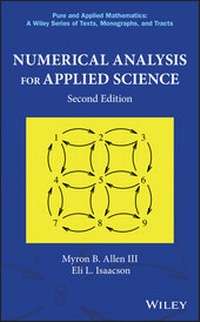
Numerical Analysis for Applied Science
Description

Numerical analysis is a core subject in data science and an essential tool for applied mathematicians, engineers, and physical and biological scientists. This updated and expanded edition of Numerical Analysis for Applied Science follows the tradition of its precursor by providing a modern, flexible approach to the theory and practical applications of the field. As before, the authors emphasize the motivation, construction, and practical considerations before presenting rigorous theoretical analysis. This approach allows instructors to adapt the textbook to a spectrum of uses, ranging from one-semester, methods-oriented courses to multi-semester theoretical courses.
The book includes an expanded first chapter reviewing useful tools from analysis and linear algebra. Subsequent chapters include clearly structured expositions covering the motivation, practical considerations, and theory for each class of methods. The book includes over 250 problems exploring practical and theoretical questions and 32 pseudocodes to help students implement the methods. Other notable features include:
* A preface providing advice for instructors on using the text for a single semester course or multiple-semester sequence of courses
* Discussion of topics covered infrequently by other texts at this level, such as multidimensional interpolation, quasi-Newton methods in several variables, multigrid methods, preconditioned conjugate-gradient methods, finite-difference methods for partial differential equations, and an introduction to finite-element theory
* New topics and expanded treatment of existing topics to address developments in the field since publication of the first edition
* More than twice as many computational and theoretical exercises as the first edition.
Numerical Analysis for Applied Science, Second Edition provides an excellent foundation for graduate and advanced undergraduate courses in numerical methods and numerical analysis. It is also an accessible introduction to the subject for students pursuing independent study in applied mathematics, engineering, and the physical and life sciences and a valuable reference for professionals in these areas.
More details
Other editions
Additional editions
Persons
Myron B. Allen III, PhD, is Professor of Mathematics in the Department of Mathematics and Statistics at the University of Wyoming, Laramie, USA. His research focuses on the numerical analysis of fluid flows in porous media.
The Late Eli L. Isaacson, PhD, was Professor Emeritus of Mathematics in the Department of Mathematics at the University of Wyoming, Laramie, USA. His work includes analytic and numerical methods for solving systems of hyperbolic conservation laws, including front-tracking methods.
Content
Preface v
1 Some Useful Tools 1
1.1 Introduction 1
1.2 Bounded Sets 4
1.2.1 The Least Upper Bound Principle 4
1.2.2 Bounded Sets in Rn 5
1.3 Normed Vector Spaces 8
1.3.1 Vector Spaces 8
1.3.2 Matrices as Linear Operators 10
1.3.3 Norms 12
1.3.4 Inner Products 15
1.3.5 Norm Equivalence 17
1.4 Eigenvalues and Matrix Norms 19
1.4.1 Eigenvalues and Eigenvectors 19
1.4.2 Matrix Norms 21
1.5 Results from Calculus 26
1.5.1 Seven Theorems 26
1.5.2 The Taylor Theorem 28
1.6 Problems 33
2 Approximation of Functions 37
2.1 Introduction 37
2.2 Polynomial Interpolation 38
2.2.1 Motivation and Construction 38
2.2.2 Practical Considerations 42
2.2.3 Mathematical Details 43
2.2.4 Further Remarks 46
2.3 Piecewise Polynomial Interpolation 48
2.3.1 Motivation and Construction 48
2.3.2 Practical Considerations 50
2.3.3 Mathematical Details 54
2.3.4 Further Remarks 55
2.4 Hermite Interpolation 55
2.4.1 Motivation and Construction 55
2.4.2 Practical Considerations 59
2.4.3 Mathematical Details 60
2.5 Interpolation in Two Dimensions 63
2.5.1 Constructing Tensor-product Interpolants 64
2.5.2 Error Estimates for Tensor-product Methods 68
2.5.3 Interpolation on Triangles: Background 70
2.5.4 Construction of Planar Interpolants on Triangles 72
2.5.5 Error Estimates for Interpolation on Triangles 74
2.6 Splines 78
2.6.1 Motivation and Construction 78
2.6.2 Practical Considerations 84
2.6.3 Mathematical Details 85
2.6.4 Further Remarks 94
2.7 Least-squares Methods 95
2.7.1 Motivation and Construction 96
2.7.2 Practical Considerations 100
2.7.3 Mathematical Details 101
2.7.4 Further Remarks 103
2.8 Trigonometric Interpolation 104
2.8.1 Motivation and Construction 105
2.8.2 Practical Considerations: Fast Fourier Transform 109
2.8.3 Mathematical Details 116
2.8.4 Further Remarks 118
2.9 Problems 118
3 Direct Methods for Linear Systems 125
3.1 Introduction 125
3.2 The Condition Number of a Linear System 127
3.3 Gauss Elimination 131
3.3.1 Motivation and Construction 131
3.3.2 Practical Considerations 133
3.3.3 Mathematical Details 139
3.4 Variants of Gauss Elimination 148
3.4.1 Motivation 148
3.4.2 The Doolittle and Crout Methods 148
3.4.3 Cholesky Decomposition 152
3.5 Band Matrices 155
3.5.1 Motivation and Construction 155
3.5.2 Practical Considerations 161
3.5.3 Mathematical Details 163
3.5.4 Further Remarks 166
3.6 Iterative Improvement 167
3.7 Problems 169
4 Solution of Nonlinear Equations 175
4.1 Introduction 175
4.2 Bisection 179
4.2.1 Motivation and Construction 179
4.2.2 Practical Considerations 181
4.3 Successive Substitution in One Variable 183
4.3.1 Motivation and Construction 183
4.3.2 Practical Considerations 184
4.3.3 Mathematical Details 190
4.4 Newton's Method in One Variable 192
4.4.1 Motivation and Construction 192
4.4.2 Practical Considerations 194
4.4.3 Mathematical Details 199
4.5 The Secant Method 203
4.5.1 Motivation and Construction 203
4.5.2 Practical Considerations 205
4.5.3 Mathematical Details 206
4.6 Successive Substitution: Several Variables 211
4.6.1 Motivation and Construction 211
4.6.2 Convergence Criteria 213
4.6.3 An Application to Differential Equations 217
4.7 Newton's Method: Several Variables 219
4.7.1 Motivation and Construction 219
4.7.2 Practical Considerations 221
4.7.3 Mathematical Details: Newton's Method 224
4.7.4 Mathematical Details: Finite-difference Newton Methods 229
4.8 Problems 233
5 Iterative Methods for Linear Systems 239
5.1 Introduction 239
5.2 Conceptual Foundations 243
5.3 Matrix-Splitting Techniques 248
5.3.1 Motivation and Construction: Jacobi and Gauss-Seidel Methods 248
5.3.2 Practical Considerations 254
5.3.3 Mathematical Details 258
5.4 Successive Overrelaxation 266
5.4.1 Motivation 266
5.4.2 Practical Considerations 266
5.4.3 Mathematical Details 272
5.4.4 Further Remarks: The Power Method and Symmetric SOR 279
5.5 Multigrid Methods 280
5.5.1 Motivation: Error Reduction Versus Smoothing 280
5.5.2 A Two-Grid Algorithm 284
5.5.3 V-cycles and the Full Multigrid Algorithm 289
5.6 The Conjugate-Gradient Method 293
5.6.1 Motivation and Construction 293
5.6.2 Practical Considerations 298
5.6.3 Mathematical Details 303
5.6.4 Further Remarks: Krylov Methods and Steepest Descent 309
5.7 Problems 311
6 Eigenvalue Problems 317
6.1 More About Eigenvalues 318
6.2 Power Methods 323
6.2.1 Motivation and Construction 323
6.2.2 Practical Considerations 325
6.3 The QR Decomposition 328
6.3.1 Geometry and Algebra of the QR Decomposition 328
6.3.2 Application to Least-Squares Problems 333
6.3.3 Further Remarks 335
6.4 The QR Algorithm for Eigenvalues 338
6.4.1 Motivation and Construction 338
6.4.2 Practical Considerations 341
6.4.3 Mathematical Details 347
6.4.4 Further Remarks 350
6.5 Singular Value Decomposition 352
6.5.1 Theory of the Singular Value Decomposition 352
6.5.2 Computing Singular Value Decompositions 354
6.5.3 Application to Principal Component Analysis 354
6.6 Problems 358
7 Numerical Integration 363
7.1 Introduction 363
7.2 Newton-Cotes Formulas 364
7.2.1 Motivation and Construction 364
7.2.2 Practical Considerations: Composite Formulas 367
7.2.3 Mathematical Details 369
7.2.4 Further Remarks 373
7.3 Romberg and Adaptive Quadrature 373
7.3.1 Romberg Quadrature 374
7.3.2 Adaptive Quadrature 379
7.4 Gauss Quadrature 385
7.4.1 Motivation and Construction 385
7.4.2 Practical Considerations 388
7.4.3 Mathematical Details 390
7.5 Problems 399
8 Ordinary Differential Equations 403
8.1 Introduction 403
8.2 One-Step Methods 406
8.2.1 Motivation and Construction 406
8.2.2 Practical Considerations 409
8.2.3 Mathematical Details 410
8.2.4 Further Remarks: The Runge-Kutta-Fehlberg Algorithm 416
8.3 Multistep Methods: Consistency and Stability 420
8.3.1 Motivation 420
8.3.2 Adams-Bashforth and Adams-Moulton Methods 422
8.3.3 Consistency of Multistep Methods 423
8.3.4 Stability of Multistep Methods 426
8.3.5 Predictor-Corrector Methods 430
8.3.6 Mathematical Details: The Root Condition 431
8.4 Multistep Methods: Convergence 438
8.4.1 Convergence Implies Stability and Consistency 439
8.4.2 Consistency and Stability Imply Convergence 441
8.5 Problems 448
9 Difference Methods for PDEs 453
9.1 Introduction 453
9.1.1 Classification 454
9.1.2 Characteristic Curves and Characteristic Equations 455
9.1.3 Grid Functions and Difference Operators 460
9.2 The Poisson Equation 462
9.2.1 The Five-Point Method 463
9.2.2 Consistency and Convergence 466
9.2.3 Accommodating Variable Coefficients 471
9.2.4 Accommodating Other Boundary Conditions 472
9.2.5 Accommodating Nonrectangular Domains 473
9.3 The Advection Equation 475
9.3.1 The Courant-Friedrichs-Lewy Condition 476
9.3.2 Stability of Approximations to Time-Dependent Problems 480
9.3.3 Sufficient Conditions for Convergence 485
9.3.4 Further Remarks 488
9.4 Other Time-Dependent Equations 489
9.4.1 The Heat Equation 489
9.4.2 The Advection-Diffusion Equation 498
9.4.3 The Wave Equation 503
9.5 Problems 505
10 Introduction to Finite Elements 511
10.1 Introduction and Background 511
10.1.1 A Model Boundary-Value Problem 512
10.1.2 Variational Formulation 513
10.2 A Steady-State Problem 517
10.2.1 Construction of a Finite-Element Approximation 517
10.2.2 A Basic Error Estimate 520
10.2.3 Optimal-Order Error Estimates 525
10.2.4 Other Boundary Conditions 528
10.2.5 Condition Number of the Finite-Element Matrix 532
10.3 A Transient Problem 537
10.3.1 A Semidiscrete Formulation 537
10.3.2 A Fully Discrete Method 539
10.3.3 Convergence of the Fully Discrete Method 540
10.4 Problems 547
A Divided Differences 549
B Local Minima 553
C Chebyshev Polynomials 555
References 559
Index 563
Preface
Once in a while you get shown the light
In the strangest of places if you look at it right.
Robert Hunter
Preface to the First Edition
We intend this book to serve as a first graduate-level text for applied mathematicians, scientists, and engineers. We hope that these students have had some exposure to numerics, but the book is self-contained enough to accommodate students with no numerical background. Students should know a computer programming language, though.
In writing the text, we have tried to adhere to three principles:
- The book should cover a significant range of numerical methods now used in applications, especially in scientific computation involving differential equations.
- The book should be appropriate for mathematics students interested in the theory behind the methods.
- The book should also appeal to students who care less for rigorous theory than for the heuristics and practical aspects of the methods.
The first principle is a matter of taste. Our omissions may appall some readers; they include polynomial root finders, linear and nonlinear programming, digital filtering, and most topics in statistics. On the other hand, we have included topics that receive short shrift in many other texts at this level. Examples include:
- Multidimensional interpolation, including interpolation on triangles.
- Quasi-Newton methods in several variables.
- A brief introduction to multigrid methods.
- Conjugate-gradient methods, including error estimates.
- Rigorous treatment of the QR method for eigenvalues.
- An introduction to adaptive methods for numerical integration and ordinary differential equations.
- A thorough treatment of multistep schemes for ordinary differential equations (ODEs).
- Consistency, stability, and convergence of finite-difference schemes for partial differential equations (PDEs).
- An introduction to finite-element methods, including basic convergence arguments and methods for time-dependent problems.
All of these topics are prominent in scientific applications.
The second and third principles conflict. Our strategy for addressing this conflict is threefold. First, most sections of the book have a "pyramid" structure. We begin with the motivation and construction of the methods, then discuss practical considerations associated with their implementation, then present rigorous mathematical details. Thus, students in a "methods" course can concentrate on motivation, construction, and practical considerations, perhaps grazing from the mathematical details according to the instructor's tastes. Students in an "analysis" course should delve into the mathematical details as well as the practical considerations.
Second, we have included Chapter 1, "Some Useful Tools," which reviews essential notions from undergraduate analysis and linear algebra. Mathematics students should regard this chapter as a review; engineering and applied science students may profit by reading it thoroughly.
Third, at the end of each chapter are both theoretical and computational exercises. Engineers and applied scientists will probably concentrate on the computational exercises. Mathematicians should work a variety of both theoretical and computational problems. Numerical analysis without computation is a sterile enterprise.
The book's format allows instructors to use it in either of two modes. For a "methods" course, one can cover a significant set of topics in a single semester by covering the motivation, construction, and practical considerations. At the University of Wyoming, we teach such a course for graduate engineers and geophysicists. For an "analysis" course, one can construct a two- or three-semester sequence that involves proofs, computer exercises, and projects requiring written papers. At Wyoming, we offer a two-semester course along these lines for students in applied mathematics.
Most instructors will want to skip topics. The following remarks may help avoid infelicitous gaps:
- We typically start our courses with Chapter 2. Sections 2.2 and 2.3 (on polynomial interpolation) and 2.7 (on least squares) seem essential.
- Even if one has an aversion to direct methods for linear systems, it is worthwhile to discuss Sections 3.1 and 3.3. Also, the introduction to matrix norms and condition numbers in Sections 1.4 and 3.6 is central to much of numerical analysis.
- While Sections 4.1-4.4 contain the traditional core material on nonlinear equations, our experience suggests that engineering students profit from some coverage of the multidimensional methods discussed in Sections 4.6 and 4.7.
- Even in a proof-oriented course, one might reasonably leave some of the theory in Sections 5.3 and 5.4 for independent reading. Section 5.6, The Conjugate-Gradient Method, is independent of earlier sections in that chapter.
- Taste permitting, one can skip Chapter 6, Eigenvalue Problems, completely.
- One should cover Section 7.1 and at least some of Section 7.2, Newton-Cotes Formulas, in preparation for Chapter 8. Engineers use Gauss quadrature so often, and the basic theory is so elegant, that we seldom skip Section 7.4.
- We rarely cover Chapter 8 (on ODEs) completely. Still, in preparation for Chapter 9, one should cover at least the most basic material - through Euler methods - from Sections 8.1 and 8.2.
- While many first courses in numerics omit the treatment of PDEs, at least some coverage of Chapter 9 seems crucial for virtually all of the students who take our courses.
- Chapter 10, on finite-element methods, emphasizes analysis at the expense of coding, since the latter seems to lie at the heart of most semester-length engineering courses on the subject. It is hard to get this far in a one-semester "methods" course.
We owe tremendous gratitude to many people, including former teachers and many remarkable colleagues too numerous to list. We thank the students and colleagues who graciously endured our drafts and uncovered an embarrassing number of errors. Especially helpful were the efforts of Marian Anghel, Damian Betebenner, Bryan Bornholdt, Derek Mitchum, Patrick O'Leary, Eun-Jae Park, Gamini Wickramage, and the amazingly keen-eyed Li Wu. (Errors undoubtedly remain; they are our fault.) The first author wishes to thank the College of Engineering and Mathematics at the University of Vermont, at which he wrote early drafts during a sabbatical year. Finally, we thank our wives, Adele Aldrich and Lynne Ipiña, to whom we dedicate the book. Their patience greatly exceeds that required to watch a book being written.
Midnight on a carousel ride,
Reaching for the gold ring down inside.
Never could reach
It just slips away when I try.
Robert Hunter
Preface to the Second Edition
In producing this second edition of Numerical Analysis for Applied Science, I pursued two goals. First, I incorporated many suggestions and corrections made by people who have used the book since it first appeared in print. I owe my sincerest thanks to colleagues who have shared these improvements over the years. Professor Scott Fulton of Clarkson University and Professor Aleksey Telyakovskiy of the University of Nevada at Reno deserve special thanks for their extraordinary generosity in this respect.
Second, I have incorporated new topics or expanded treatments of existing topics, to reflect some of the evolving applications of numerical analysis during the past two decades. Among the new contents are the following:
- A description of the symmetric successive overrelaxation method in Chapter 5, to facilitate an expanded discussion of preconditioners later in the chapter.
- A separate section in Chapter 5 on multigrid methods for solving linear systems, including more detail than the first edition's brief discussion.
- A revised section in Chapter 5 on the conjugate-gradient method, including a more detailed discussion of preconditioners.
- A short discussion in Chapter 5 of the method of steepest descent.
- More details on the power and QR methods for computing eigenvalues in Chapter 6.
- An introduction in Chapter 6 to the singular value decomposition and its application to principal components analysis.
- Revised and expanded discussion in Chapter 9 of the approximation of elliptic PDEs by finite-difference methods, including the treatment of irregular boundaries in two dimensions.
- Revised approximation error estimates for the finite-element method in Chapter 10.
- An additional section in Chapter 10 on the condition number of the stiffness matrix, a major motivation for many advances in numerical linear algebra over the past three decades.
- Seven new pseudocodes, bringing the total to 32.
- More than twice as many problems as appeared in the first edition.
Also, I moved a section on eigenvalues and matrix norms to Chapter 1 and a section on the condition number to Section 3.2, to make it easier to skip most of Chapter 3 in favor of...
