

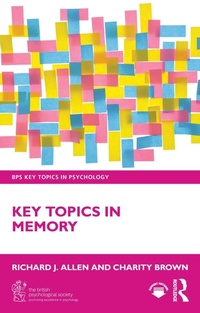
Key Topics in Memory
Will be published approx. on 15. June 2026
204 pages
978-1-040-64135-4 (ISBN)
Description

Key Topics in Memory explores the essential role of memory in human cognition, and how it connects us to the past, grounds us in the present, and guides our anticipation of the future. The book examines the dynamic and active nature of memory, exploring how it is influenced by both conscious effort and automatic, non-conscious processes, while addressing its remarkable flexibility, detail, and capacity alongside its fragility and vulnerability to distortion and loss. In doing so, it examines how memory enables us to learn, make decisions, pursue our goals, and maintain meaningful connections with others and the world around us.
This book provides an overview of key foundations, theories, and methodologies across various memory systems, processes, and functions. It integrates classic and contemporary research and offers insights into how these developments influence real-world applications. Readers will gain a deeper understanding of memory's complexity, from fleeting moments to lifelong experiences, and how it forms our understanding of ourselves and the world. By bridging theoretical concepts with empirical insights and practical implications, Key Topics in Memory highlights the transformative potential of memory research. It also highlights examples of where women researchers have played a key role in advancing the field and ends with a call to action for future investigation of interactions between memory, culture, and technology,
Key Topics in Memory is an essential resource for researchers, students, and professionals in psychology, neuroscience, and related fields who are interested in the science of memory. It is ideal for those seeking to understand the mechanisms and functions of memory, as well as its broader implications for human cognition and behaviour. Whether exploring foundational theories, methodological advances, or the application of memory research in real-world contexts, this book offers valuable insights into this fascinating area of study.
This book provides an overview of key foundations, theories, and methodologies across various memory systems, processes, and functions. It integrates classic and contemporary research and offers insights into how these developments influence real-world applications. Readers will gain a deeper understanding of memory's complexity, from fleeting moments to lifelong experiences, and how it forms our understanding of ourselves and the world. By bridging theoretical concepts with empirical insights and practical implications, Key Topics in Memory highlights the transformative potential of memory research. It also highlights examples of where women researchers have played a key role in advancing the field and ends with a call to action for future investigation of interactions between memory, culture, and technology,
Key Topics in Memory is an essential resource for researchers, students, and professionals in psychology, neuroscience, and related fields who are interested in the science of memory. It is ideal for those seeking to understand the mechanisms and functions of memory, as well as its broader implications for human cognition and behaviour. Whether exploring foundational theories, methodological advances, or the application of memory research in real-world contexts, this book offers valuable insights into this fascinating area of study.
More details
Series
Language
English
Place of publication
London
United Kingdom
Publishing group
Taylor & Francis Ltd
Target group
College/higher education
Professional and scholarly
Product notice
Reflowable
Illustrations
9 Line drawings, black and white; 3 Halftones, black and white; 12 Illustrations, black and white
File size
1,80 MB
ISBN-13
978-1-040-64135-4 (9781040641354)
Copyright in bibliographic data and cover images is held by Nielsen Book Services Limited or by the publishers or by their respective licensors: all rights reserved.
Schweitzer Classification
Other editions
Additional editions
Richard J. Allen | Charity Brown
Key Topics in Memory
Book
approx. 06/2026
1st Edition
Routledge
€29.00
Not yet published
Richard J. Allen | Charity Brown
Key Topics in Memory
Book
approx. 06/2026
1st Edition
Routledge
€179.50
Not yet published
Persons
Richard J. Allen is Professor of Cognitive Psychology in the School of Psychology at the University of Leeds, UK. He has over 15 years' experience in teaching memory and cognition at undergraduate and postgraduate levels. His research focuses on memory processes, particularly working memory, attentional control, long-term memory, and forgetting, across the lifespan and in both typical and atypical populations.
Charity Brown is an Associate Professor in the School of Psychology at the University of Leeds, UK. She has over 15 years' experience teaching memory and cognition at undergraduate and postgraduate levels and, for the past decade, has combined part-time academic work with caring responsibilities. Her research focuses on diverse memory-related topics, including eyewitness and autobiographical memory.
Charity Brown is an Associate Professor in the School of Psychology at the University of Leeds, UK. She has over 15 years' experience teaching memory and cognition at undergraduate and postgraduate levels and, for the past decade, has combined part-time academic work with caring responsibilities. Her research focuses on diverse memory-related topics, including eyewitness and autobiographical memory.
Content
Table of Contents. Chapter 1: Foundations for Studying Human Memory. Chapter 2: Working Memory. Chapter 3: Long-Term Memory. Chapter 4: Autobiographical Memory. Chapter 5: Encoding and Retrieval. Chapter 6: The Fallibility of Memory. Chapter 7: Studying Memory in its Wider Context: Synthesis and Future Directions.
