

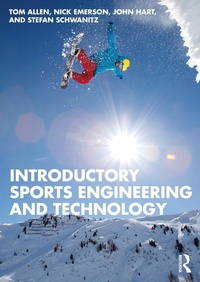
Introductory Sports Engineering and Technology
1st Edition
Will be published approx. on 22. July 2026
268 pages
978-1-040-49218-5 (ISBN)
Description

Introductory Sports Engineering and Technology provides a fundamental primer to the world of Sports Engineering and Technology, including the key themes that dominate design and practice. The text has been created to provide a comprehensive overview of key principles and is developed from established and recognised education providers.
This new text includes case studies and worked examples to facilitate deeper learning and prepare readers for a high-performance future in sports engineering and technology. Sports performance is a complex and increasingly technology-enhanced environment, incorporating a broad range of disciplines and topics. The sports engineer or technologist plays a key role within this environment, applying fundamental techniques derived from maths and physics to solve problems, analyse opportunities, and optimise equipment and practice to maximise performance outcomes and reduce injury risk.
This book is the first to offer a concise overview of the fundamental concepts required for budding sports engineers and technologists and is key reading for undergraduate and master's students of Sports Engineering and Technology degree courses, as well as undergraduate engineering, technology, and product design students.
This new text includes case studies and worked examples to facilitate deeper learning and prepare readers for a high-performance future in sports engineering and technology. Sports performance is a complex and increasingly technology-enhanced environment, incorporating a broad range of disciplines and topics. The sports engineer or technologist plays a key role within this environment, applying fundamental techniques derived from maths and physics to solve problems, analyse opportunities, and optimise equipment and practice to maximise performance outcomes and reduce injury risk.
This book is the first to offer a concise overview of the fundamental concepts required for budding sports engineers and technologists and is key reading for undergraduate and master's students of Sports Engineering and Technology degree courses, as well as undergraduate engineering, technology, and product design students.
More details
Edition
1. Auflage
Language
English
Place of publication
London
United Kingdom
Publishing group
Taylor & Francis Ltd
Target group
College/higher education
Professional and scholarly
Illustrations
13 Tables, black and white; 42 Line drawings, black and white; 157 Halftones, black and white; 199 Illustrations, black and white
File size
17,05 MB
ISBN-13
978-1-040-49218-5 (9781040492185)
Copyright in bibliographic data and cover images is held by Nielsen Book Services Limited or by the publishers or by their respective licensors: all rights reserved.
Schweitzer Classification
Other editions
Additional editions
Tom Allen | Nick Emerson | John Hart
Introductory Sports Engineering and Technology
Book
approx. 07/2026
1st Edition
Routledge
€66.00
Not yet published

Tom Allen | Nick Emerson | John Hart
Introductory Sports Engineering and Technology
Book
approx. 07/2026
1st Edition
Routledge
€191.50
Not yet published
Persons
Tom Allen, PhD, is a Reader in the Department of Engineering at Manchester Metropolitan University, UK. He is a Fellow of the Institution of Mechanical Engineers (IMechE) and serves as Editor-in-Chief of Sports Engineering.
Nick Emerson, PhD, is a Senior Lecturer and Associate Head of the School of Product Design within the Faculty of Engineering at the University of Canterbury, New Zealand. He is a Chartered Mechanical Engineer in the UK and Australia and a member of the Design Institute of New Zealand.
John Hart, PhD, is a Senior Research Fellow in the Sports Engineering Research Group at the Advanced Wellbeing Research Centre, Sheffield Hallam University, UK. He leads the MSc programme in Sports Engineering and Artificial Intelligence at Sheffield Hallam University.
Stefan Schwanitz, PhD, is a Senior Lecturer in Sports Engineering at Chemnitz University of Technology, Germany. He has taught on both the bachelor's and master's degree programmes in Sports Engineering at Chemnitz for over 15 years.
Nick Emerson, PhD, is a Senior Lecturer and Associate Head of the School of Product Design within the Faculty of Engineering at the University of Canterbury, New Zealand. He is a Chartered Mechanical Engineer in the UK and Australia and a member of the Design Institute of New Zealand.
John Hart, PhD, is a Senior Research Fellow in the Sports Engineering Research Group at the Advanced Wellbeing Research Centre, Sheffield Hallam University, UK. He leads the MSc programme in Sports Engineering and Artificial Intelligence at Sheffield Hallam University.
Stefan Schwanitz, PhD, is a Senior Lecturer in Sports Engineering at Chemnitz University of Technology, Germany. He has taught on both the bachelor's and master's degree programmes in Sports Engineering at Chemnitz for over 15 years.
Content
1. An Introduction to Sports Engineering and Technology 2. Developing Sporting Goods 3. Sports Mechanics 4. Fluid Dynamics in Sport 5. Fundamentals of Sports Materials 6. Materials in Sporting Goods 7. Manufacturing Sporting Goods 8. Testing Sporting Goods 9. Gauging the Effect of Technology on Sport 10. Current Trends and Future Challenges in Sports Engineering and Technology 11. Other Books on Sports Engineering and Technology
