

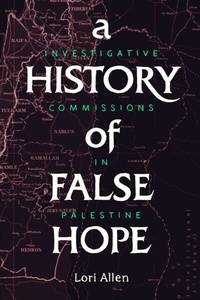
A History of False Hope
Investigative Commissions in Palestine
Published on 15. December 2020
432 pages
978-1-5036-1419-2 (ISBN)
Available for download
Description

This book offers a provocative retelling of Palestinian political history through an examination of the international commissions that have investigated political violence and human rights violations. More than twenty commissions have been convened over the last century, yet no significant change has resulted from these inquiries. The findings of the very first, the 1919 King-Crane Commission, were suppressed. The Mitchell Committee, convened in the heat of the Second Intifada, urged Palestinians to listen more sympathetically to the feelings of their occupiers. And factfinders returning from a shell-shocked Gaza Strip in 2008 registered their horror at the scale of the destruction, but Gazans have continued to live under a crippling blockade.
Drawing on debates in the press, previously unexamined UN reports, historical archives, and ethnographic research, Lori Allen explores six key investigative commissions over the last century. She highlights how Palestinians' persistent demands for independence have been routinely translated into the numb language of reports and resolutions. These commissions, Allen argues, operating as technologies of liberal global governance, yield no justice-only the oppressive status quo. A History of False Hope issues a biting critique of the captivating allure and cold impotence of international law.
Drawing on debates in the press, previously unexamined UN reports, historical archives, and ethnographic research, Lori Allen explores six key investigative commissions over the last century. She highlights how Palestinians' persistent demands for independence have been routinely translated into the numb language of reports and resolutions. These commissions, Allen argues, operating as technologies of liberal global governance, yield no justice-only the oppressive status quo. A History of False Hope issues a biting critique of the captivating allure and cold impotence of international law.
Reviews / Votes
"This brilliant study not only succeeds in recovering the lives, aspirations and agency of Palestinians written out of history, but helps correct the balance of long-term bias against them. All those who have wondered why successive investigative commissions in Palestine have created only impotent solidarity should read this book."-Raja Shehadeh, author of Going Home: A Walk Through Fifty Years of Occupation "Lori Allen provides a remarkable account of how investigative commissions shaped the form, content, and tenor of conversations about Palestine and between Palestinians and western powers. A History of False Hope is indispensable for understanding the nature of the failure of international law in Palestine."-Ilana Feldman, George Washington University "Lori Allen has produced a fascinating, engaging, and innovative scholarly assessment of how international commissions have failed to deliver political results to the Palestinian people. This disillusioning narrative of good intentions gone awry sheds light on the interplay of law and politics in international relations, and is further enriched by illuminating archival research and the arresting insights of a first-class anthropologist."-Richard Falk, Former UN Special Rapporteur for Palestine, author of Palestine's Horizon: Toward a Just Peace "Allen's book juxtaposes Palestinian investment in their political rights against the international community's determination to thwart a solution. A book that takes a subaltern view of history, the book presents the illusion of "hope" in an accessible and chronological manner, pinning culpability on the international culprits that exploited Palestine for the spoils of settler-colonialism."-Ramona Wadi, The New Arab "A History of False Hope constitutes a significant contribution to the scholarly understanding of the workings of international law and of investigative bodies, along with a fresh perspective on how and why they have failed the Palestinians."-Zachary Lockman, H-Diplo "If history serves as a signpost for the future, Allen's book expertly shows the limitations of engaging with international commissions and international law as a mechanism for Palestinians to attain their long-denied rights."-Josh Ruebner, The Electronic Intifada "Focusing on half a dozen of the most important missions with a sharp anthropologist's eye, Lori Allen highlights the reaction of Palestinian opinion to the ostensible opportunities offered by the commissions, and the hopes they raised and dashed."-Jim Muir, London School of Economics Review of Books "The project of [A History of False Hope] is to explain why Palestinians have generally provided consent to processes that have contributed to their subjugation and undermined their national desires at every turn. Allen does this successfully through careful explication of how the liberal paradigm came to dominate Palestinian politics."-Abraham Silberstein, Israel Studies ReviewMore details
Edition
New edition
Language
English
Place of publication
Palo Alto
United States
Target group
Professional and scholarly
Edition type
New edition
ISBN-13
978-1-5036-1419-2 (9781503614192)
Copyright in bibliographic data and cover images is held by Nielsen Book Services Limited or by the publishers or by their respective licensors: all rights reserved.
Schweitzer Classification
Other editions
Additional editions
Book
12/2020
Stanford University Press
€121.50
Shipment within 15-20 days
Person
Lori Allen is Reader in Anthropology at SOAS University of London. She is the author of The Rise and Fall of Human Rights: Cynicism and Politics in Occupied Palestine (Stanford, 2013).
Content
Introduction: International Law as a Way of Being
1. Petitioning Liberals: The King-Crane Commission
2. Universalizing Liberal Internationalism: The Arab Revolt and the Boycott of the Peel Commission
3. The Humanitarian Politics of Jewish Suffering: The Anglo-American Committee of Inquiry
4. Third World Solidarity at the General Assembly: A UN Special Committee on Human Rights
5. The Silences of Democratic Listening: The Mitchell Committee
6. The Shift to Crime and Punishment: UN Missions Renewing Hope in International Law
Conclusion: Toward an Anthropology of International Law, and Next Time and Again for Palestine
1. Petitioning Liberals: The King-Crane Commission
2. Universalizing Liberal Internationalism: The Arab Revolt and the Boycott of the Peel Commission
3. The Humanitarian Politics of Jewish Suffering: The Anglo-American Committee of Inquiry
4. Third World Solidarity at the General Assembly: A UN Special Committee on Human Rights
5. The Silences of Democratic Listening: The Mitchell Committee
6. The Shift to Crime and Punishment: UN Missions Renewing Hope in International Law
Conclusion: Toward an Anthropology of International Law, and Next Time and Again for Palestine

