

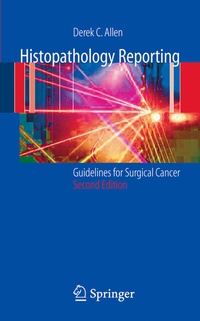
Histopathology Reporting
Guidelines for Surgical Cancer
2nd Edition
Published on 30. January 2007
XXXVI, 466 pages
978-1-84628-170-9 (ISBN)
Description

Many of the introductory comments in the ?rst edition of this book regarding the increasingly focused approach required of pathologists to surgical cancer histopathology reports still pertain. In the intervening period a number of trends have continued to develop that have required an update. system-speci?c cancer multidisciplinary meetings with specialized c- nicians and appropriate pathological, radiological and oncological support. Increasingly these meetings require fewer pathologists repo- ing signi?cant numbers of relevant cases rather than a large number of pathologists reporting them only sporadically. From this has arisen cancer-speci?c lead pathologists encompassing a spectrum of speci- ist differentiation from "monospecialists" to "generalists with an int- est in" and variations in between. Cancer report datasets aimed at maintaining overall standards of reporting are freely available p- lished by various bodies, viz the Royal College of Pathologists, the As- ciation of Directors of Anatomic and Surgical Pathology and the College of American Pathologists. In the UK the Royal College Datasets are a model for standardized reporting and their success is measured by their ongoing revision and second cycle of publication. No doubt specialist and team reporting will increase, particularly as the pa- meters for each cancer type report become more complex. Datasets with their notes and attendant information are required not only to update pathologists but also to keep them aware of signi?cant pat- logy in other areas that might impact on their own specialization, e. g. metastatic carcinoma.
Reviews / Votes
From reviews of the 1st edition: "... Derek Allen has set out to systematically collate all of the requirements necessary to formulate a comprehensive report for organ specific tumours across the whole range of malignant disease. This he achieves admirably. The result is a clear and concise handbook, which is very easy to use. ... a well-conceived and succinctly executed book." (Ashley Graham, ACP News. Spring 2002:40-41) "The author . has provided an easy-to-understand 'framework' for pathologists in their reporting of common surgical cancers. Tumours are grouped according to site and are dealt with in order of importance under the following headings: gross description, histological type, extent of local tumour spread, lymphovascular invasion, lymph nodes, excision margins, other pathology and other malignancy. As a pathologist I found this method useful, as it not only provides a step-by-step approach to the reporting of theses cases, but also continually reminds one of the ever-increasing number of facts required to do this task correctly. This is of particular value to the generalist having to deal with tumours outside of his or her field of knowledge." (John Davies, South African Journal of Surgery. 2002;40(2):82) "With the advent of multi-disciplinary groups and the increased use of novel immunohistochemical and molecular techniques that provide more accurate information about prognosis and response to treatment, not only has histopathological reporting become increasingly more complex, but there is an increasing need to standardize reporting to enable the clinician to select appropriate treatment and recruit patients to randomized clinical trials.The publication of this book is therefore timely. . It runs to almost 400 pages yet fits into the pocket of a white coat.This is an excellent book containing a wealth of information, clearly and thoughtfully laid out. It should appeal to awide range of trainee and established clinicians and pathologists. No surgical unit dealing with the management of cancer and no department of pathology should be without a copy." (CS McArdle, Annals of Oncology. 2001;12:1194) "Whether or not you are a box ticker and welcome the advent of the minimal data set proformas, prefer entirely free text, but need prompting to ensure you include all the essential parameters or favour standard outline template reports into which you insert the details of each particular case, you will find this book helpful. The wealth of information the book contains certainly justifies the price and the author is to be congratulated fro bringing together so much of practical relevance into such a handy volume." (Journal of Pathology. 2001;194(1):138-139) " The overall product is an extremely valuable guide to reporting cancers in histopathology laboratories. It is a particularly valuable resource in those sites where national organizations have not yet produced their own minimum data sets and guidelines. This book is the sort of invaluable reference that should be available in every histopathology laboratory and is likely to need regular replacement as it will experience accelerated wear due to the frequency with which it is referred to." (S Cross, Histopathology. 2001;38(3):276)More details
Series
Edition
2nd ed. 2006
Language
English
Place of publication
London
United Kingdom
Publishing group
Springer London
Target group
Professional and scholarly
Illustrations
XXXVI, 466 p. 140 illus.
File size
5,22 MB
ISBN-13
978-1-84628-170-9 (9781846281709)
DOI
10.1007/1-84628-170-9
Schweitzer Classification
Other editions
Additional editions
Book
07/2006
2nd Edition
Springer
€139.09
Article exhausted; check for reprint
Previous edition
E-Book
06/2013
1st Edition
Springer
€85.59
Available for download
Person
Content
Gastrointestinal Cancer.- Oesophageal Carcinoma.- Gastric Carcinoma.- Ampulla of Vater and Head of Pancreas Carcinoma.- Small Intestinal Carcinoma.- Colorectal Carcinoma.- Vermiform Appendix Tumours.- Anal Canal Carcinoma (with comments on pelvic exenteration).- Gall Bladder Carcinoma.- Extrahepatic Bile Duct Carcinoma.- Liver Carcinoma.- Head and Neck Cancer.- General Comments.- Lip and Oral Cavity Carcinoma.- Oropharyngeal Carcinoma (with comments on nasopharynx and hypopharynx).- Nasal Cavity and Paranasal Sinus Carcinoma.- Laryngeal Carcinoma.- Salivary Gland Tumours.- Thyroid Gland Tumours (with comments on parathyroid).- Respiratory and Mediastinal Cancer.- Lung Carcinoma.- Malignant Mesothelioma.- Mediastinal Cancer.- Skin Cancer.- Non-Melanocytic Skin Carcinoma.- Malignant Melanoma.- Breast Cancer.- Breast Carcinoma.- Gynaecological Cancer.- Ovarian Carcinoma (with comments on fallopian tube carcinoma).- Endometrial Carcinoma.- Cervical Carcinoma.- Vaginal Carcinoma.- Vulval Carcinoma.- Gestational Trophoblastic Tumours.- Urological Cancer.- Renal Cell and Renal Pelvis/Ureter Carcinoma.- Bladder Carcinoma.- Prostate Carcinoma.- Urethral Carcinoma.- Testicular Cancer.- Penile Carcinoma.- Lymph Node Cancer.- Nodal Malignant Lymphoma (with comments on extranodal lymphoma and metastatic cancer).- Bone and Soft Tissue Cancer.- Bone and Soft Tissue Sarcomas (with comments on retroperitoneum and adrenal gland).- Ophthalmic Cancer.- Intraocular Malignancy.- Extraocular Malignancy.
