

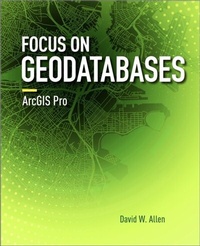
Focus on Geodatabases in ArcGIS Pro
Description

Focus on Geodatabases in ArcGIS Pro introduces readers to the geodatabase, the comprehensive information model for representing and managing geographic information across the ArcGIS platform.
Sharing best practices for creating and maintaining data integrity, chapter topics include the careful design of a geodatabase schema, building geodatabases that include data integrity rules, populating geodatabases with existing data, working with topologies, editing data using various techniques, building 3D views, and sharing data on the web. Each chapter includes important concepts with hands-on, step-by-step tutorials, sample projects and datasets, 'Your turn' segments with less instruction, study questions for classroom use, and an independent project. Instructor resources are available by request.
Note: This e-book requires ArcGIS software. You can download the ArcGIS Trial at http://www.esri.com/arcgis/trial, contact your school or business Esri Site License Administrator, or purchase a student or individual license through the Esri Store.
All prices
More details
Other editions
Additional editions
Person
David W. Allen has been working in the GIS field for over 35 years, the last 30 with the City of Euless, Texas, and has seen many versions of ArcInfo and ArcGIS come along since he started with version 5. He spent 18 years as an adjunct professor at Tarrant County College in Fort Worth, Texas, and now serves as the State Director of Operations for a volunteer emergency response group developing databases and templates. Mr. Allen is the author of GIS Tutorial 2: Spatial Analysis Workbook (Esri Press, 2016).
Content
Introduction
Chapter 1 Designing the geodatabase schema
Tutorial 1-1: Creating a geodatabase--building a logical model
Exercise 1-1
Tutorial 1-2: Creating a geodatabas--expanding the logical model
Exercise 1-2
Chapter 2 Creating a geodatabase
Tutorial 2-1: Building a geodatabase
Exercise 2-1
Tutorial 2-2: Adding complex geodatabase components
Exercise 2-2
Chapter 3 Populating and sharing a geodatabase
Tutorial 3-1: Loading data into a geodatabase
Exercise 3-1
Tutorial 3-2: Populating geodatabase subtypes
Exercise 3-2
Chapter 4 Extending data formats
Tutorial 4-1: Putting your data online
Exercise 4-1
Tutorial 4-2: Creating 3D scenes
Exercise 4-2
Chapter 5 Working with features
Tutorial 5-1: Creating new features
Exercise 5-1
Tutorial 5-2: Using context menu creation tools
Exercise 5-2
Chapter 6 Advanced editing
Tutorial 6-1: Exploring more creation tools
Exercise 6-1
Tutorial 6-2: Building feature templates
Exercise 6-2
Chapter 7 Working with topology
Tutorial 7-1: Working with map topology
Exercise 7-1
Tutorial 7-2:Working with geodatabase topology
Exercise 7-2
Index
