

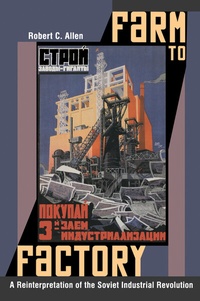
Farm to Factory
A Reinterpretation of the Soviet Industrial Revolution
1st Edition
Published on 8. September 2021
312 pages
978-1-4008-3255-2 (ISBN)
Description

To say that history's greatest economic experiment--Soviet communism--was also its greatest economic failure is to say what many consider obvious. Here, in a startling reinterpretation, Robert Allen argues that the USSR was one of the most successful developing economies of the twentieth century. He reaches this provocative conclusion by recalculating national consumption and using economic, demographic, and computer simulation models to address the "what if" questions central to Soviet history. Moreover, by comparing Soviet performance not only with advanced but with less developed countries, he provides a meaningful context for its evaluation.
Although the Russian economy began to develop in the late nineteenth century based on wheat exports, modern economic growth proved elusive. But growth was rapid from 1928 to the 1970s--due to successful Five Year Plans. Notwithstanding the horrors of Stalinism, the building of heavy industry accelerated growth during the 1930s and raised living standards, especially for the many peasants who moved to cities. A sudden drop in fertility due to the education of women and their employment outside the home also facilitated growth.
While highlighting the previously underemphasized achievements of Soviet planning, Farm to Factory also shows, through methodical analysis set in fluid prose, that Stalin's worst excesses--such as the bloody collectivization of agriculture--did little to spur growth. Economic development stagnated after 1970, as vital resources were diverted to the military and as a Soviet leadership lacking in original thought pursued wasteful investments.
Although the Russian economy began to develop in the late nineteenth century based on wheat exports, modern economic growth proved elusive. But growth was rapid from 1928 to the 1970s--due to successful Five Year Plans. Notwithstanding the horrors of Stalinism, the building of heavy industry accelerated growth during the 1930s and raised living standards, especially for the many peasants who moved to cities. A sudden drop in fertility due to the education of women and their employment outside the home also facilitated growth.
While highlighting the previously underemphasized achievements of Soviet planning, Farm to Factory also shows, through methodical analysis set in fluid prose, that Stalin's worst excesses--such as the bloody collectivization of agriculture--did little to spur growth. Economic development stagnated after 1970, as vital resources were diverted to the military and as a Soviet leadership lacking in original thought pursued wasteful investments.
More details
Other editions
Additional editions
Book
07/2009
Princeton University Press
€44.80
Shipment within 10-20 days
Book
10/2003
Princeton University Press
€68.09
Article exhausted; check different version
Person
Robert C. Allen is Professor of Economic History at Oxford University and a Fellow of the Royal Society of Canada. He is the author of Enclosure and the Yeoman.
Content
- Cover Page
- Half-title Page
- Title Page
- Copyright Page
- Dedication Page
- Contents
- List of Figures
- List of Tables
- Acknowledgments
- Chapter One: Soviet Development in World-Historical Perspective
- Part One: The Economy before Stalin
- Chapter Two: Economic Growth before 1917
- Chapter Three: The Development Problem in the 1920s
- Chapter Four: NEP Agriculture and Economic Development
- Part Two: Stalin's Industrial Revolution
- Chapter Five: Planning, Collectivization, and Rapid Growth
- Chapter Six: The Population History of the USSR
- Chapter Seven: The Standard of Living
- Chapter Eight: The Causes of Rapid Industrialization
- Chapter Nine: Preobrazhensky in Action
- Part Three: After Stalin
- Chapter Ten: The Soviet Climacteric
- Appendix A: Soviet National Income
- Appendix B: The Simulation Model of the Soviet Economy
- Appendix C: Data Sources
- Appendix D: The Demographic Databases and Simulation Model Used in Chapter 6
- Notes
- Bibliography
- Index
