

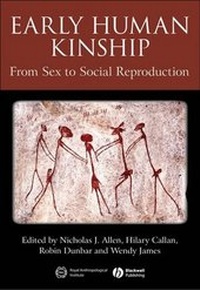
Early Human Kinship
From Sex to Social Reproduction
Published on 22. January 2009
336 pages
978-1-4443-0272-1 (ISBN)
Description

Early Human Kinship brings together original studies fromleading figures in the biological sciences, social anthropology,archaeology, and linguistics to provide a major breakthrough in thedebate over human evolution and the nature of society.
* A major new collaboration between specialists across the rangeof the human sciences including evolutionary biology andpsychology; social/cultural anthropology; archaeology andlinguistics
* Provides a ground-breaking set of original studies offering anew perspective on early human history
* Debates fundamental questions about early human society: Wasthere a connection between the beginnings of language and thebeginnings of organized 'kinship and marriage'? How far didevolutionary selection favor gender and generation as principlesfor regulating social relations?
* Sponsored by the Royal Anthropological Institute of GreatBritain and Ireland in conjunction with the British Academy
Reviews / Votes
"This is an important and timely volume, which in its multipleapproaches brings new questions to bear on a topic that is thebedrock of anthropology." Stanley Ulijaszek, University of Oxford "An international collection of leading figures in paleontology,linguistics, geography and anthropology consider the transitionfrom the biological kinship of primates to social kinship of modernhumans which also marks the transition to language and the socialcontrol of the environment." R.H. Barnes, University of Oxford "For too long, studies of the cultural and the genetic aspectsof kinship have proceeded in isolation from one another. Thisvolume marks the beginning of what promises to be a fruitfulconversation between evolutionary biology and socialanthropology." Daniel Nettle, Newcastle University "Early Human Kinship brings together exciting newperspectives from a range of human sciences. Useful for teaching,it will also encourage further cross-disciplinary research into theorigins of human kinship, and therefore of humanity itself." Robert Parkin, University of Oxford "This important book puts the study of kinship back in thecenter of deep history-exactly where nineteenth centuryanthropology first found it. Welcome back!" Thomas Trautmann, University of Michigan "In the middle of last century, Lévi-Strauss advanced thatour ancestors came out of their animal state as the result of two"big bangs". Symbolic thinking and language, heclaimed, suddenly appeared, and humans were then able to leave offbedding their sisters or their daughters, and instead exchange themfor other men's daughters. Thus the incest taboo and maledomination were sufficient to promote our ancestors from a state ofnature to one of culture. Today the authors of Early Human Kinshipshow that these "big bangs" never happened and that theancestors of modern humans shook off their original animal statethrough a series of transformations that began with the appearanceof Homo erectus and the domestication of fire (500,000 BP). It wasabove all the development of our ancestors' cognitivecapacities that enabled them to imagine and gradually to put intopractice various social forms of sexual intercourse and to decidethat the children born of these unions belonged to a given group ofadults considered to be their kin. Kinship relations have alwaysformed systems, but they have never been the only foundingprinciple of any society." Maurice Godelier, École des Hautes Études enSciences SocialesMore details
Other editions
Additional editions
Book
01/2011
Wiley
€45.00
Shipment within 10-20 days
Software
03/2009
Wiley-Blackwell
€88.84
No shipping information available
Book
06/2008
Wiley
€132.50
Shipment within 3-4 weeks
Persons
Nicholas J. Allen is Emeritus Fellow of Wolfson College,University of Oxford. He has published on the Himalayas, kinshiptheory, the Durkheimian School and Indo-European Comparativism. Hisbooks include Categories and Classifications (2000) andMarcel Mauss: A Centenary Tribute (1998).
Hilary Callan has been Director of the RoyalAnthropological Institute of Great Britain and Ireland since 2000.Her research and publications include work on biological and socialanthropology, occupational cultures, and gender, includingEthology and Society (1970)and The Incorporated Wife(edited with Shirley Ardener, 1984).
Wendy James was until recently Professor of SocialAnthropology at the University of Oxford, and is now EmeritusFellow of St Cross College, Oxford. She has carried outethnographic research in North East Africa, and her books includeWar and Survival in Sudan's Frontierlands: Voices from the BlueNile (2007) and The Ceremonial Animal: A New Portraitof Anthropology (2003).
Robin Dunbar is Professor of Evolutionary Anthropology,University of Oxford, and specializes in primate behaviour. He isco-director of the British Academy's Centenary Research Project('From Lucy to Language: The Archaeology of the Social Brain'). Heis the author or co-author of numerous books, including TheHuman Story (2004) and Evolutionary Psychology: A Beginner'sGuide (2005).
Content
List of Tables.
List of Figures.
List of Illustrations.
Preface.
Acknowledgements.
Notes on Contributors.
INTRODUCTION AND BACKGROUND.
Why 'Kinship'? New Questions on an Old Topic (WendyJames).
A Brief Overview of Human Evolution (John A. J. Gowlett andRobin Dunbar).
PART I Where and When: The Archaeological Evidence for EarlySocial Life in Africa.
1 Kinship and Material Culture: Archaeological Implications ofthe Human Global Diaspora (Clive Gamble).
2 Deep Roots of Kin: Developing the Evolutionary Perspectivefrom Prehistory (John A. J. Gowlett).
PART II Women, Children, Men - and the Puzzles ofComparative Social Structure.
3 Early Human Kinship Was Matrilineal (Chris Knight).
4 Alternating Birth Classes: A Note from Eastern Africa(Wendy James).
5 Tetradic Theory and the Origin of Human Kinship Systems(Nicholas J. Allen).
6 What Can Ethnography Tell Us about Human Social Evolution?(Robert Layton).
PART III Other Primates and the Biological Approach.
7 Kinship in Biological Perspective (Robin Dunbar).
8 The Importance of Kinship in Monkey Society (Amanda H.Korstjens).
9 Meaning and Relevance of Kinship in Great Apes (JuliaLehmann).
10 Grandmothering and Female Coalitions: A Basis for MatrilinealPriority? (Kit Opie and Camilla Power).
PART IV Reconstructions: Evidence from Cultural Practice andLanguage.
11 A Phylogenetic Approach to the History of Cultural Practices(Laura Fortunato).
12 Reconstructing Ancient Kinship in Africa (ChristopherEhret).
13 The Co-evolution of Language and Kinship (AlanBarnard).
EPILOGUE.
Reaching across the Gaps (Hilary Callan).
Appendices to Chapter 12.
Bibliography.
Index.
