

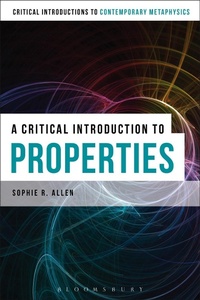
A Critical Introduction to Properties
1st Edition
Published on 25. February 2016
256 pages
978-1-4725-7557-9 (ISBN)
Description

What do blue things have in common? Or electrons? Or planets? Distinct things appear to share properties; but what are properties and what is the best philosophical account of them? A Critical Introduction to Properties introduces different ontological accounts of properties, exploring how their formulation is shaped by the explanatory demands placed upon them.
This accessible introduction begins with a discussion of universals, tropes, sets and resemblance classes, the major objections to them and their responses, providing readers with a firm grasp on the competing ontological accounts of what (if anything) grounds similarity and difference. It then explores issues concerning the formulation and justification of property theories such as: how many properties are there? Should we accept a sparse ontology of properties, or an abundant one? Can we make a distinction between intrinsic and extrinsic properties? Do properties have their causal roles necessarily? What is the relationship between properties and other metaphysical phenomena such as causality, laws and modality? These questions get to the heart of why a coherent theory of properties is so important to metaphysics, and to philosophy more generally.
By concluding with the question of the ontological status of properties, the reader is introduced to some Carnapian and contemporary themes about the content and methodology of metaphysics. For students looking for an accessible resource and a more comprehensive understanding of contemporary metaphysics, A Critical Introduction to Properties is a valuable starting point.
This accessible introduction begins with a discussion of universals, tropes, sets and resemblance classes, the major objections to them and their responses, providing readers with a firm grasp on the competing ontological accounts of what (if anything) grounds similarity and difference. It then explores issues concerning the formulation and justification of property theories such as: how many properties are there? Should we accept a sparse ontology of properties, or an abundant one? Can we make a distinction between intrinsic and extrinsic properties? Do properties have their causal roles necessarily? What is the relationship between properties and other metaphysical phenomena such as causality, laws and modality? These questions get to the heart of why a coherent theory of properties is so important to metaphysics, and to philosophy more generally.
By concluding with the question of the ontological status of properties, the reader is introduced to some Carnapian and contemporary themes about the content and methodology of metaphysics. For students looking for an accessible resource and a more comprehensive understanding of contemporary metaphysics, A Critical Introduction to Properties is a valuable starting point.
More details
Series
Edition
1. Auflage
Language
English
Place of publication
London
United Kingdom
Publishing group
Bloomsbury Publishing PLC
Target group
Professional and scholarly
College/higher education
ISBN-13
978-1-4725-7557-9 (9781472575579)
Copyright in bibliographic data and cover images is held by Nielsen Book Services Limited or by the publishers or by their respective licensors: all rights reserved.
Schweitzer Classification
Other editions
Additional editions
Sophie Allen
A Critical Introduction to Properties
Book
02/2016
Bloomsbury Academic
€54.00
Shipment within 15-20 days
Person
Sophie R. Allen is Supernumerary Fellow in Philosophy at Harris Manchester College, and Philosophy Lecturer at St Peter's College, University of Oxford, UK
Content
1. Introduction
PART I: QUESTIONS OF ONTOLOGY
2. Universals
3. Tropes
4. Properties as Sets
5. Resemblance Classes
6. Properties as Ungrounded Entities
PART II: DIFFERENT ACCOUNTS OF PROPERTIES:WHICH PROPERTIES ARE THERE, AND WHAT CAN THEY DO?
7. Properties at Work
8. Are Properties Sparse or Abundant?
9. The Ontological Status of Properties
Conclusion
Glossary
References
Index
PART I: QUESTIONS OF ONTOLOGY
2. Universals
3. Tropes
4. Properties as Sets
5. Resemblance Classes
6. Properties as Ungrounded Entities
PART II: DIFFERENT ACCOUNTS OF PROPERTIES:WHICH PROPERTIES ARE THERE, AND WHAT CAN THEY DO?
7. Properties at Work
8. Are Properties Sparse or Abundant?
9. The Ontological Status of Properties
Conclusion
Glossary
References
Index
