

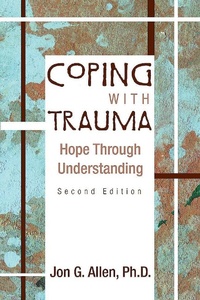
Coping With Trauma
Description

Combining years of research, teaching, and experience treating trauma survivors, Dr. Jon G. Allen offers compassionate and practical guidance to understanding trauma and its effects on the self and relationships. Coping With Trauma is based on more than a decade of Dr. Allen's experience conducting educational groups for persons struggling with psychiatric disorders stemming from trauma. Written for a general audience, this book does not require a background in psychology. Readers will gain essential knowledge to embark on the process of healing from the complex wounds of trauma, along with a guide to current treatment approaches.
In this supportive and informative work, readers will be introduced to and encouraged in the process of healing by an author who is both witness and guide. This clearly written, insightful book not only teaches clinicians about trauma but also, equally important, teaches clinicians how to educate their patients about trauma.
Reshaped by recent developments in attachment theory, including the importance of cumulative stress over a lifetime, this compelling work retains the author's initial focus on attachment as he looks at trauma from two perspectives. From the psychological perspective, the author discusses the impact of trauma on emotion, memory, the self, and relationships, incorporating research from neuroscience to argue that trauma is a physical illness. From the psychiatric perspective, the author discusses various trauma-related disorders and symptoms: depression, posttraumatic stress disorder, and dissociative disorders, along with a range of self-destructive behaviors to which trauma can make a contribution.
Important updates include substantive and practical information on ¿ Emotion and emotion regulation, prompted by extensive contemporary research on emotion -- which is becoming a science unto itself.¿ Illness, based on current developments in the neurobiological understanding of trauma.¿ Depression, a pervasive trauma-related problem that poses a number of catch-22s for recovery.¿ Various forms of self-destructiveness -- substance abuse, eating disorders, and deliberate self-harm -- all construed as coping strategies that backfire.¿ Suicidal states and self-defeating aspects of personality disorders.
The author addresses the challenges of healing by reviewing strategies of emotion regulation as well as a wide range of sound treatment approaches. He concludes with a new chapter on the foundation of all healing: maintaining hope.
This exceptionally comprehensive overview of a wide range of traumatic experiences, written in nontechnical language with extensive references to both classic and contemporary theoretical, clinical, and research literature, offers a uniquely useful guide for victims of trauma, their family members, and mental health care professionals alike.
More details
Other editions
Additional editions
Person
Content
About the AuthorForewordPrefaceIntroductionA Guide to Reading This BookPart I: FOUNDATIONSChapter 1. TraumaChapter 2. AttachmentPart II: EFFECTS OF TRAUMAChapter 3. EmotionChapter 4. MemoryChapter 5. SelfChapter 6. RelationshipsChapter 7. IllnessPart III: TRAUMA-RELATED PSYCHIATRIC DISORDERSChapter 8. DepressionChapter 9. Posttraumatic Stress DisorderChapter 10. Dissociative DisordersChapter 11. Self-DestructivenessPart IV: HEALINGChapter 12. Emotion RegulationChapter 13. Treatment ApproachesChapter 14. HopeGlossaryReferencesSuggested ReadingsIndex
