

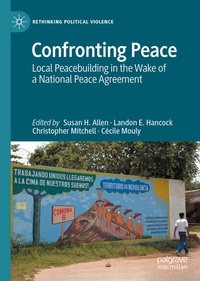
Confronting Peace
Description

Most recent works about the efforts of local communities caught up in a civil war have focused on their efforts to remain places of security and safety from the violence that surrounds them-neutral peace communities or zones. This book, in contrast, focuses on local peace communities facing new challenges and opportunities once a peace agreement has been signed at the national level, such as those in South Africa, the Philippines, Burundi, East Timor, Sierra Leone, and the present peace process in Colombia between the FARC and the Colombian Government. The communities' task is to make a stable and durable peace in the aftermath of a violent civil war and a deal on which local people have usually had little or no influence. Such agreements seek to involve them in both short and longer term peace-building, and expect local communities to cope with problems of armed ex-combatants, IDPs and refugees, law and order in the absence of much state presence, high unemployment and the need for widespread and massive reconstruction of physical infrastructure damaged or destroyed during the war. How local communities have coped with the demands of "peace" is thus the theme that runs through each of these individual chapters, written by authors with direct experience of grassroots communities struggling with such "problems of peace."
Reviews / Votes
"This fourth in a series of studies on the relationship between national and local level peacebuilding strategies is fundamental reading for scholars interested in what happens at the local level after a national peace agreement has been signed. A diverse group of pracademics in the peace sector from around the world reflect on how the problems that arise from national level peace differ from those confronting local communities. The editors provide a carefully cogent analysis of the case studies presented in order to give readers a highly applied, thorough and useful guide to the challenges and possibilities available to local actors in a post-agreement context."- Pamina Firchow , Associate Professor of Conflict Resolution and Coexistence at Brandeis University's Heller School for Social Policy and Management, USA
"The wider field of peace and conflict studies has long confronted the challenge of ending wars. After thirty years of research tracking negotiations, mediation and agreements, perhaps nothing is more urgent than better understanding of the realities captured in this book. The challenge of confronting peace. The authors and the approach give the volume a deep legitimacy, as the key in this effort requires us to understand the specific processes and innovations needed to bolster and face the many faceted developments that emerge in the aftermath of peace processes and accords. These reflections, research and proposed recommendations offer empirical evidence and grounded learning for improving the chances that social and political transitions can offer both the hope of ending war and of solidifying the changes needed to sustain a more robust peace."
- John Paul Lederach , Professor Emeritus, University of Notre Dame, USA
"This book, with its impressive weaving together of peace practice and research, points to a potential new wave in conflict analysis and engagement - making peace with conflict. That is, as the case studies in this book amply illustrate, "post" conflict peacemaking is rarely about the end of conflict. Rather, as illustrated in two main "negative" case studies, where peace agreements have so far failed to hold (in Colombia and the Philippines) and other cases of failed peace, seeking and pursuing peace in the face of ongoing conflict is about the daily engagement and commitment of local communities. This is a brave text about the benefits and perils if peace."
- Jay Rothman , President, the ARIA Group, USA and Israel
More details
Other editions
Additional editions
Persons
Susan Allen is Director of the Center for Peacemaking Practice at the Jimmy and Rosalynn Carter School for Peace and Conflict Resolution at George Mason University, USA, where she is an Associate Professor teaching action research, reflective practice, evaluation and other ways of blending research and practice in the conflict resolution field. Dr. Allen holds an M.S. and Ph.D. from the same institution in Conflict Analysis and Resolution.
Landon Hancock is Professor at Kent State University's School of Peace and Conflict Studies, USA, and Affiliated Faculty at Kyung Hee University's Graduate Institute of Peace Studies, South Korea, and the Program for the Prevention of Mass Violence at George Mason University's Jimmy & Rosalynn Carter School for Peace and Conflict Resolution, USA. His research focuses the role of ethnicity and identity in conflict generation, dynamics, resolution and post-conflict efforts in transitional justice. This is coupled with an interest in grassroots peacebuilding, zones of peace and the role of agency in the success or failure of peacebuilding efforts. He is co-editor (with Christopher Mitchell) of Zones of Peace (2007), Local Peacebuilding and National Peace (2012) and Local Peacebuilding and Legitimacy (2018).
Christopher Mitchell is Emeritus Professor of Conflict Research at George Mason University's Carter School, USA. He works on the practical and theoretical aspects of peace making, and has published books and articles on conflict resolution, and on ending asymmetric conflicts. He has recently co-edited three books about grassroots peacebuilding with Landon Hancock, the latest of which, Legitimacy and Local Peace-building [Routledge] was published in Spring 2018. His retrospective text book, The Nature of Intractable Conflict , was published in Spanish as La Naturaleza de los Conflictos Intratables [Edicions Bellaterra] in 2016.
CécileMouly is Research Professor at FLACSO Ecuador and their Coordinator of the research group in Peace and Conflict. She is also a practitioner and as teaches postgraduate courses and practitioner trainings on conflict analysis, conflict transformation and peacebuilding. She is a resource person in "Conflict Prevention: Analysis for Action" for the UN System Staff College and a member of the academic council of the International Center on Nonviolent Conflict. She currently collaborates with the Colombian truth commission. Her research focuses on the role of civil society in peacebuilding, peace processes, civil resistance in the context of armed conflict and the social reintegration of former combatants.
