

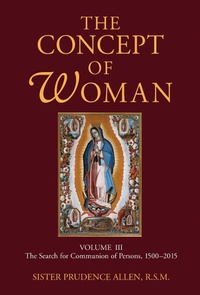
Concept of Woman, Volume 3
The Search for Communion of Persons, 1500-2015
Published on 5. January 2017
493 pages
978-1-4674-4593-1 (ISBN)
Description

The culmination of a lifetime's scholarly work, this pioneering study by Sister Prudence Allen traces the concept of woman in relation to man in Western thought from ancient times to the present. In her third and final volume Allen covers the years 1500-2015, continuing her chronological approach to individual authors and also offering systematic arguments to defend certain philosophical positions over against others. Building on her work from Volumes I and II, Allen draws on four "communities of discourse"-Academic, Humanist, Religious, and Satirical-as she traces several recurring strands of sex and gender identity from the Renaissance to the present. Now complete, Allen's magisterial study is a valuable resource for scholars and students in the fields of women's studies, philosophy, history, theology, literary studies, and political science.
More details
Other editions
Additional editions
Book
01/2017
William B Eerdmans Publishing Co
€59.10
Shipment within 15-20 days
Person
Professor of philosophy at St. John Vianney TheologicalSeminary, Denver Colorado. She has spent more thantwenty-five years engaged in research on the concept ofwoman in relation to the concept of man in philosophy.
Content
- Intro
- Title Page
- Copyright
- Contents
- CHRONOLOGICAL TABLES
- Chronological Table of Authors for Volume 3
- Chronological Table of Authors for Volume 2
- Chronological Table of Authors for Volume 1
- ILLUSTRATIONS
- LIST OF TABLES
- ACKNOWLEDGMENTS
- INTRODUCTION
- Method of Approach
- The Meaning of Sex and Gender in This Book
- Can Integral Gender Complementarity Be Proven? Newman's Notion of Proof
- Two Original Ideas Essential to Integral Gender Complementarity and Their Development Described in The Concept of Woman I
- Identity of First Original Type: Aristotle's Soul/Body Composite Unity of a Woman or a Man
- Identity of Second Original Type: Augustine's Complementarity of Woman and Man in Heaven
- First Developments of the Two Original Types with Preservation of Type, Continuity of Principles, and Assimilative Power of These Living Ideas
- Hildegard of Bingen's Complementarity of Woman and Man in the World
- Thomas Aquinas's Soul/Body Composite Unity Expands Soul as Form and Spirit
- Conservative Action of Original Type on Its Past with Corruption Tending to Its Destruction Described in The Concept of Woman II
- Satires Devalue Women While Humanist Dialogues of Complementarity Spring Up
- Christine de Pizan's Vigorous Defense of Complementarity against Corrupt Satirical Devaluations of Woman
- The Structure of Volume 3
- 1. ENGENDERED IDENTITIES IN RELIGIOUS EVENTS AND AUTHORS
- Isabella of Portugal (1451-1504)
- Two Religious Events at the Beginning of the Modern Era
- The Pregnant Woman: Mary of Guadalupe (1531)
- The Crucified Man: The Shroud of Turin (1535)
- Summary and Comparison of the Tilma and the Shroud
- Women in the Later Humanist Reformation
- The Reformers and Women's Obedience in Marriage
- Saint Thomas More (1478-1535) and His Daughter Margaret (1505-1544)
- Unisex Model of Education
- Conscience in the Context of Violence and Hatred
- Saint Margaret Clitherow (c. 1553-1586) and Her Children
- Fragmentation in Communion and Person
- Women in the Counter-Reformation
- Saint Catherine of Genoa (1447-1510)
- The Carmelite Age
- Saint Teresa of Ávila (1518-1582)
- Saint John of the Cross (1542-1591)
- Further Research on Religious Women in the New World
- Integration in Person and Communion
- 2. WOMAN'S IDENTITY IN ACADEMIC AND LATER HUMANIST TEXTS
- The Beginning of Reverse Sex and Gender Polarity Arguments
- Baldassare Castiglione, The Book of the Courtier (1528)
- Henricus Cornelius Agrippa, Declamation on the Nobility and Preeminence of the Female Sex (1529)
- Sir Thomas Elyot, The Defence of Good Women (1540)
- Moderata Fonte, The Worth of Women: Wherein Is Clearly Revealed Their Nobility and Their Superiority to Men (1600)
- Lucrezia Marinella, The Nobility and Excellence of Women and the Defects and Vices of Men (1601)
- Argument from Nouns, Nature, and Essence
- Arguments from Causes
- On the Nature and Essence of the Female Sex
- Marinella's Critique of Renaissance Aristotelians
- Marinella's Gathering of Women Philosophers
- Summary of Reverse Sex and Gender Polarity Arguments
- Satires Consider Women, Masculinity, and Femininity
- Valens Acidalius, A New Disputation against Women, Which Proves That They Are Not Human (1595)
- Simon Gediccus, Defense of the Female Sex (1595)
- Elena (Suor Arcangela) Tarabotti, That Women Are of the Same Species as Men: A Defense of Women (1651)
- Dorothy Sayers, "Are Women Human?" and "The Human-Not-Quite-Human" (1938)
- Joseph Swetnam, Haec Vir/Hic Mulier/Muld Sacke (1620)
- Joseph (Thomas) Swetnam Accused in the Querelle des femmes
- Hic Mulier: or, The Man-Woman: Being a Medicine to cure the Coltish Disease of the Staggers in the Masculine-Feminines of our Times. Expressed in a brief Declamation (1620)
- Haec-Vir: Or The Womanish-Man: Being an answere to a late Book intituled Hic-Mulier (1620)
- Muld Sacke, or The Apologie of Hic Mulier (1620)
- New Types of Satires about Women
- 3. GENDER IDENTITY AND THE COPERNICAN REVOLUTION IN MACROCOSM AND MICROCOSM
- Woman and Generation in the Macrocosm
- Astronomy Overturns Aristotelian Theory of Heavy Passive "Mother" Earth
- Nicolaus Copernicus (1473-1543): The Triple Motion of Earth
- Galileo Galilei (1564-1645): Ennobling Mother Earth
- Johannes Kepler (1571-1630): Attraction of Earth to Father Sun
- Displacement of Gender in Cosmic Theories of Generation
- Women and Generation in the Microcosm
- Anatomy Overturns Aristotelian Theory of Lack of Female Seed
- Leonardo da Vinci (1452-1519)
- Andreas Vesalius (1514-1564)
- Hieronymus Fabricius (1533-1619)
- William Harvey (1578-1657)
- Aristotelian Sex Ideology Persists in Public Debate in England
- Sir Thomas Browne (1605-1682)
- Sir Kenelm Digby (1603-1665)
- Alexander Ross (1591-1654)
- Nathaniel Highmore (1613-1685)
- The Microscope Confirms the Existence and Nature of Female Seed and Male Seed
- Displaced Sex Ideology Inverts the Copernican Revolution in Gender Identity
- 4. THE CARTESIAN REVOLUTION IN SEX AND GENDER IDENTITY
- Descartes and Women Philosophers
- René Descartes (1596-1650)
- Life and Relations
- Dualistic Fragmentation of Mind and Body
- Rejection of Form
- Women Philosophers Engage with Descartes's Dualism
- Elisabeth of Bohemia (1618-1680)
- Anne Finch Conway (1631-1679)
- Margaret (Lucas) Cavendish, Duchess of Newcastle (1623-1673)
- Implicit Counter-Reformation in Integral Sex and Gender Complementarity
- Modern Redefinition or Rejection of Form and New Problems of Women's Identity
- Effects of Cartesian Philosophy on the Concept of Woman
- Cartesian Unisex Rationale for Women's Higher Education
- The Precursors
- The Cartesians
- Cartesian Unisex Rationale for Women's Rights to Citizenship
- Theorists of the French Revolution
- Women Activists of the French Revolution
- The Gift of the Carmelite Martyrs
- The Flight from Woman Controversy
- Karl Stern and the Cartesian "Flight" from Women
- The Cartesian "Masculinization" of Thought and the Feminist Fallacy
- The Transcendental Argument against Descartes
- Descartes's Complex Legacy for the Concept of Woman
- 5. POST-CARTESIAN BATTLE OVER SEX AND GENDER IDENTITY
- Post-Cartesian Rise of Fractional Complementarity with Hidden Polarity
- Jean-Jacques Rousseau (1712-1778)
- Immanuel Kant (1724-1804)
- Other Post-Kantian Proponents of Fractional Complementarity
- Reform Critiques of Fractional Complementarity with Polarity
- Theodor Gottlieb von Hippel (1741-1796)
- John Stuart Mill (1806-1873)
- New Forms of Sex and Gender Polarity in the Fields of Psychology
- Sigmund Freud (1856-1939)
- Carl Jung (1875-1961)
- New Vigor for the Living Idea of Integral Complementarity of Men and Women
- True development of soul/body unity and gender complementarity
- Dietrich von Hildebrand (1889-1977)
- Bernard Lonergan, SJ (1904-1984)
- Raïssa Maritain (1883-1960) and Jacques Maritain (1882-1973)
- Edith Stein (Sr. Teresa Benedicta of the Cross) (1891-1942)
- Gertrud von le Fort (1876-1971)
- Gabriel Marcel (1889-1973)
- Emmanuel Mounier (1905-1950)
- 6. SEX AND GENDER POLARITY AND IDEOLOGY IN CONFLICT WITH INTEGRAL SEX AND GENDER COMPLEMENTARITY
- New Forms of Traditional and Reverse Sex and Gender Polarities
- Jean-Paul Sartre (1905-1980)
- Simone de Beauvoir (1908-1985)
- Mary Daly (1928-2010)
- Summary of the Corruptions of Person and Relations
- The Rise of Sex and Gender Ideologies
- Alfred Kinsey (1894-1956) and Sex Ideology
- John Money (1921-2006) and Gender Ideology
- Michel Foucault (1926-1984)
- Summary of Beginning of Sex and Gender Ideologies
- Gender Ideology Goes Viral
- Margaret Mead (1901-1978)
- Kate Millett (1934-) and Other Feminist Writers of Textbooks
- Gayle Rubin (1949-)
- Spread of Gender Ideology, Postmodernists, UN Conferences
- Mapping and Attacking the Gender Ideology Virus
- Mary Ann Glendon (b. 1938)
- Dale O'Leary (1941-)
- Marguerite A. Peeters
- Contributions to Twentieth- and Twenty-First-Century Integral Gender Complementarity
- Hans Urs von Balthasar (1905-1988)
- W. Norris Clarke, SJ (1915-2008)
- Alice von Hildebrand (1923-)
- Gertrude Elizabeth M. Anscombe (1919-2001)
- Mieczyslaw Albert Krapiec, OP (1921-2008)
- Summary of Continuing Contributions
- 7. SAINT KAROL WOJTYLA/JOHN PAUL II: FOUNDER OF INTEGRAL GENDER COMPLEMENTARITY
- Karol Wojtyla (1920-1978): Philosopher of Integral Complementarity
- Pathways of Wojtyla's Approach to Woman's Identity
- Wojtyla's Significant Differentiation of Woman and Man
- Thomistic Personalism, Vatican II, Acting Person, and Mary
- The Human Person as Man/Male/Masculine and Woman/Female/Feminine
- Marriage and Family as Communion of Persons
- John Paul II (1978-2005): Apostle of Integral Complementarity
- Woman and Man at the Beginning of Time
- Equal Dignity of Women and Men
- Woman/Female/Feminine Differentiated from Man/Male/Masculine
- Synergetic Relations in Maternity and Paternity
- Fallen Woman and Man in the World of Time
- Healing the Ruptures in Time and Eternity
- Mutual Submission of Women and Men
- The Genius of Women and of Men
- Christian Humanism and New Feminism
- Finding the Communion of Persons
- CONCLUSION
- Unisex Models in Conflict with "Soul/Body Composite Identity" of a Woman and a Man
- Continuity in the Development of Integral Gender Complementarity
- Preserve the Identity and Continuity of Principles in the Type from Beginning to End
- Capacity for Assimilating Dogmatic Truth and Fidelity in Logical Sequential Development
- Cartesian Sources of the Equality of Woman and Man in a Unisex Theory
- Science and the Recovery of Aristotelianism/Thomism
- The Carmelite Age in Contributions to the Concept of Woman
- The Chronic Vigor of the Integral Complementarity of Woman and Man
- BIBLIOGRAPHY
- INDEX
