

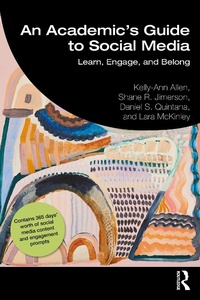
An Academic's Guide to Social Media
Learn, Engage, and Belong
1st Edition
Published on 30. November 2022
146 pages
978-1-000-77630-0 (ISBN)
Description

Are you an academic who struggles to know what to post on social media and how to disseminate your research effectively on different social media platforms?
Social media serves as a powerful communication tool, yet while most academics are aware of the benefits of social media, many are unsure of what to post, and how to do it in a way that is authentic, engaging, and above all, comfortable! This user-friendly practical guide is designed for all academics who aim to engage in social media platforms in an effective and productive way. This book explains how academics can build their reputation, develop networks, and disseminate their research. It includes 365 useful post prompts applicable to all mainstream social media platforms which help guide academics on what to post on the platforms they choose to engage with.
The book is designed for all academics at all levels and can be applied across various social media platforms including Facebook, Linkedin, Twitter, and Instagram.
Social media serves as a powerful communication tool, yet while most academics are aware of the benefits of social media, many are unsure of what to post, and how to do it in a way that is authentic, engaging, and above all, comfortable! This user-friendly practical guide is designed for all academics who aim to engage in social media platforms in an effective and productive way. This book explains how academics can build their reputation, develop networks, and disseminate their research. It includes 365 useful post prompts applicable to all mainstream social media platforms which help guide academics on what to post on the platforms they choose to engage with.
The book is designed for all academics at all levels and can be applied across various social media platforms including Facebook, Linkedin, Twitter, and Instagram.
More details
Edition
1. Auflage
Language
English
Place of publication
London
United Kingdom
Publishing group
Taylor & Francis Ltd
Target group
College/higher education
Professional and scholarly
Illustrations
9 Tables, black and white; 18 Halftones, black and white; 18 Illustrations, black and white
ISBN-13
978-1-000-77630-0 (9781000776300)
Copyright in bibliographic data and cover images is held by Nielsen Book Services Limited or by the publishers or by their respective licensors: all rights reserved.
Schweitzer Classification
Other editions
Additional editions
Kelly-Ann Allen | Shane R. Jimerson | Daniel S. Quintana
An Academic's Guide to Social Media
Learn, Engage, and Belong
Book
11/2022
1st Edition
Routledge
€185.50
Shipment within 10-20 days
Kelly-Ann Allen | Shane R. Jimerson | Daniel S. Quintana
An Academic's Guide to Social Media
Learn, Engage, and Belong
Book
11/2022
1st Edition
Routledge
€40.40
Shipment within 10-20 days
Persons
Kelly-Ann Allen, PhD, FAPS, is an associate professor and Educational and Developmental Psychologist in the School of Educational Psychology and Counselling, Faculty of Education, Monash University and an Honorary Principal Fellow at the Centre for Wellbeing Science, University of Melbourne.
Shane R. Jimerson, PhD, NCSP, is a professor at the University of California, Santa Barbara in the Department of Counseling, Clinical, and School Psychology.
Daniel S. Quintana, PhD, is a psychological scientist at the Department of Psychology at the University of Oslo, and the Norwegian Centre of Expertise for Neurodevelopmental Disorders and Hypersomnias at Oslo University Hospital.
Lara McKinley is an award-winning content producer and social media manager at the Faculty of Education, Monash University.
Shane R. Jimerson, PhD, NCSP, is a professor at the University of California, Santa Barbara in the Department of Counseling, Clinical, and School Psychology.
Daniel S. Quintana, PhD, is a psychological scientist at the Department of Psychology at the University of Oslo, and the Norwegian Centre of Expertise for Neurodevelopmental Disorders and Hypersomnias at Oslo University Hospital.
Lara McKinley is an award-winning content producer and social media manager at the Faculty of Education, Monash University.
Content
Part I. Getting Started 1. Social Media use in the academy: The positives and pitfalls 2. Choosing your social media platform 3. The Twitter rule book Part II. Social media content and engagement prompts for busy academics 4. 365 social media content and engagement prompts: #SocialAcademics Part III. Taking a deeper dive 5. Maintaining a social media presence 6. Controlling the trolls and other online misadventures 7. Ethical standards for social media use by academics 8. The future is bright for academics 9. Frequently asked questions about social media use in academia 10. The final word on using social media successfully
