

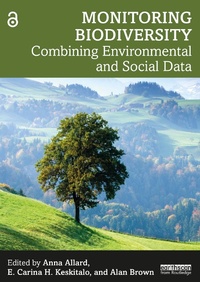
Monitoring Biodiversity
Combining Environmental and Social Data
1st Edition
Published on 17. March 2023
416 pages
978-1-000-84063-6 (ISBN)
Description

This book is an exciting reappraisal of the role and practice of biodiversity monitoring, showing how new technologies and software applications are rapidly maturing and can both complement and maintain continuity with the best practice in traditional field skills.
Environmental monitoring is a key component in a large number of national programmes and constitutes an important aspect of understanding environmental change and supporting policy development. Taking an interdisciplinary approach, Monitoring Biodiversity begins by discussing monitoring as an established field and examines the various budgetary and technological challenges. It examines different methodologies, the variation between countries, and the design features relevant to understanding monitoring systems created for new policy goals or different funding situations. The huge variety of methods revealed across 18 chapters, which vary from statistical designs to remote sensing, interviews, surveys, and new ways of stacking and combining data and thematic information for visualization and modelling, underlines just how mature and multifaceted the modern practice of monitoring can be. It concludes with several problem-based chapters that discuss the design and implementation of environmental monitoring in specific scenarios such as urban and aquatic areas. All chapters include key messages, study questions, and further reading.
With a focus on Europe but with international relevance, Monitoring Biodiversity will be an essential resource for students at all levels of environmental monitoring, assessment, and management.
Environmental monitoring is a key component in a large number of national programmes and constitutes an important aspect of understanding environmental change and supporting policy development. Taking an interdisciplinary approach, Monitoring Biodiversity begins by discussing monitoring as an established field and examines the various budgetary and technological challenges. It examines different methodologies, the variation between countries, and the design features relevant to understanding monitoring systems created for new policy goals or different funding situations. The huge variety of methods revealed across 18 chapters, which vary from statistical designs to remote sensing, interviews, surveys, and new ways of stacking and combining data and thematic information for visualization and modelling, underlines just how mature and multifaceted the modern practice of monitoring can be. It concludes with several problem-based chapters that discuss the design and implementation of environmental monitoring in specific scenarios such as urban and aquatic areas. All chapters include key messages, study questions, and further reading.
With a focus on Europe but with international relevance, Monitoring Biodiversity will be an essential resource for students at all levels of environmental monitoring, assessment, and management.
More details
Edition
1. Auflage
Language
English
Place of publication
London
United Kingdom
Publishing group
Taylor & Francis Ltd
Target group
College/higher education
Illustrations
25 Tables, black and white; 45 Line drawings, black and white; 46 Halftones, black and white; 91 Illustrations, black and white
File size
39,26 MB
ISBN-13
978-1-000-84063-6 (9781000840636)
Copyright in bibliographic data and cover images is held by Nielsen Book Services Limited or by the publishers or by their respective licensors: all rights reserved.
Schweitzer Classification
Other editions
Additional editions
Anna Allard | E. Carina H. Keskitalo | Alan Brown
Monitoring Biodiversity
Combining Environmental and Social Data
Book
03/2023
1st Edition
Routledge
€187.40
Shipment within 10-20 days
Anna Allard | E. Carina H. Keskitalo | Alan Brown
Monitoring Biodiversity
Combining Environmental and Social Data
Book
03/2023
1st Edition
Routledge
€56.40
Shipment within 10-20 days
Persons
Anna Allard is researcher in the Division of Landscape Analysis, Swedish University of Agricultural Sciences. She has worked for many years in national monitoring of biodiversity on the landscape scale, in several ongoing monitoring schemes including seashores and mountains as well as national digital vegetation mapping. Her expertise is in landscape ecology and analysis of the landscape and vegetation by remote sensing.
E. Carina H. Keskitalo is professor of political science in the Department of Geography, Umea University, and a guest researcher at the Swedish University of Agricultural Sciences. She has published widely on forest and natural resource policy and use applying qualitative methods.
Alan Brown has worked for one of the UK nature conservation agencies as the senior remote sensing manager, previously as the lead on terrestrial monitoring. His professional background is in upland ecology, vegetation survey and monitoring, computer programming, and multivariate and statistical analysis.
E. Carina H. Keskitalo is professor of political science in the Department of Geography, Umea University, and a guest researcher at the Swedish University of Agricultural Sciences. She has published widely on forest and natural resource policy and use applying qualitative methods.
Alan Brown has worked for one of the UK nature conservation agencies as the senior remote sensing manager, previously as the lead on terrestrial monitoring. His professional background is in upland ecology, vegetation survey and monitoring, computer programming, and multivariate and statistical analysis.
Content
1. Monitoring biodiversity: - combining environmental and social data
E. Carina H. Keskitalo, Anna Allard, and Alan Brown
2. Monitoring as a field
Anna Allard, Claire Wood, Lisa Norton, Andreas Aagard Christensen, Veerle Van Eetvelde, Alan Brown, Henrik Persson, and Louise Eriksson
3. Demands on monitoring
Anna Allard, Santiago Guerrero, Andreas Aagaard Christensen, Armin Benzler, Magnus Appelberg, Goeran Stahl, and Mats Sandewall
4. Designing monitoring systems
Asa Ranlund, Anton Grafstroem, Alan Brown, Henrik Hedenas, and Gregor Levin
5. Data collected in situ: unique details or integrated components of monitoring schemes
Anna Allard, Alan Brown, Clive Hurford, Christian Isendahl, Andreas Hilpold, Ulrike Tappeiner, Julia Strolb, and Henrik Hedenas
6. Citizen Science: data collection by volunteers
Anders Bryn, Rene Van Der Wal, Lisa Norton, and Tim Hofmeester
7. Remote sensing and Earth observation systems
Mats Nilsson, Jonas Ardoe, Mats Soederstroem, Anna Allard, Alan Brown, and Luke Webber
8. New and changing use of technologies in monitoring: drones, artificial intelligence, and environmental DNA
Anna Allard, Luke Webber, Jonas Hentati Sundberg, and Alan Brown
9. Managing hybrid methods for integration and combination of data
Anna Allard, Andreas Aagaard Christensen, Alan Brown, and Veerle Van Eetvelde
10. Social data: what exists in reporting schemes for different land systems?
Claire Wood, Mats Sandewall, Stefan Sandstroem, Goeran Stahl, Anna Allard, Andreas Eriksson, Christian Isendahl, and Lisa Norton
11. Understanding the social context of monitoring
E. Carina H. Keskitalo and Gun Lidestav
12. Register data as a resource for analysis
Urban Lindgren and Einar
13. Survey questionnaires: data collection for understanding management conditions
Kerstin Westin, Claire Wood, Ursa Vilhar, and Marcus Hedblom
14. Interviews with landowners and managers - what can they provide?
E. Carina H. Keskitalo and Elias Andersson
15. Designing and adapting biodiversity monitoring schemes
Alan Brown, Henrik Hedenas, Einar Holm, Torgny Lind, Anna E. Richards, Suzanne M. Prober, and Becky Schmidt
16. Monitoring small biotopes and habitats with a history of cultural management
Clive Hurford and Gregor Levin
17. Case study: reindeer husbandry plans - "Is this even monitoring?"
Per Sandstroem, Stefan Sandstroem, Ulrika Roos, and Erik Cronvall
18. Reflections on monitoring: conclusions and ways forward
E. Carina H. Keskitalo, Alan Brown, and Anna Allard
Index
E. Carina H. Keskitalo, Anna Allard, and Alan Brown
2. Monitoring as a field
Anna Allard, Claire Wood, Lisa Norton, Andreas Aagard Christensen, Veerle Van Eetvelde, Alan Brown, Henrik Persson, and Louise Eriksson
3. Demands on monitoring
Anna Allard, Santiago Guerrero, Andreas Aagaard Christensen, Armin Benzler, Magnus Appelberg, Goeran Stahl, and Mats Sandewall
4. Designing monitoring systems
Asa Ranlund, Anton Grafstroem, Alan Brown, Henrik Hedenas, and Gregor Levin
5. Data collected in situ: unique details or integrated components of monitoring schemes
Anna Allard, Alan Brown, Clive Hurford, Christian Isendahl, Andreas Hilpold, Ulrike Tappeiner, Julia Strolb, and Henrik Hedenas
6. Citizen Science: data collection by volunteers
Anders Bryn, Rene Van Der Wal, Lisa Norton, and Tim Hofmeester
7. Remote sensing and Earth observation systems
Mats Nilsson, Jonas Ardoe, Mats Soederstroem, Anna Allard, Alan Brown, and Luke Webber
8. New and changing use of technologies in monitoring: drones, artificial intelligence, and environmental DNA
Anna Allard, Luke Webber, Jonas Hentati Sundberg, and Alan Brown
9. Managing hybrid methods for integration and combination of data
Anna Allard, Andreas Aagaard Christensen, Alan Brown, and Veerle Van Eetvelde
10. Social data: what exists in reporting schemes for different land systems?
Claire Wood, Mats Sandewall, Stefan Sandstroem, Goeran Stahl, Anna Allard, Andreas Eriksson, Christian Isendahl, and Lisa Norton
11. Understanding the social context of monitoring
E. Carina H. Keskitalo and Gun Lidestav
12. Register data as a resource for analysis
Urban Lindgren and Einar
13. Survey questionnaires: data collection for understanding management conditions
Kerstin Westin, Claire Wood, Ursa Vilhar, and Marcus Hedblom
14. Interviews with landowners and managers - what can they provide?
E. Carina H. Keskitalo and Elias Andersson
15. Designing and adapting biodiversity monitoring schemes
Alan Brown, Henrik Hedenas, Einar Holm, Torgny Lind, Anna E. Richards, Suzanne M. Prober, and Becky Schmidt
16. Monitoring small biotopes and habitats with a history of cultural management
Clive Hurford and Gregor Levin
17. Case study: reindeer husbandry plans - "Is this even monitoring?"
Per Sandstroem, Stefan Sandstroem, Ulrika Roos, and Erik Cronvall
18. Reflections on monitoring: conclusions and ways forward
E. Carina H. Keskitalo, Alan Brown, and Anna Allard
Index
