

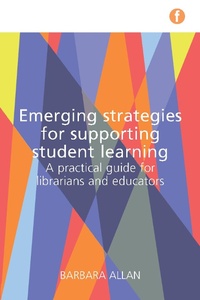
Emerging Strategies for Supporting Student Learning
Description

Emerging Strategies for Supporting Student Learning provides a straightforward and accessible guide to the latest learning and teaching practices appropriate for use with higher education students.
It is both an exciting and challenging time to be working in higher education as the sector experiences rapid changes including: an increasingly diverse student population with changing expectations; changes in technology including the rise in the use of social media; increased emphasis on employability and internationalisation; development of new social learning spaces; as well as an ever-decreasing resource base. As a result of these changes, new approaches to supporting student learning are developing rapidly.
In the past five years, developments in both the theory and practice of learning and teaching have created a complex landscape which it is sometimes difficult to navigate. Emerging Strategies for Supporting Student Learning provides practical guidance and brings together theory and practice in an accessible style. The book covers a wide range of tools and techniques (relevant to face-to-face, blended learning and online practices) which will suit students in different contexts from large groups of 500+ to very small classes of research students.
This practical book makes extensive use of case studies, examples, checklists and tables and contains:
- An analysis of the current higher education landscape, the changes that are occurring and the diverse nature of students populations
- An exploration of new theories of digital literacy including case studies demonstrating how library and information workers have applied these models in practice
- A demonstration of the many different ways in which academic library and information services are working in support of student employability
- A theoretical overview of different approaches to teaching and learning including Kolb's learning cycle, Laurillard's conversational framework for university teaching, Entwistle's teaching for understanding at university, Land and Meyer's threshold concepts, and the Higher Education Academy's work on flexible pedagogies
- Practical guidance on designing, developing and evaluating courses and other learning and teaching events in different situations in including face-to-face, flipped classroom, blended learning, and online learning
- An exploration of approaches to personal and professionals development including 90+ approaches to workplace learning; accredited courses; short courses, conferences and workshops; networking through professional organisations; and developing online networks.
Emerging Strategies for Supporting Student Learning will be essential reading for different groups working in colleges and universities including library and information workers, staff developers, educational technologists, educational development project workers, educational change agents and students of library and information science who are planning their careers in higher education institutions.
More details
Other editions
Additional editions
Person
Barbara Allan is an author and trainer. Her background includes managing workplace and academic libraries. She has spent many years working in business schools where her focus was on enhancing learning, teaching and the student experience, and the internationalization and employability agendas. Her qualifications include a doctorate in education (on the topic of e-mentoring and women into leadership). She is a Principal Fellow of the Higher Education Academy and was awarded a National Teaching Fellowship in 2008.Barbara is a Member of CILIP and the author of several Facet Publishing titles including: Project Management (2004), Blended Learning (2007) andThe No-nonsense Guide to Training in Libraries (2013).
