

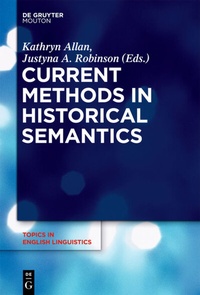
Current Methods in Historical Semantics
1st Edition
Published on 23. December 2011
VIII, 347 pages
978-3-11-025290-3 (ISBN)
Description

Innovative, data-driven methods provide more rigorous and systematic evidence for the description and explanation of diachronic semantic processes. The volume systematises, reviews, and promotes a range of empirical research techniques and theoretical perspectives that currently inform work across the discipline of historical semantics. In addition to emphasising the use of new technology, the potential of current theoretical models (e.g. within variationist, sociolinguistic or cognitive frameworks) is explored along the way.
More details
Other editions
Additional editions
Kathryn Allan | Justyna A. Robinson
Current Methods in Historical Semantics
Book
12/2011
1st Edition
De Gruyter Mouton
€189.95
Shipment within 7-9 days
Persons
Kathryn Allan, University College London, UK; Justyna A. Robinson, University of Sussex, UK.
Content
1 - Preface [Seite 6]
2 - Table of contents [Seite 8]
3 - Introduction: Exploring the "state of the art" in historical semantics [Seite 10]
4 - Section 1: Data and sources [Seite 24]
4.1 - Using OED data as evidence [Seite 26]
4.2 - Developing The Historical Thesaurus of the OED [Seite 50]
4.3 - The NeoCrawler: identifying and retrieving neologisms from the internet and monitoring on-going change [Seite 68]
4.4 - Commentary [Seite 106]
5 - Section 2: Corpus-based methods [Seite 116]
5.1 - How anger rose: Hypothesis testing in diachronic semantics [Seite 118]
5.2 - Diachronic collostructional analysis: How to use it and how to deal with confounding factors [Seite 142]
5.3 - Tracing semantic change with Latent Semantic Analysis [Seite 170]
5.4 - Commentary [Seite 193]
6 - Section 3: Theoretical Approaches [Seite 206]
6.1 - A sociolinguistic perspective on semantic change [Seite 208]
6.2 - A pragmatic approach to historical semantics, with special reference to markers of clausal negation in Medieval French [Seite 242]
6.3 - The pervasiveness of contiguity and metonymy in semantic change [Seite 268]
6.4 - A cognitive approach to the methodology of semantic reconstruction: The case of English chin and knee [Seite 322]
6.4.1 - Commentary [Seite 343]
7 - Subject index [Seite 352]
8 - Index of word forms and concepts [Seite 355]
2 - Table of contents [Seite 8]
3 - Introduction: Exploring the "state of the art" in historical semantics [Seite 10]
4 - Section 1: Data and sources [Seite 24]
4.1 - Using OED data as evidence [Seite 26]
4.2 - Developing The Historical Thesaurus of the OED [Seite 50]
4.3 - The NeoCrawler: identifying and retrieving neologisms from the internet and monitoring on-going change [Seite 68]
4.4 - Commentary [Seite 106]
5 - Section 2: Corpus-based methods [Seite 116]
5.1 - How anger rose: Hypothesis testing in diachronic semantics [Seite 118]
5.2 - Diachronic collostructional analysis: How to use it and how to deal with confounding factors [Seite 142]
5.3 - Tracing semantic change with Latent Semantic Analysis [Seite 170]
5.4 - Commentary [Seite 193]
6 - Section 3: Theoretical Approaches [Seite 206]
6.1 - A sociolinguistic perspective on semantic change [Seite 208]
6.2 - A pragmatic approach to historical semantics, with special reference to markers of clausal negation in Medieval French [Seite 242]
6.3 - The pervasiveness of contiguity and metonymy in semantic change [Seite 268]
6.4 - A cognitive approach to the methodology of semantic reconstruction: The case of English chin and knee [Seite 322]
6.4.1 - Commentary [Seite 343]
7 - Subject index [Seite 352]
8 - Index of word forms and concepts [Seite 355]
