

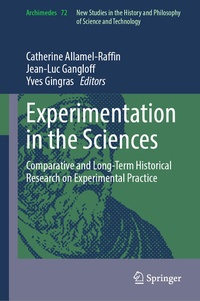
Experimentation in the Sciences
Description

This book takes a novel approach by highlighting comparative and long-term historical perspectives on experimental practice. The juxtaposition of accounts of natural, social, and medical experimentation is very enlightening, especially because the authors put the emphasis on the different kinds of objects of experimentation (physical matter, chemical reagents, social groups, organizations, sick individuals, archeological remains) and demonstrate how much the kinds of objects matter for the practice of experimentation, its methods, tools, and methodologies. Taken together, the chapters raise several fascinating questions for further study: What do these different approaches have in common? Why do we call them "experimentation"? What are the intersections among the fields and their developments? The volume engages philosophical approaches that are not well known to Anglophone readers (Bachelard, Bergson, Bernard, Canguilhem, among others) and brings to attention a wealth of Francophone secondary literature on past and present scientific experimentation. The collection fills a yawning gap in science, science studies, and philosophy of science teaching, making it particularly valuable philosophers and historians of science in all subfields.
More details
Other editions
Additional editions
Persons
Catherine Allamel-Raffin
is Professor at the University of Strasbourg and Co-Director of the Archives Henri Poincaré Laboratory (CNRS, University of Lorraine, University of Strasbourg). Her research focuses on objectivity of scientific images. She has written, co-written or edited a dozen books and some forty articles.
Jean-Luc Gangloff
teaches both at a high school and at the University of Strasbourg. He has written, co-written or edited a dozen books and some twenty articles. His research focuses on questions of philosophy of science and on the representation of science in fiction.
Yves Gingras
is Professor of history and sociology of science at Université du Québec à Montréal. His research focuses on the transformations of scientific disciplines. He has written, co-written or edited twenty books, and published over one hundred and forty articles.
Content
Dedication.- Chapter 1. The characteristics and diversity of experimentation in the sciences (Catherine Allamel-Raffin, Jean-Luc Gangloff and Yves Gingras).- Chapter 2. Experimentation in physics (Yves Gingras).- Chapter 3. Experimentation in chemistry (Jean-Pierre Llored).- Chapter 4. Experimentation in the life sciences (Laurent Loison).- Chapter 5. Experimentation in psychology (Jean Audusseau).- Chapter 6. Experimentation in sociology (Dominique Raynaud).- Chapter 7. Experimentation in economics (Herrade Igersheim & Mathieu Lefebvre).- Chapter 8. Experimentation in management science (Vincent Helfrich).- Chapter 9. Experimentation in Medecine (Stéphanie Dupouy).- Chapter 10. The medical clinic as an experimental practice (Jean-Christophe Weber).- Chapter 11. Experimentation in Archeology (Nicolas Monteix).
