

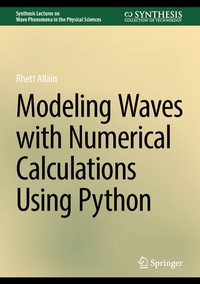
Modeling Waves with Numerical Calculations Using Python
Description

Numerical calculations (what many call computational physics) is a core tool in modern physics. With numerical methods it's possible to solve problems that would otherwise be impossible. Most physics students and educators have at least some exposure to the wave equation. It shows up in many different contexts-light, quantum mechanics, and even a simple wave on a string. However, it can be difficult to come up with non-trivial solutions to the wave equation. This text goes through the techniques to create a numerical model of the wave equation starting from the very basics and using free and open source tools such as Python and Web VPython.
More details
Other editions
Additional editions
Person
Rhett Allain is an Associate Professor of Physics at Southeastern Louisiana. Besides his role as a physics educator, he is also an active science communicator. In 2010, Allain began writing about fun and interesting physics topics on WIRED.com. These initial blog posts lead to other opportunities including becoming the science advisor for both MythBusters and CBS MacGyver. He maintains an active YouTube channel (Dot Physics) and also writes at medium.com. In his spare time, he likes to take things apart but he can't always put them back together.
Content
Introduction to Numerical Calculations: A mass on a spring.- Introduction to Web VPython: Modeling a mass on a spring.- Wave on a String and the Wave Equation.- Many Masses and Many Springs: A Wave on a String.- Solving the Wave Equation With the Finite Difference Method.
