

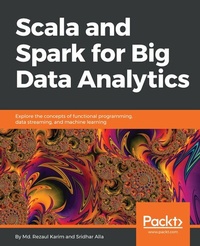
Scala and Spark for Big Data Analytics
Explore the concepts of functional programming, data streaming, and machine learning
Published on 8. July 2025
796 pages
978-1-78355-050-0 (ISBN)
Description

Harness the power of Scala to program Spark and analyze tonnes of data in the blink of an eye!
Key Features
[*]Learn Scala's sophisticated type system that combines Functional Programming and object-oriented concepts
[*]Work on a wide array of applications, from simple batch jobs to stream processing and machine learning
[*]Explore the most common as well as some complex use-cases to perform large-scale data analysis with Spark
Book DescriptionScala has been observing wide adoption over the past few years, especially in the field of data science and analytics. Spark, built on Scala, has gained a lot of recognition and is being used widely in productions. Thus, if you want to leverage the power of Scala and Spark to make sense of big data, this book is for you. The first part introduces you to Scala, helping you understand the object-oriented and functional programming concepts needed for Spark application development. It then moves on to Spark to cover the basic abstractions using RDD and DataFrame. This will help you develop scalable and fault-tolerant streaming applications by analyzing structured and unstructured data using SparkSQL, GraphX, and Spark structured streaming. Finally, the book moves on to some advanced topics, such as monitoring, configuration, debugging, testing, and deployment. You will also learn how to develop Spark applications using SparkR and PySpark APIs, interactive data analytics using Zeppelin, and in-memory data processing with Alluxio. By the end of this book, you will have a thorough understanding of Spark, and you will be able to perform full-stack data analytics with a feel that no amount of data is too big.What you will learn
[*] Understand object-oriented & functional programming concepts of Scala
[*] In-depth understanding of Scala collection APIs
[*] Work with RDD and DataFrame to learn Spark's core abstractions
[*] Analysing structured and unstructured data using SparkSQL and GraphX
[*] Scalable and fault-tolerant streaming application development using Spark structured streaming
[*] Learn machine-learning best practices for classification, regression, dimensionality reduction, and recommendation system to build predictive models with widely used algorithms in Spark MLlib & ML
[*] Build clustering models to cluster a vast amount of data
[*] Understand tuning, debugging, and monitoring Spark applications
[*] Deploy Spark applications on real clusters in Standalone, Mesos, and YARN
Who this book is forAnyone who wishes to learn how to perform data analysis by harnessing the power of Spark will find this book extremely useful. No knowledge of Spark or Scala is assumed, although prior programming experience (especially with other JVM languages) will be useful to pick up concepts quicker.
Key Features
[*]Learn Scala's sophisticated type system that combines Functional Programming and object-oriented concepts
[*]Work on a wide array of applications, from simple batch jobs to stream processing and machine learning
[*]Explore the most common as well as some complex use-cases to perform large-scale data analysis with Spark
Book DescriptionScala has been observing wide adoption over the past few years, especially in the field of data science and analytics. Spark, built on Scala, has gained a lot of recognition and is being used widely in productions. Thus, if you want to leverage the power of Scala and Spark to make sense of big data, this book is for you. The first part introduces you to Scala, helping you understand the object-oriented and functional programming concepts needed for Spark application development. It then moves on to Spark to cover the basic abstractions using RDD and DataFrame. This will help you develop scalable and fault-tolerant streaming applications by analyzing structured and unstructured data using SparkSQL, GraphX, and Spark structured streaming. Finally, the book moves on to some advanced topics, such as monitoring, configuration, debugging, testing, and deployment. You will also learn how to develop Spark applications using SparkR and PySpark APIs, interactive data analytics using Zeppelin, and in-memory data processing with Alluxio. By the end of this book, you will have a thorough understanding of Spark, and you will be able to perform full-stack data analytics with a feel that no amount of data is too big.What you will learn
[*] Understand object-oriented & functional programming concepts of Scala
[*] In-depth understanding of Scala collection APIs
[*] Work with RDD and DataFrame to learn Spark's core abstractions
[*] Analysing structured and unstructured data using SparkSQL and GraphX
[*] Scalable and fault-tolerant streaming application development using Spark structured streaming
[*] Learn machine-learning best practices for classification, regression, dimensionality reduction, and recommendation system to build predictive models with widely used algorithms in Spark MLlib & ML
[*] Build clustering models to cluster a vast amount of data
[*] Understand tuning, debugging, and monitoring Spark applications
[*] Deploy Spark applications on real clusters in Standalone, Mesos, and YARN
Who this book is forAnyone who wishes to learn how to perform data analysis by harnessing the power of Spark will find this book extremely useful. No knowledge of Spark or Scala is assumed, although prior programming experience (especially with other JVM languages) will be useful to pick up concepts quicker.
All prices
More details
Edition
Digital original
Language
English
Place of publication
Birmingham
United Kingdom
Target group
Professional and scholarly
US School Grade: College Graduate Student
Edition type
Digital original
File size
82,26 MB
ISBN-13
978-1-78355-050-0 (9781783550500)
Copyright in bibliographic data and cover images is held by Nielsen Book Services Limited or by the publishers or by their respective licensors: all rights reserved.
Schweitzer Classification
Other editions
Additional editions
Md. Rezaul Karim | Sridhar Alla
Scala and Spark for Big Data Analytics
Explore the concepts of functional programming, data streaming, and machine learning
Book
07/2017
Packt Publishing
€83.70
Shipment within 3-4 weeks
Persons
Alla Sridhar :
Sridhar?Alla?is the co-founder and CTO of Blue Whale Consulting and is expert at helping companies (big and small) define their vision for systems and capabilities that will allow them to establish a strategic execution plan to deal with the ever-growing data collected to support analytics and product teams. He has very experienced at dealing with all aspects of data collection, security, governance, and processing as part of end-to-end big data analytics and machine learning initiatives (including predictive modeling, deep learning, and ML automation). Sridhar?is a published book author and an avid presenter at numerous conferences, including Strata, Hadoop World, and Spark Summit.? He also has several patents filed with the US PTO on large-scale computing and distributed systems.? He has over 18 years' experience writing code in Scala, Java, C, C++, Python, R, and Go, and has extensive hands-on knowledge of Spark, Flink, TensorFlow, Keras, Hadoop, Cassandra, HBase, MongoDB, Riak, Redis, Zeppelin, Mesos, Docker, Kafka, ElasticSearch, Solr, H2O, machine learning, text analytics, distributed computing, and high-performance computing. Sridhar lives with his wife and daughter in New Jersey and in his spare time loves blogging and coaching organizations on next-generation advancements in technology and their alignment with business goals.Karim Md. Rezaul :
Md. Rezaul Karim is a researcher, author, and data science enthusiast with a strong computer science background, coupled with 10 years of research and development experience in machine learning, deep learning, and data mining algorithms to solve emerging bioinformatics research problems by making them explainable. He is passionate about applied machine learning, knowledge graphs, and explainable artificial intelligence (XAI). Currently, he is working as a research scientist at Fraunhofer FIT, Germany. He is also a PhD candidate at RWTH Aachen University, Germany. Before joining FIT, he worked as a researcher at the Insight Centre for Data Analytics, Ireland. Previously, he worked as a lead software engineer at Samsung Electronics, Korea.
Sridhar?Alla?is the co-founder and CTO of Blue Whale Consulting and is expert at helping companies (big and small) define their vision for systems and capabilities that will allow them to establish a strategic execution plan to deal with the ever-growing data collected to support analytics and product teams. He has very experienced at dealing with all aspects of data collection, security, governance, and processing as part of end-to-end big data analytics and machine learning initiatives (including predictive modeling, deep learning, and ML automation). Sridhar?is a published book author and an avid presenter at numerous conferences, including Strata, Hadoop World, and Spark Summit.? He also has several patents filed with the US PTO on large-scale computing and distributed systems.? He has over 18 years' experience writing code in Scala, Java, C, C++, Python, R, and Go, and has extensive hands-on knowledge of Spark, Flink, TensorFlow, Keras, Hadoop, Cassandra, HBase, MongoDB, Riak, Redis, Zeppelin, Mesos, Docker, Kafka, ElasticSearch, Solr, H2O, machine learning, text analytics, distributed computing, and high-performance computing. Sridhar lives with his wife and daughter in New Jersey and in his spare time loves blogging and coaching organizations on next-generation advancements in technology and their alignment with business goals.Karim Md. Rezaul :
Md. Rezaul Karim is a researcher, author, and data science enthusiast with a strong computer science background, coupled with 10 years of research and development experience in machine learning, deep learning, and data mining algorithms to solve emerging bioinformatics research problems by making them explainable. He is passionate about applied machine learning, knowledge graphs, and explainable artificial intelligence (XAI). Currently, he is working as a research scientist at Fraunhofer FIT, Germany. He is also a PhD candidate at RWTH Aachen University, Germany. Before joining FIT, he worked as a researcher at the Insight Centre for Data Analytics, Ireland. Previously, he worked as a lead software engineer at Samsung Electronics, Korea.
Content
Table of Contents
Introduction to Scala
Object-oriented Scala
Functional programming concepts
Collections API
Tackle Big Data Spark comes to the party
Start Working with Spark REPL and RDDs
Special RDD Operations
Introduce a Little Structure SparkSQL
Stream Me Up Scotty: Spark Streaming
Everything is Connected GraphX
Learning Machine Learning Spark Mllib
Advanced Machine Learning Best Practices
My Name is Bayes, Naive Bayes
Time to Put Some Order Cluster Your Data with Spark Mllib
Text Analytics using Spark ML
Spark Tuning
Time to Go to ClusterLand Deploy Spark on a Cluster
Testing and Debugging Spark
PySpark and SparkR
Appendix A - Accelerating Spark with Alluxio
Appendix B - Interactive Data Analytics with Apache Zepplin
Introduction to Scala
Object-oriented Scala
Functional programming concepts
Collections API
Tackle Big Data Spark comes to the party
Start Working with Spark REPL and RDDs
Special RDD Operations
Introduce a Little Structure SparkSQL
Stream Me Up Scotty: Spark Streaming
Everything is Connected GraphX
Learning Machine Learning Spark Mllib
Advanced Machine Learning Best Practices
My Name is Bayes, Naive Bayes
Time to Put Some Order Cluster Your Data with Spark Mllib
Text Analytics using Spark ML
Spark Tuning
Time to Go to ClusterLand Deploy Spark on a Cluster
Testing and Debugging Spark
PySpark and SparkR
Appendix A - Accelerating Spark with Alluxio
Appendix B - Interactive Data Analytics with Apache Zepplin

