

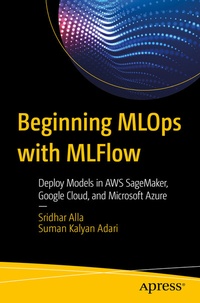
Beginning MLOps with MLFlow
Deploy Models in AWS SageMaker, Google Cloud, and Microsoft Azure
Published on 7. December 2020
XIV, 330 pages
978-1-4842-6549-9 (ISBN)
Description

Integrate MLOps principles into existing or future projects using MLFlow, operationalize your models, and deploy them in AWS SageMaker, Google Cloud, and Microsoft Azure. This book guides you through the process of data analysis, model construction, and training.
The authors begin by introducing you to basic data analysis on a credit card data set and teach you how to analyze the features and their relationships to the target variable. You will learn how to build logistic regression models in scikit-learn and PySpark, and you will go through the process of hyperparameter tuning with a validation data set. You will explore three different deployment setups of machine learning models with varying levels of automation to help you better understand MLOps. MLFlow is covered and you will explore how to integrate MLOps into your existing code, allowing you to easily track metrics, parameters, graphs, and models. You will be guided through the process of deploying and querying your models with AWS SageMaker, Google Cloud, and Microsoft Azure. And you will learn how to integrate your MLOps setups using Databricks.
Data scientists and machine learning engineers who want to learn MLOps and know how to operationalize their models
The authors begin by introducing you to basic data analysis on a credit card data set and teach you how to analyze the features and their relationships to the target variable. You will learn how to build logistic regression models in scikit-learn and PySpark, and you will go through the process of hyperparameter tuning with a validation data set. You will explore three different deployment setups of machine learning models with varying levels of automation to help you better understand MLOps. MLFlow is covered and you will explore how to integrate MLOps into your existing code, allowing you to easily track metrics, parameters, graphs, and models. You will be guided through the process of deploying and querying your models with AWS SageMaker, Google Cloud, and Microsoft Azure. And you will learn how to integrate your MLOps setups using Databricks.
What You Will Learn
- Perform basic data analysis and construct models in scikit-learn and PySpark
- Train, test, and validate your models (hyperparameter tuning)
- Know what MLOps is and what an ideal MLOps setup looks like
- Easily integrate MLFlow into your existing or future projects
- Deploy your models and perform predictions with them on the cloud
Data scientists and machine learning engineers who want to learn MLOps and know how to operationalize their models
More details
Series
Edition
1st ed.
Language
English
Place of publication
Berkeley
United States
Publishing group
APRESS
Target group
Professional and scholarly
Product notice
Reflowable
Illustrations
XIV, 330 p. 267 illus.
File size
10,70 MB
ISBN-13
978-1-4842-6549-9 (9781484265499)
DOI
10.1007/978-1-4842-6549-9
Schweitzer Classification
Other editions
Additional editions
Sridhar Alla | Suman Kalyan Adari
Beginning MLOps with MLFlow
Deploy Models in AWS SageMaker, Google Cloud, and Microsoft Azure
Book
12/2020
APress
€64.19
Shipment within 15-20 days
Persons
Sridhar Alla
is the co-founder and CTO of Bluewhale, which helps big and small organizations build AI-driven big data solutions and analytics. He is a published author of books and an avid presenter at numerous Strata, Hadoop World, Spark Summit, and other conferences. He also has several patents filed with the US PTO on large-scale computing and distributed systems. He has extensive hands-on experience in several technologies, including Spark, Flink, Hadoop, AWS, Azure, Tensorflow, Cassandra, and others. He spoke on Anomaly Detection Using Deep Learning at Strata SFO in March of 2019 and at Strata London in October of 2019. He was born in Hyderabad, India and now lives in New Jersey, USA with his wife Rosie and daughter Evelyn. When he is not busy writing code, he loves to spend time with his family and also training, coaching, and organizing meetups.
Suman Kalyan Adari is an undergraduate student pursuing a BS degree in computer science atthe University of Florida. He has been conducting deep learning research in the field of cybersecurity since his freshman year, and has presented at the IEEE Dependable Systems and Networks workshop on Dependable and Secure Machine Learning held in Portland, Oregon, USA in June of 2019. He is passionate about deep learning, and specializes in its practical uses in various fields such as image recognition, anomaly detection, natural language processing, targeted adversarial attacks, and more.
Suman Kalyan Adari is an undergraduate student pursuing a BS degree in computer science atthe University of Florida. He has been conducting deep learning research in the field of cybersecurity since his freshman year, and has presented at the IEEE Dependable Systems and Networks workshop on Dependable and Secure Machine Learning held in Portland, Oregon, USA in June of 2019. He is passionate about deep learning, and specializes in its practical uses in various fields such as image recognition, anomaly detection, natural language processing, targeted adversarial attacks, and more.
Content
Chapter 1: Getting Started: Data Analysis.- Chapter 2: Building Models.- Chapter 3: What Is MLOps?.- Chapter 4: Introduction to MLFlow.- Chapter 5: Deploying in AWS.- Chapter 6: Deploying in Azure.- Chapter 7: Deploying in Google.- Appendix A: a2ml.
