

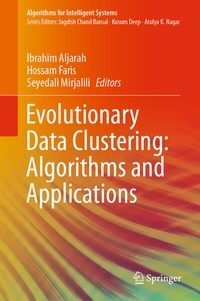
Evolutionary Data Clustering: Algorithms and Applications
Description

More details
Other editions
Additional editions
Persons
Ibrahim Aljarah is an associate professor of BIG Data Mining and Computational Intelligence at the University of Jordan-Department of Information Technology, Jordan. Currently, he is the Director of the Open Educational Resources and Blended Learning Center at The University of Jordan. He obtained his PhD in computer science from the North Dakota State University, USA, in 2014. He also obtained the master degree in computer science and information systems from the Jordan University of Science and Technology - Jordan in 2006. He obtained the bachelor degree in Computer Science from Yarmouk University - Jordan, 2003. He participated in many conferences in the field of data mining, machine learning, and Big data such as CEC, GECCO, NTIT, CSIT, IEEE NABIC, CASON, and BIGDATA Congress. Furthermore, he contributed in many projects in USA such as Vehicle Class Detection System (VCDS), Pavement Analysis Via Vehicle Electronic Telemetry (PAVVET), and Farm Cloud Storage System(CSS) projects. He has published more than 60 papers in refereed inter-national conferences and journals. His research focuses on Data Mining, Data Science, Machine Learning, Opinion Mining, Sentiment Analysis, Big Data, MapReduce, Hadoop, Swarm intelligence, Evolutionary Computation, and large-scale distributed algorithms.
Hossam Faris is a Professor in the Information Technology Department at King Abdullah II School for Information Technology at The University of Jordan, Jordan. Hossam Faris received his B.A. and M.Sc. degrees in computer science from the Yarmouk University and Al-Balqa' Applied University in 2004 and 2008, respectively, in Jordan. He was awarded a full-time competition-based scholarship from the Italian Ministry of Education and Research to peruse his Ph.D. degrees in e-Business at the University of Salento, Italy, where he obtained his Ph.D. degree in 2011. In 2016, he worked as a postdoctoral researcher with the GeNeura team at the Information and Communication Technologies Research Center (CITIC), University of Granada, Spain. His research interests include applied computational intelligence, evolutionary computation, knowledge systems, data mining, semantic web, and ontologies.
Seyedali Mirjalili
is an Associate Professor and the director of the Centre for Artificial Intelligence Research and Optimization at Torrens University Australia. He is internationally recognized for his advances in Swarm Intelligence and Optimization, including the first set of algorithms from a synthetic intelligence standpoint - a radical departure from how natural systems are typically understood - and a systematic design framework to reliably benchmark, evaluate, and propose computationally cheap robust optimization algorithms. He has published over 200 publications with over 20,000 citations and is in the list of 1% highly-cited researchers by Web of Science. Seyedali is a senior member of IEEE and an associate editor of severaljournals including Neurocomputing, Applied Soft Computing, Advances in Engineering Software, Applied Intelligence, and IEEE Access. His research interests include Robust Optimization, Engineering Optimization, Multi-objective Optimization, Swarm Intelligence, Evolutionary Algorithms, Machine Learning, and Artificial Neural Networks.
