

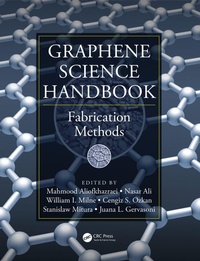
Graphene Science Handbook
Fabrication Methods
1st Edition
Published on 27. April 2016
594 pages
978-1-040-07393-3 (ISBN)
Description

Explores Chemical-Based, Non-Chemical Based, and Advanced Fabrication MethodsThe Graphene Science Handbook is a six-volume set that describes graphene's special structural, electrical, and chemical properties. The book considers how these properties can be used in different applications (including the development of batteries, fuel cells, photovolt
Reviews / Votes
"Since its inception in 2004, graphene research has become so fragmented that keeping up with its progress alone has become a daunting task-yet application of graphene's extraordinary properties remains as elusive as ever. This handbook focuses on the fabrication of graphene, providing the newest findings on the strategies for obtaining desired structures ranging from large-scale single-layer graphene sheets, to graphene nanocomposites, to atomically precise graphene nanoribbons; for the purpose of future device fabrication. This volume not only reports on the progress of familiar fabrication methods (e.g., chemical vapor deposition, graphene oxide reduction, etc.), but it also reports on more unconventional methods, such as electrochemical and flame syntheses. It is a comprehensive collection of the cutting-edge graphene-fabrication advances to date-an essential reference for anyone interested in the application of graphene's revolutionary properties."-Patrick Han, Advanced Institute for Materials Research (AIMR), Tohoku University, Japan
"I am confident in the materials ... The wide scope of information covered, and the qualifications of the contributors projects a positive image of the potential quality of the publication."
-Albert V. Tamashausky, Asbury Carbons Inc.
"This book is a result of an impressive project to collect views from experts in every aspect of graphene science. All popular topics in the research of this impressive material are covered. This is the best and most complete presentation that has been published so far for the hottest material of our times. A must-have reference."
-Ioannis Remediakis, Department of Materials Science and Technology, University of Crete, Greece
"... this set of volumes represents a complete handbook showing the state of the art of science and technology related with graphene. This set of books is written by great specialists and competent experts. For someone who works in this field, this set of volumes is an essential reference for the characterization and application of graphene."
-Dr. Alex Axelevitch, Holon Institute of Technology (HIT)
More details
Edition
1. Auflage
Language
English
Place of publication
London
United Kingdom
Publishing group
Taylor & Francis Ltd
ISBN-13
978-1-040-07393-3 (9781040073933)
Copyright in bibliographic data and cover images is held by Nielsen Book Services Limited or by the publishers or by their respective licensors: all rights reserved.
Schweitzer Classification
Other editions
Additional editions
Book
04/2016
1st Edition
CRC Press
€394.33
Shipment within 15-20 days
Persons
Mahmood Aliofkhazraei is an assistant professor in the Materials Engineering Department at Tarbiat Modares University. Dr. Aliofkhazraei's research interests include nanotechnology
and its use in surface and corrosion science. One of his main interests is plasma electrolysis, and he has published more than 40 papers and a book in this area. Overall he has published more than 12 books and 90 journal articles. Aliofkhazraei has received numerous awards, including the Khwarizmi award, IMES medal, INIC award, best-thesis award, best-book award, and the best young nanotechnologist award of Iran. He is on the advisory editorial board of several nanotechnology journals.
Nasar Ali is a visiting professor at Meliksah University in Turkey. Earlier he held the post of chief scientific officer at CNC Coatings Company based in Rochdale, UK. Prior to this Dr. Ali was a faculty member (assistant professor) at the University of Aveiro in Portugal where he founded and led the Surface Engineering and Nanotechnology group. He has over 120 international refereed research publications, including a number of book chapters. Dr. Ali serves on a number of committees for international conferences based on nanomaterials, thin films, and emerging technologies (nanotechnology), and he chairs the highly successful NANOSMAT congress.
William I. Milne, FREng, FIET, FIMMM, was head of the Electrical Engineering Division of the Engineering Department at Cambridge University from 1999 until 2014 and was Director of the Centre for Advanced Photonics and Electronics (CAPE) from 2004 until 2015. He earned a BSc at St. Andrews University in Scotland in 1970 and later earned a PhD in electronic materials at the Imperial College London. In 2003 he was awarded a DEng (honoris causa) by the University of Waterloo, Canada. His research interests include large area silicon-and carbon-based electronics, thin film materials, and, MEMS a
and its use in surface and corrosion science. One of his main interests is plasma electrolysis, and he has published more than 40 papers and a book in this area. Overall he has published more than 12 books and 90 journal articles. Aliofkhazraei has received numerous awards, including the Khwarizmi award, IMES medal, INIC award, best-thesis award, best-book award, and the best young nanotechnologist award of Iran. He is on the advisory editorial board of several nanotechnology journals.
Nasar Ali is a visiting professor at Meliksah University in Turkey. Earlier he held the post of chief scientific officer at CNC Coatings Company based in Rochdale, UK. Prior to this Dr. Ali was a faculty member (assistant professor) at the University of Aveiro in Portugal where he founded and led the Surface Engineering and Nanotechnology group. He has over 120 international refereed research publications, including a number of book chapters. Dr. Ali serves on a number of committees for international conferences based on nanomaterials, thin films, and emerging technologies (nanotechnology), and he chairs the highly successful NANOSMAT congress.
William I. Milne, FREng, FIET, FIMMM, was head of the Electrical Engineering Division of the Engineering Department at Cambridge University from 1999 until 2014 and was Director of the Centre for Advanced Photonics and Electronics (CAPE) from 2004 until 2015. He earned a BSc at St. Andrews University in Scotland in 1970 and later earned a PhD in electronic materials at the Imperial College London. In 2003 he was awarded a DEng (honoris causa) by the University of Waterloo, Canada. His research interests include large area silicon-and carbon-based electronics, thin film materials, and, MEMS a
Content
FABRICATION METHODS AND STRATEGIES. CHEMICAL-BASED METHODS. NONCHEMICAL METHODS. ADVANCES OF FABRICATION METHODS.
