

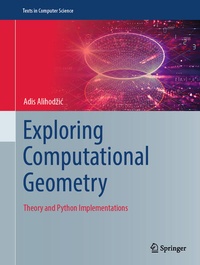
Exploring Computational Geometry
Description

Computational geometry plays a vital role in fields ranging from algorithms, data structures, robotics, and computer graphics to geographic information systems and AI. Providing a comprehensive toolkit, this core textbook constructs a strong bridge between rigorous geometric theory and practical, real-world implementations-making complex concepts accessible and engaging. Uniquely, the volume presents a modern approach to computational geometry through the lens of Python programming. Emphasizing clarity, structure, and visualization, the book introduces core geometric structures and algorithms, supported by detailed illustrations and interactive examples. With its project-based learning orientation and emphasis on conceptual understanding, it can serve as both a textbook and a reference guide for those exploring the computational side of geometry.
Topics and features:
· All geometric algorithms implemented in native Python
· 400+ illustrations and visualizations
· Includes project-based exercises for students
· Coverage: Core Structures and Algorithms, Geometric Objects in Python, Algorithms for Geometric Objects, Convex Hull Algorithms in 2D and 3D, Polygon Triangulation Methods, Delaunay Triangulation, Voronoi Diagrams, Visualization Techniques, Algorithms for Space Exploration, Quadtrees, Robot Motion Planning, AI in Computational Geometry
· Suitable for advanced undergraduate and graduate courses
· GitHub repository with all source code
Ideal for students of computer science, the textbook/reference will have real utility as well for those in mathematics and engineering. Researchers and practitioners working in computational geometry, algorithm design, data visualization, or related disciplines will find the work an indispensable resource and guide.
Adis Alihodzic is a Full Professor at the Department of Mathematics and Computer Science, Faculty of Natural Sciences and Mathematics, University of Sarajevo.
More details
Other editions
Additional editions
Person
Adis Alihodzic´ is a Full Professor at the Department of Mathematics and Computer Science, Faculty of Natural Sciences and Mathematics, University of Sarajevo, where he teaches courses in computational geometry, image processing, neural networks, machine learning, databases, programming, and computer systems. He earned his Bachelor's degree in 2006 with a thesis on "Fortune's Algorithm for Voronoi Diagram Construction", his Master's degree in 2011 with a thesis on "Reconstruction of Multidimensional Images from Projections Using Integral Transforms with Applications in Medicine", and his PhD in Computer Science in 2016 with a dissertation on "Improving the Bat Algorithm Metaheuristic for Constrained Optimization Problems". Throughout his career, he has taught at all levels of study and has served as a lecturer and mentor in doctoral programs. He is the author and co-author of several textbooks, covering topics such as dynamic web systems, computability theory, statistics, computational geometry, machine learning, and databases. His research interests include artificial intelligence, machine learning, optimization problems, metaheuristics, computational geometry, digital image processing, object recognition, algorithms, and data structures. He has published over 70 scientific papers in international journals and conference proceedings, including publications in the Lecture Notes in Computer Science, Studies in Computational Intelligence, and IEEE conference series.
Content
Core Structures and Algorithms.- Geometric Objects in Python.- Algorithms for Geometric Objects.- Convex Hull Algorithms.- Polygon Triangulation Methods.- Delaunay Triangulation.- Voronoi Diagrams.- Visualization Techniques.- Algorithms for Space Exploration.- Quadtrees.- Robot Motion Planning.- AI in Computational Geometry.
