

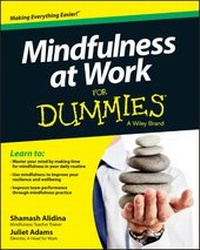
Mindfulness at Work For Dummies
Description

Mindfulness at Work For Dummies provides essential guidancefor employees at all levels of an organization who areseeking more focus and clarity in their work. Itexplains how mindfulness can help employers wishing toimplement mindful practices into the workplace, and providesleaders and mentors within an organization with the tools they needto become more effective leaders and coaches. The audiodownload contains guided mindfulness exercises andmeditations suited to workplace scenarios, a core feature ofmindfulness programmes.
Mindfulness at Work For Dummies includes:
* An introduction to mindfulness, and how it can help improveworking behaviour
* An explanation of how the brain retains new mindfulworking patterns... with a bit of practice!
* Useful tips on incorporating mindfulness into your workingday
* How organisations can benefit from implementing mindfulapproaches to work
* Guidance for leaders on how mindfulness can help develop theirleadership qualities
More details
Other editions
Additional editions
Persons
Content
Part I: Getting Started with Mindfulness at Work 5
Chapter 1: Exploring Mindfulness in the Workplace 7
Chapter 2: Exploring the Benefits of Mindfulness in the Workplace 29
Chapter 3: Applying Mindfulness in the Workplace 49
Part II: Working with Mindfulness 75
Chapter 4: Practising Mindfulness Day to Day 77
Chapter 5: Boosting your Mental Resilience 97
Chapter 6: Discovering Mindfulness At Work Training 117
Chapter 7: Applying Mindfulness At Work Training 143
Chapter 8: Practising Mindfulness in the Digital Age 169
Part III: Mindfulness for Organisations 187
Chapter 9: Improving Team Performance with Mindfulness 189
Chapter 10: Using Mindfulness to Assist Different Business Functions 207
Chapter 11: Integrating Mindfulness with Coaching 225
Chapter 12: Commissioning Mindfulness Training in the Workplace 243
Part IV: Leading with Mindfulness 261
Chapter 13: Thriving on the Challenges of Leadership 263
Chapter 14: Leading without Boundaries 279
Chapter 15: Leading People, Change and Strategy 295
Part V: The Part of Tens 313
Chapter 16: Ten Ways to Be More Mindful at Work 315
Chapter 17: Ten Ways to Improve Your Brain with Mindfulness 325
Chapter 18: Ten Ways to Mindfully Manage Work Pressures 333
Chapter 19: Ten Ways to be Mindful in a Minute 341
Chapter 20: About Ten Resources for Further Study 349
Part VI: The Appendixes 357
Appendix A: Answers to Learning Check Questions 359
Appendix B: Summary of Research 361
Index 365
Chapter 1
Exploring Mindfulness in the Workplace
In This Chapter
Identifying what mindfulness is and is not
Retraining your brain
Getting started
In tough economic times, many organisations are looking for new ways to deliver better products and services to customers while simultaneously reducing costs. Carrying on as normal is not isn’t an option. Organisations are looking for sustainable ways to be more innovative. Leaders must really engage staff, and everyone needs to become more resilient in the face of ongoing change. For these reasons, more and more organisations are offering staff training in mindfulness.
Major corporations in the USA, like General Mills, and major employers in the UK, such as the National Health Service, have offered staff mindfulness training in recent years. Google and eBay are among the many companies that now provide rooms for staff to practise mindfulness in work time. Business schools including Harvard Business School in the USA and Ashridge Business School in the UK now include mindfulness principles in their leadership programmes.
So what is mindfulness, and why are so many leading organisations investing in it?
Becoming More Mindful at Work
In this section you will discover what mindfulness is. More importantly, you’ll also discover what mindfulness is not! You’ll find out how mindfulness evolved and why it’s become so important in the modern day workplace.
Clarifying what mindfulness is
Have you ever driven somewhere and arrived at your destination remembering nothing about your journey? Or grabbed a snack and noticed a few moments later that all you have left is an empty packet? Most people have! These examples are common ones of ‘mindlessness’, or ‘going on automatic pilot’.
Like many humans, you’re probably ‘not present’ for much of your own life. You may fail to notice the good things in your life or hear what your body is telling you. You probably also make your life harder than it needs to be by poisoning yourself with toxic self-criticism.
Mindfulness can help you to become more aware of your thoughts, feelings and sensations in a way that suspends judgement and self-criticism. Developing the ability to pay attention to and see clearly whatever is happening moment by moment does not eliminate life’s pressures, but it can help you respond to them in a more productive, calmer manner.
Learning and practising mindfulness can help you to recognise and step away from habitual, often unconscious emotional and physiological reactions to everyday events. Practising mindfulness allows you to be fully present in your life and work and improves your quality of life.
Mindfulness can help you to:
- Recognise, slow down or stop automatic and habitual reactions
- Respond more effectively to complex or difficult situations
- See situations with greater focus and clarity
- Become more creative
- Achieve balance and resilience at both work and home
Mindfulness at work is all about developing awareness of thoughts, emotions and physiology and how they interact with one another. Mindfulness is also about being aware of your surroundings, helping you better understand the needs of those around you.Mindfulness training is like going to the gym. In the same way as training a muscle, you can train your brain to direct your attention to where you want it to be. In simple terms, mindfulness is all about managing your mind.
Taking a look at the background
Mindfulness has its origins in ancient Eastern meditation practices. Jon Kabat-Zinn developed Mindfulness-Based Stress Reduction (MBSR) in the USA in the late 1970s, which became the foundation for modern-day mindfulness. Figure 1-1 shows how it developed.
Figure 1-1: Mindfulness timeline.
In the 1990s Mark Williams, John Teasdale and Zindel Segal further developed MBSR to help people suffering from depression. Mindfulness Based Cognitive Therapy (MBCT) combined cognitive behavioural therapy (CBT) with mindfulness. In 2004, MBCT was clinically approved in the UK by the National Institute for Clinical Excellence (NICE) as a ‘treatment of choice’ for recurrent depression.
Since the late 1970s, research into the benefits of mindfulness has steadily increased. Recent studies have examined, for example, the impact of practising mindfulness on the immune system and its effects on those working in high pressure environments.
Advances in brain scanning technology have demonstrated that as little as eight weeks of mindfulness training can positively alter brain structures, including the amygdala (the fear centre) and the left prefrontal cortex (an area associated with happiness and well-being). Other studies show benefits in even shorter periods of time.
Busy leaders who practise mindfulness have long extolled its virtues, but little research has existed to back up their claims. Fortunately, researchers are now increasingly focusing their attention on the benefits of mindfulness from a workplace perspective.
MBSR and MBCT are taught using a standard eight-week curriculum, and all teachers follow a formalised development route. The core techniques are the same for both courses. Most workplace mindfulness courses are based around MBCT or MBSR, but tailored to meet the needs of the workplace.
Although MBSR and MBCT were first developed to help treat a range of physical and mental health conditions, new applications for the techniques have been established. Mindfulness is now being taught in schools and universities, and has even been introduced to prisoners. Many professional education programmes, such as MBAs, now include mindfulness training.
Researchers have linked the practice of mindfulness to skills that are highly valuable in the workplace. Research suggests that practising mindfulness can enhance:
- Emotional intelligence
- Creativity and innovation
- Employee engagement
- Interpersonal relationships
- Ability to see the bigger picture
- Resilience
- Self-management
- Problem solving
- Decision making
- Focus and concentration
In addition, mindfulness is valuable in the workplace because it has a positive impact on immunity and general well-being. It has been demonstrated to relieve the symptoms of depression, anxiety and stress. See www.mawt.co.uk for a list of some of the research papers on mindfulness at work.
ACT
In the late 1980s, research began by Steven Hayes and colleagues for another form training called Acceptance and Commitment Theraphy (ACT). ACT combines mindfulness and acceptance with action-based strategies. In the last few years, ACT has begun to been adapted to meet the modern workplace, sometimes called Acceptance and Commitment Training.
Recognising what mindfulness isn’t
Misleading myths about mindfulness abound. Here are a few:
Myth 1: ‘I will need to visit a Buddhist centre, go on a retreat or travel to the Far East to learn mindfulness.’
Experienced mindfulness instructors are operating all over the world. Many teachers now teach mindfulness to groups of staff in the workplace. One-to-one mindfulness teaching can be delivered in the office, in hotel meeting rooms or even via the web. Some people do attend retreats after learning mindfulness if they wish to deepen their knowledge, experience peace and quiet or gain further tuition, but doing so isn’t essential.
Myth 2: ‘Practising mindfulness will conflict with my religious beliefs.’
Mindfulness isn’t a religion. For example, MBSR, MBCT are entirely secular – as are most workplace programs. No religious belief of any kind is necessary. Mindfulness can help you step back from your mental noise and tune into your own innate wisdom. Mindfulness is practised by people of all faiths and by those with no spiritual beliefs. Practising mindfulness won’t turn you into a hemp-clad tofu eater, a tree-hugging hippie or a monk sitting on top of a mountain – unless you want to be one of these people, of course!
Myth 3: ‘I’m too busy to sit and be quiet for any length of time.’
When you’re busy, the thought of sitting and ‘doing nothing’ may seem like the last thing you want to do. In 2010 researchers at Harvard University gathered evidence from a quarter of a million people suggesting that, on average, the mind wanders for 47 per cent of the working day. Just 15 minutes a day spent practising mindfulness can help you to become more productive and less distracted. Then you’ll be able to make the most of your busy day and get more done in less time. When you first start practising mindfulness, you’ll almost certainly experience mental distractions, but if you persevere you’ll find it easier to tune out distractions and to manage your mind. As time goes on, your ability to concentrate increases as does your sense of well-being and feeling of control over your life.
Myth 4: ‘Practising mindfulness will reduce my ambition and drive.’
Practising mindfulness can help you become more focused on your goals and better able to achieve them. It can help you become more creative and to gain new perspectives on life. If...
