

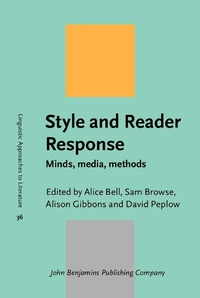
Style and Reader Response
Minds, media, methods
1st Edition
Published on 8. February 2021
244 pages
978-90-272-6037-6 (ISBN)
Description

Style and Reader Response: Minds, media, methods profiles the diversity of theoretical and methodological approaches in reception-oriented research in stylistics. Collectively, the chapters investigate how real readers, players, audiences, and viewers respond to, experience, and interpret texts. Contributions to the book investigate discourse types such as contemporary literature, poetry, political speeches, digital fiction, art exhibitions, and online news discourse. The volume also exemplifies the variety of empirical approaches in reception research, with contributors drawing on a range of methods including discussion groups, interviews, questionnaires, and think-aloud protocols with data analysed from both online and offline sources. Style and Reader Response makes an important contribution to an emerging paradigm within stylistics in which verifiable insights from readers are used to generate new models and new understandings of texts across media, with each essay demonstrating the centrality of empirical research for theoretical, methodological, and/or analytical advancements within and beyond stylistics.
More details
Other editions
Additional editions
Book
02/2021
John Benjamins Publishing Co
€123.30
Shipment within 10-15 days
Content
- Intro
- Style and Reader Response
- Editorial page
- Title page
- Copyright page
- Table of contents
- Acknowledgements
- 1. Responding to style
- 1. Introduction
- 2. Stylistics and the reader
- 3. Minds
- 4. Media
- 5. Methods
- 6. Conclusion
- 2. Interpretation in interaction
- 1. Introduction
- 1.1 Reading groups
- 1.2 Data collection: Andy's group
- 2. Style: The poem under discussion
- 3. Dialogism
- 3.1 Dialogic syntax
- 4. Response: Dialogic interpretation
- 5. Conclusion
- 3. Modelling an unethical mind
- 1. Introduction: The dystopian imagination
- 2. Reading dystopian minds
- 2.1 Text World Theory and mind-modelling
- 3. The refracted text-worlds of Bacigalupi's "Pop Squad"
- 4. Mind-modelling the narrator
- 5. Conclusion: Projecting and resisting text-world ethics
- 4. Towards an empirical stylistics of critical reception
- 1. Introduction
- 2. Text World Theory and critical reception
- 3. Resisting "out loud"
- 4. Resisting the writer (.and the other discourse participants)
- 5. Resisting the text-world
- 6. Conclusion: towards a stylistics of critical reception
- 5. A cognitive and cultural reader response theory of character construction
- 1. Introduction
- 2. Context, literary reading, and cultural models
- 3. A cognitive and cultural reader response theory of character construction
- 3.1 Cultural models in character construction: Categorical knowledge and interpretive patterns
- 3.2 The cultural model of character
- 4. Toward the (empirical) analysis of cultural models at work
- 6. "Why do you insist that Alana is not real?"
- 1. Introduction: There's no artist like Alana Olsen
- 2. Fictionality and empirical Research: There's no reality like fiction
- 2.1 The development of fiction/reality distinctions
- 2.2 Factors effecting fiction/reality judgment and processing
- 2.3 Summary of fictionality and empirical research
- 3. Modelling cognition in museums: There's no methodology like cognitive stylistics
- 4. Exhibition style: There's no place like time
- 5. Questionnaire response: There's no data like qualitative answers
- 5.1 Is Alana Olsen real enough to meet?
- 5.2 Retrospective disbelief
- 5.3 Belief in the auto/biographical retrospective and emotional response
- 5.4 Personal relevance and reality creating fiction
- 6. Conclusion: There's no felt experience like referentiality
- 7. Reading hyperlinks in hypertext fiction
- 1. Introduction
- 2. Hyperlinks in hypertext fiction
- 3. Different typologies
- 4. Our empirical approach to hyperlinks
- 5. Analysis
- 5.1 New Pics, Rain, Danish
- 5.2 Last Summer, Thing
- 6. Conclusion
- 8. Evaluating news events
- 1. Introduction
- 2. Reader response to news media
- 3. Evaluative language analysis
- 3.1 Appreciation
- 3.2 Appraisal and news values
- 4. Methodology
- 4.1 News texts collection
- 4.2 Interview collection
- 4.3 Analysis
- 5. Results
- 5.1 Reader response through negative quality
- 5.2 Differences in news event evaluations using negative quality
- 5.3 Summary of Results
- 6. Conclusion
- 9. In defence of introspection
- 1. The problem of observing reading
- 2. The nature of introspection
- 3. Introspecting a poem
- 4. A retrospective on the argument
- References
- 10. Reading the readers
- 1. Introduction
- 2. Background to the study of readers and audiences
- 3. The impact of the digital
- 4. Web 2.0 and online participatory cultures
- 5. Going beyond text
- 6. Access and anonymity: Negotiating the public versus the private
- 7. Reflexivity and the responsibilities of researchers
- 8. Mixed methods approaches
- 9. Moving from subjects to participants
- 10. Creative participatory methods
- 11. Conclusion
- Funding
- References
- 11. Extra-textuality and affective intensities
- 1. Introduction
- 2. Extending reading and the extra-textual
- 3. Assemblages of bodies, materials, environments, and texts
- 3.1 Affect and stylistics
- 3.2 Affect and literacy studies
- 3.3 Literacy as ideological and multitudinous
- 3.4 Relational practices
- 3.5 Immersion, pleasure and affect
- 4. The extra-textual in the analysis of writing
- 4.1 "Un-thinking" with Grimm & Co: Background and methodology
- 4.2 The coming together of people, places and things, in the creation of a story
- 5. Conclusion
- Funding
- Acknowledgements
- References
- 12. Postscript
- 1. Introduction
- 2. Overview
- 3. Conclusion
- References
- Index
