

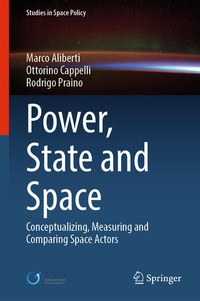
Power, State and Space
Description

This book explains on what basis a nation can claim the status of space power, what are the criteria differentiating a space power from "lesser" space actors, and how their spacepower can be empirically measured and assessed. To this end, it sets forth a comprehensive multidisciplinary framework to enable a dynamic comparison of space actors and of the pathways that lead them in and out of the space powers' club. Drawing upon a critical review of the existing literature, it conceptualises spacepower as a form of state power based on the complex interplay between the two defining dimensions of stateness, namely the well-studied dimension of capacity and the often neglected yet exceedingly important dimension of autonomy.
The book demonstrates that only actors possessing high levels of both autonomy and capacity qualify as space powers. Different levels of either capacity or autonomy produce other types of space actors, including skilled spacefarers, self-reliant spacefarers, primed spacefarers, and emerging space actors. This innovative conceptual framework is complemented by an in-depth comparative assessment that collects and processes a large amount of hard-to-find data on the most active global space actors and aggregates multiple indicators into a compound, non-hierarchical index of space power visualised in the form of a matrix.
More details
Other editions
Additional editions
Persons
Marco Aliberti is a space policy professional with more than ten years of experience in leading research activities at the European Space Policy Institute (ESPI) in Vienna, Austria. As a senior research fellow at ESPI, he has carried out and published a number of research projects in the areas of access to space and space strategy, international relations and governance of outer space, and Asia's space programmes, particularly those of China, Japan, and India.
Dr. Ottorino Cappelli is a senior researcher and lecturer at the University of Naples "L'Orientale", Italy, where he teaches Political Science and Comparative Politics. His long-standing research interests are in the comparative analysis of regime transitions. Over the past few years, his scholarly works have been centered on the establishment of a theoretical-empirical model for defining and assessing the various dimensions of state power.
Dr. Rodrigo Praino is an associate professor of Politics and Public Policyat Flinders University, Adelaide, Australia. A political scientist with expertise in decision-making and political behaviour, he is interested in space politics and space policy, with particular focus on the importance of space assets for defence, economic development, international relations, and decision-making.
Content
Introduction.- Conceptualising Space Actors: State And Power In Space.- Measuring Space Actors: A Methodological Framework.- Comparing Space Actors: An Empirical Assessment.
