

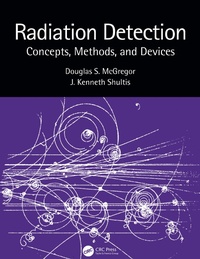
Radiation Detection
Concepts, Methods, and Devices
1st Edition
Published on 19. August 2020
1312 pages
978-1-000-03860-6 (ISBN)
Description

Radiation Detection: Concepts, Methods, and Devices provides a modern overview of radiation detection devices and radiation measurement methods. The book topics have been selected on the basis of the authors' many years of experience designing radiation detectors and teaching radiation detection and measurement in a classroom environment.
This book is designed to give the reader more than a glimpse at radiation detection devices and a few packaged equations. Rather it seeks to provide an understanding that allows the reader to choose the appropriate detection technology for a particular application, to design detectors, and to competently perform radiation measurements. The authors describe assumptions used to derive frequently encountered equations used in radiation detection and measurement, thereby providing insight when and when not to apply the many approaches used in different aspects of radiation detection. Detailed in many of the chapters are specific aspects of radiation detectors, including comprehensive reviews of the historical development and current state of each topic. Such a review necessarily entails citations to many of the important discoveries, providing a resource to find quickly additional and more detailed information.
This book generally has five main themes:
Physics and Electrostatics needed to Design Radiation Detectors
Properties and Design of Common Radiation Detectors
Description and Modeling of the Different Types of Radiation Detectors
Radiation Measurements and Subsequent Analysis
Introductory Electronics Used for Radiation Detectors
Topics covered include atomic and nuclear physics, radiation interactions, sources of radiation, and background radiation. Detector operation is addressed with chapters on radiation counting statistics, radiation source and detector effects, electrostatics for signal generation, solid-state and semiconductor physics, background radiations, and radiation counting and spectroscopy. Detectors for gamma-rays, charged-particles, and neutrons are detailed in chapters on gas-filled, scintillator, semiconductor, thermoluminescence and optically stimulated luminescence, photographic film, and a variety of other detection devices.
This book is designed to give the reader more than a glimpse at radiation detection devices and a few packaged equations. Rather it seeks to provide an understanding that allows the reader to choose the appropriate detection technology for a particular application, to design detectors, and to competently perform radiation measurements. The authors describe assumptions used to derive frequently encountered equations used in radiation detection and measurement, thereby providing insight when and when not to apply the many approaches used in different aspects of radiation detection. Detailed in many of the chapters are specific aspects of radiation detectors, including comprehensive reviews of the historical development and current state of each topic. Such a review necessarily entails citations to many of the important discoveries, providing a resource to find quickly additional and more detailed information.
This book generally has five main themes:
Physics and Electrostatics needed to Design Radiation Detectors
Properties and Design of Common Radiation Detectors
Description and Modeling of the Different Types of Radiation Detectors
Radiation Measurements and Subsequent Analysis
Introductory Electronics Used for Radiation Detectors
Topics covered include atomic and nuclear physics, radiation interactions, sources of radiation, and background radiation. Detector operation is addressed with chapters on radiation counting statistics, radiation source and detector effects, electrostatics for signal generation, solid-state and semiconductor physics, background radiations, and radiation counting and spectroscopy. Detectors for gamma-rays, charged-particles, and neutrons are detailed in chapters on gas-filled, scintillator, semiconductor, thermoluminescence and optically stimulated luminescence, photographic film, and a variety of other detection devices.
More details
Edition
1. Auflage
Language
English
Place of publication
London
United Kingdom
Publishing group
Taylor & Francis Ltd
Target group
College/higher education
Product notice
Reflowable
Illustrations
753 Illustrations, black and white
ISBN-13
978-1-000-03860-6 (9781000038606)
Copyright in bibliographic data and cover images is held by Nielsen Book Services Limited or by the publishers or by their respective licensors: all rights reserved.
Schweitzer Classification
Other editions
Additional editions
Book
09/2020
1st Edition
CRC Press
€184.50
Shipment within 15-20 days
Persons
Douglas S. McGregor is a University Distinguished Professor in Kansas State University (KSU) and holds the Boyd D. Brainard Chair in Mechanical and Nuclear Engineering. Professor McGregor serves as director of the Semiconductor Materials and Radiological Technologies Laboratory at KSU, a 9500 sq ft laboratory dedicated to radiation detector research.He has published over 200 research articles and reports, is co-inventor on over 20 radiation detector patents, and his research group has received five R&D-100 Awards for radiation detector innovations. Prof. McGregor is also the recipient of various other honors, including the KSU College of Engineering (CoE) Frankenhoff Outstanding Research Award (2006) and the CoE Engineering Distinguished Researcher Award (2016).
J. Kenneth Shultis joined the Nuclear Engineering faculty at Kansas State University in 1969 and where he presently holds the Black and Veatch Distinguished Professorship and is the Ike and Letty Conerstone teaching scholar.Besides being coauthor of this book he has coauthored the books Fundamentals of Nuclear Science and Engineering, Radiation Shielding, Radiological Assessment, Principles of Radiation Shielding, and Exploring Monte Carlo Methods.He is a Fellow of the American Nuclear Society (ANS), and has received many awards for his teaching and research, including the infrequently awarded ANS Rockwell Lifetime Achievement Award for his contributions over 50 years to the practice of radiation shielding.
J. Kenneth Shultis joined the Nuclear Engineering faculty at Kansas State University in 1969 and where he presently holds the Black and Veatch Distinguished Professorship and is the Ike and Letty Conerstone teaching scholar.Besides being coauthor of this book he has coauthored the books Fundamentals of Nuclear Science and Engineering, Radiation Shielding, Radiological Assessment, Principles of Radiation Shielding, and Exploring Monte Carlo Methods.He is a Fellow of the American Nuclear Society (ANS), and has received many awards for his teaching and research, including the infrequently awarded ANS Rockwell Lifetime Achievement Award for his contributions over 50 years to the practice of radiation shielding.
Content
1. Origins. 2. Introduction to Nuclear Instrumentation. 3. Basic Atomic and Nuclear Physics. 4. Radiation Interactions. 5. Sources of Radiation. 6. Probability and Statistics for Radiation Counting. 7. Source and Detector Effects. 8. Essential Electrostatics. 9. Gas-Filled Detectors: Ion Chambers. 10. Gas-Filled Detectors: Proportional Counters. 11. Gas-Filled Detectors: Geiger-M?uller Counters. 12. Review of Solid State Physics. 13. Scintillation Detectors and Materials. 14. Light Collection Devices. 15. Basics of Semiconductor Detector Devices. 16. Semiconductor Detectors. 17. Slow Neutron Detectors. 18. Fast Neutron Detectors. 19. Luminescent and Additional Detectors. 20. Radiation Measurements and Spectroscopy. 21. Mitigating Background. 22. Nuclear Electronics.
