

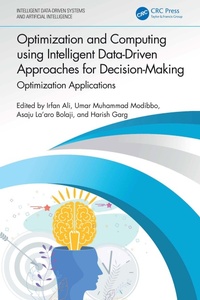
Optimization and Computing using Intelligent Data-Driven Approaches for Decision-Making
Optimization Applications
1st Edition
Published on 26. December 2024
334 pages
978-1-040-16462-4 (ISBN)
Description

This book comprehensively discusses nature-inspired algorithms, deep learning methods, applications of mathematical programming, and artificial intelligence techniques. It further covers important topics such as the use of machine learning and the Internet of Things and multi-objective optimization under Fermatean hesitant fuzzy and uncertain environment.
This book:
Addresses solving practical problems such as supply chain management, smart manufacturing, and healthcare analytics using intelligent computing and discusses solving the fuzzy inference system in ant colony optimization for traveling salesman problem
Presents an overview of artificial intelligence (AI) and explainable AI decision-making (XAIDM) and illustrates a data-driven optimization concept for modeling environmental and economic sustainability
Discusses machine learning-based multi-objective optimization technique for load balancing in integrated fog-cloud environment
Explains the use of heuristics and metaheuristics in supply chain networks and the use of fuzzy optimization in sustainable development goals
Discusses sustainable transit of hazardous waste, green fractional transportation system, perishable inventory, M-estimation of functional regression operator, and intuitionistic fuzzy sets applications
The text is primarily written for graduate students and academic researchers in diverse fields, including operations research, mathematics, statistics, computer science, information and communication technology, and industrial engineering.
This book:
Addresses solving practical problems such as supply chain management, smart manufacturing, and healthcare analytics using intelligent computing and discusses solving the fuzzy inference system in ant colony optimization for traveling salesman problem
Presents an overview of artificial intelligence (AI) and explainable AI decision-making (XAIDM) and illustrates a data-driven optimization concept for modeling environmental and economic sustainability
Discusses machine learning-based multi-objective optimization technique for load balancing in integrated fog-cloud environment
Explains the use of heuristics and metaheuristics in supply chain networks and the use of fuzzy optimization in sustainable development goals
Discusses sustainable transit of hazardous waste, green fractional transportation system, perishable inventory, M-estimation of functional regression operator, and intuitionistic fuzzy sets applications
The text is primarily written for graduate students and academic researchers in diverse fields, including operations research, mathematics, statistics, computer science, information and communication technology, and industrial engineering.
More details
Series
Edition
1. Auflage
Language
English
Place of publication
London
United Kingdom
Publishing group
Taylor & Francis Ltd
Target group
College/higher education
Professional and scholarly
Illustrations
55 Tables, black and white; 45 Line drawings, black and white; 8 Halftones, black and white; 53 Illustrations, black and white
ISBN-13
978-1-040-16462-4 (9781040164624)
Copyright in bibliographic data and cover images is held by Nielsen Book Services Limited or by the publishers or by their respective licensors: all rights reserved.
Schweitzer Classification
Other editions
Additional editions
Irfan Ali | Umar Muhammad Modibbo | Asaju La'aro Bolaji
Optimization and Computing using Intelligent Data-Driven Approaches for Decision-Making
Optimization Applications
Book
approx. 07/2026
1st Edition
CRC Press
€77.00
Not yet published
Irfan Ali | Umar Muhammad Modibbo | Asaju La'aro Bolaji
Optimization and Computing using Intelligent Data-Driven Approaches for Decision-Making
Optimization Applications
Book
12/2024
1st Edition
CRC Press
€232.40
Shipment within 10-20 days

Irfan Ali | Umar Muhammad Modibbo | Asaju La'aro Bolaji
Optimization and Computing Using Intelligent Data-Driven Approaches for Decision-Making
Optimization Applications
Book
11/2024
CRC Press
Unfortunately, price unknown
Available (delivery time upon request)
Persons
Irfan Ali earned his B.Sc., M.Sc., M.Phil., and Ph.D. degrees from Aligarh Muslim University. He is currently a working faculty member with the Department of Statistics and Operations Research, Aligarh Muslim University. He received the Post-Graduate Merit Scholarship Award during his M.Sc. (statistics) and the UGC-BSR Scholarship Award during his Ph.D. (statistics) program. His research interests include applied statistics, survey sampling, reliability theory, supply chain networks and management, mathematical programming, fuzzy optimization, and multi-objective optimization. He has supervised M.Sc., M.Phil., and Ph.D. students in operations research. He completed a research project UGC?Start-Up Grant Project, UGC, New Delhi, India. He published more than 100 research articles in SCI/SCIE and other reputed journals and serves as a reviewer for several journals. He has published some edited books with international publishers, and some are in the process of publication. He published a textbook entitled Optimization with LINGO 18 Problems and Applications. This book is helpful for academicians, practitioners, students, and researchers in the field of OR. He is a lifetime member of various professional societies: Operational Research Society of India, Indian Society for Probability and Statistics, Indian Mathematical Society, and The Indian Science Congress Association. He has delivered invited talks at several universities and institutions. He also serves as associate editor for some journals and guest editor for SCI/SCIE.
Umar Muhammad Modibbo is a Senior Lecturer at the Modibbo Adama University, Yola, Nigeria. He earned his Ph.D. in Operations Research at the Aligarh Muslim University, Aligarh, India, in 2022. He earned his Master of Technology (M.Tech.) and Bachelor of Technology (B.Tech.) degrees in Operations Research at the Federal University of Technology, Yola, Nigeria (now The Modibbo Adama University, Yola) in 2016 and 2010, respectively. He is a recipient of the university's grant to study M.Tech. Operations Research in 2014 and a Nigerian Tertiary Education Trust Fund (TETFund) to study Ph.D. Operations Research in 2018. He received the Young Researcher Award and the Research Excellence Award from the Institute of Scholars (InSc), India, in 2020. He specialized in Applied Mathematical Programming and Computing. His research areas include mathematical programming and its applications, Soft computing, reliability optimization, fuzzy programming, multi-objective optimization, inventory and supply chain management, renewable energy, circular economy, Sustainable Development Goals and sustainability. He is Fellow and President of the Operations Research Institute for Decision Sciences & Analytics of Nigeria (ORIDSAN) and a lifetime and Execrative Member of the African Federation of Operations Research Societies (AFROS) and the International Federation of Operational Research Societies (IFORS). He has published over 40 research articles in journals of national and international repute with over 800 Google Scholar citations. He delivered an invited talk and attended conferences and workshops in his domain area. He is a reviewer of many journals. He is currently writing a book on the United Nations Sustainable Development Goals.
Asaju Bolaji La'aro earned his Ph.D. in Computer Science, majoring in Artificial Intelligence and Operations Research from the University of Science Malaysia, in 2014. He earned his M.Sc. in Mathematics at the University of Ilorin in 2006 and B.Sc. in Physics/Computer Science at the Federal University of Technology, Minna, in 2000. Prof. Asaju is currently the Dean of the Faculty of Computing and Information Systems, at Federal University Wukari, Taraba State. He is also the Head of the AI and OR Research Group (ECRG), which publishes numerous scientific publications in high-quality and well-reputed journals and conferences. Prof. Asaju has over 21 years of teaching experience in higher education institutions. He has taught several Computer Science and Artificial Intelligence courses at the university. In addition to his research, teaching, and administrative capabilities, Prof. Asaju has special strength in developing web-based applications that build more than 12 academic web systems related to research, quality assurance, e-learning, for postgraduate students, and poses vast experience in administrative activities.
Harish Garg is an Associate Professor at Thapar Institute of Engineering & Technology, Deemed University, Patiala, Punjab, India. He is ranked in the world's top 2% scientists list and ranked No. 1 in India and No. 229 in World Rank, which was published by Stanford University in four consecutive years: 2020, 2021, 2022, and 2023. He received the Most Outstanding Researcher Award in the field of Mathematics from Carrer 360 Academy. He is also the recipient of the International Obada-Prize 2022 ? Young Distinguished Researchers. He is also the recipient of the Top-Cited paper by an India-based author (2015?2019) from Elsevier publisher. He serves as an advisory board member of the Universal Scientific Education and Research Network (USERN). He is a Research Fellow at the INTI International University, Malaysia. His research interests include computational intelligence, multi-criteria decision-making, evolutionary algorithms, reliability analysis, expert systems and decision support systems, computing with words, and soft computing. He has authored more than 520 papers (over 500 are SCI) published in refereed international journals, including IEEE Transactions, Elsevier, and Springer. His Google citations are over 24,490 with H-index ? 88. He is one of the leading researchers in the world related to the MCDM and soft computing approaches. He also serves on editorial boards of several leading international journals. He is the Founding Editor-in-Chief of the Journal of Computational and Cognitive Engineering. He is also the Associate Editor of Alexandria Engineering Journal, Journal of Intelligent & Fuzzy Systems, Journal of Industrial & Management Optimization, CAAI Transactions on Intelligence Technology, etc. For more details about him, kindly follow his webpage https://sites.google.com/site/harishg58iitr/home
Umar Muhammad Modibbo is a Senior Lecturer at the Modibbo Adama University, Yola, Nigeria. He earned his Ph.D. in Operations Research at the Aligarh Muslim University, Aligarh, India, in 2022. He earned his Master of Technology (M.Tech.) and Bachelor of Technology (B.Tech.) degrees in Operations Research at the Federal University of Technology, Yola, Nigeria (now The Modibbo Adama University, Yola) in 2016 and 2010, respectively. He is a recipient of the university's grant to study M.Tech. Operations Research in 2014 and a Nigerian Tertiary Education Trust Fund (TETFund) to study Ph.D. Operations Research in 2018. He received the Young Researcher Award and the Research Excellence Award from the Institute of Scholars (InSc), India, in 2020. He specialized in Applied Mathematical Programming and Computing. His research areas include mathematical programming and its applications, Soft computing, reliability optimization, fuzzy programming, multi-objective optimization, inventory and supply chain management, renewable energy, circular economy, Sustainable Development Goals and sustainability. He is Fellow and President of the Operations Research Institute for Decision Sciences & Analytics of Nigeria (ORIDSAN) and a lifetime and Execrative Member of the African Federation of Operations Research Societies (AFROS) and the International Federation of Operational Research Societies (IFORS). He has published over 40 research articles in journals of national and international repute with over 800 Google Scholar citations. He delivered an invited talk and attended conferences and workshops in his domain area. He is a reviewer of many journals. He is currently writing a book on the United Nations Sustainable Development Goals.
Asaju Bolaji La'aro earned his Ph.D. in Computer Science, majoring in Artificial Intelligence and Operations Research from the University of Science Malaysia, in 2014. He earned his M.Sc. in Mathematics at the University of Ilorin in 2006 and B.Sc. in Physics/Computer Science at the Federal University of Technology, Minna, in 2000. Prof. Asaju is currently the Dean of the Faculty of Computing and Information Systems, at Federal University Wukari, Taraba State. He is also the Head of the AI and OR Research Group (ECRG), which publishes numerous scientific publications in high-quality and well-reputed journals and conferences. Prof. Asaju has over 21 years of teaching experience in higher education institutions. He has taught several Computer Science and Artificial Intelligence courses at the university. In addition to his research, teaching, and administrative capabilities, Prof. Asaju has special strength in developing web-based applications that build more than 12 academic web systems related to research, quality assurance, e-learning, for postgraduate students, and poses vast experience in administrative activities.
Harish Garg is an Associate Professor at Thapar Institute of Engineering & Technology, Deemed University, Patiala, Punjab, India. He is ranked in the world's top 2% scientists list and ranked No. 1 in India and No. 229 in World Rank, which was published by Stanford University in four consecutive years: 2020, 2021, 2022, and 2023. He received the Most Outstanding Researcher Award in the field of Mathematics from Carrer 360 Academy. He is also the recipient of the International Obada-Prize 2022 ? Young Distinguished Researchers. He is also the recipient of the Top-Cited paper by an India-based author (2015?2019) from Elsevier publisher. He serves as an advisory board member of the Universal Scientific Education and Research Network (USERN). He is a Research Fellow at the INTI International University, Malaysia. His research interests include computational intelligence, multi-criteria decision-making, evolutionary algorithms, reliability analysis, expert systems and decision support systems, computing with words, and soft computing. He has authored more than 520 papers (over 500 are SCI) published in refereed international journals, including IEEE Transactions, Elsevier, and Springer. His Google citations are over 24,490 with H-index ? 88. He is one of the leading researchers in the world related to the MCDM and soft computing approaches. He also serves on editorial boards of several leading international journals. He is the Founding Editor-in-Chief of the Journal of Computational and Cognitive Engineering. He is also the Associate Editor of Alexandria Engineering Journal, Journal of Intelligent & Fuzzy Systems, Journal of Industrial & Management Optimization, CAAI Transactions on Intelligence Technology, etc. For more details about him, kindly follow his webpage https://sites.google.com/site/harishg58iitr/home
Content
1. M-Estimation of Functional Regression Operator with Responses Missing at Random. 2. A Multi-Objective Solid Transportation Problem for the Sustainable Transit of Hazardous Waste in the Complex Fermatean Hesitant Fuzzy Environment. 3. A Framework of Hybrid Metaheuristic H - Gey Optimization for Embedding Factor Decision Making in Digital Image Watermarking on Social Media. 4. New Cosine Similarity Measures For Intuitionistic Fuzzy Sets With Application In Decision Making. 5. Multi-Objective Optimization Problems in Focus: Meaning, Approaches, and Implementation. 6. Optimization and Computing Using Intelligent Data-Driven Approaches for Decision-Making. 7. Evaluation of Factors Affecting Destination Selection in Medical Tourism with Spherical Fuzzy Analytic Hierarchy Process Method. 8. Effect Of Artificial Intelligence On Education. 9. Unleashing the Power of IoT: Transforming Industries and Enabling Connected Environments. 10. A multi-Echelon Multi-Objective Sustainable Supply Chain Considering Traffic Congestion. 11. Digital supply chain management in manufacturing industries. 12. A Green Fractional Transportation System Under Dual Hesitant Fermatean Fuzzy Configuration with Safety Factor. 13. Application of Hybrid SVM-LR Algorithm for Sentiment Analysis
