

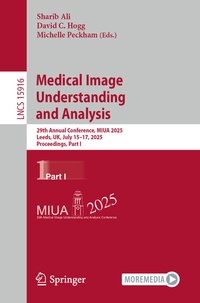
Medical Image Understanding and Analysis
Description

The three-volume set LNCS 15916,15917 & 15918 constitutes the refereed proceedings of the 29th Annual Conference on Medical Image Understanding and Analysis, MIUA 2025, held in Leeds, UK, during July 15-17, 2025.
The 67 revised full papers presented in these proceedings were carefully reviewed and selected from 99 submissions. The papers are organized in the following topical sections:
Part I: Frontiers in Computational Pathology; and Image Synthesis and Generative Artificial Intelligence.
Part II: Image-guided Diagnosis; and Image-guided Intervention.
Part III: Medical Image Segmentation; and Retinal and Vascular Image Analysis.
More details
Other editions
Additional editions
Content
.- Frontiers in Computational Pathology .
.- Transductive Survival Ranking for Pan-cancer Automatic Risk Stratification using Whole Slide Images.
.- Benchmarking Histopathology Foundation Models in a Multi-center Dataset for Skin Cancer Subtyping.
.- MitoNet: Efficient Ki-67 Detection in H\&E-Stained Images.
.- ASTER: Automated Segmentation of Endometrial Histology Images for Reproductive Health Assessment.
.- Leveraging Pathology Foundation Models for Panoptic Segmentation of Melanoma in H\&E Images.
.- SMatt-DINO: Spatially Aware Masked Attention Network for High Resolution Brain Image Classification.
.- Persistent Homology and Gabor Features Reveal Inconsistencies Between Widely Used Colorectal Cancer Training and Testing Datasets.
.- SWIFT-Reg: Slide-Wide Intelligent Feature-based Tissue Registration.
.- Learnable Moran's Index for Modeling Spatial Autocorrelation in Whole Slide Images to Predict Breast Cancer Outcomes.
.- Image Synthesis and Generative Artificial Intelligence .
.- Augmenting Chest X-ray Datasets with Non-Expert Annotations.
.- Leveraging Synthetic Data for Whole-Body Segmentation in X-ray Images.
.- Transform(AI)ng Radiology with CheXSBT: Integrating Dual-Attention Swin Transformer with BERT for Seamless Chest X-Ray Report Generation.
.- Cardiac Ultrasound Video Generation Using a Diffusion Model with Temporal Transformer.
.- KCLVA: Knowledge-enhanced Contrastive Learning and View-specific Attention for Chest X-ray Report Generation.
.- BlastDiffusion: A Latent Diffusion Model for Generating Synthetic Embryo Images to Address Data Scarcity in In Vitro Fertilization.
.- MediAug: Exploring Visual Augmentation in Medical Imaging.
.- On the Robustness of Medical Vision-Language Models: Are they Truly Generalizable?.
.- DiNO-Diffusion: Scaling Medical Diffusion Models via Self-Supervised Pre-Training.
.- Knowledge-Driven Hypothesis Generation for Burn Diagnosis from Ultrasound with Vision-Language Model.
.- Multimodal Federated Learning With Missing Modalities through Feature Imputation Network.
.- Parameter-Efficient Multimodal Adaptation for Certified Robustness of Medical Vision-Language Models.
