

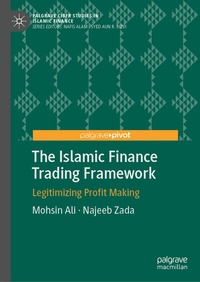
The Islamic Finance Trading Framework
Description

More details
Other editions
Additional editions
Persons
Mohsin Ali has a diverse background in academia and professional Islamic banking. He currently works as a Senior Lecturer at Taylor's Business School, Taylor's University, Malaysia. His research interests include conventional and Islamic economics and finance. He has a PhD in Islamic finance from INCEIF, Malaysia and received his bachelor's and master's in business administration from the International Islamic University, Islamabad.
Najeeb Zada completed his PhD in Islamic finance at INCEIF, Malaysia and is currently serving as a Lecturer in the historical Islamia College University, Peshawar, Pakistan. He has earned three master's degrees in Shariah, English, and Arabic respectively and has also completed a bachelor's degree in law (LLB). He serves as a Shariah board member of multiple institutions globally and undertakes research in the area of Shariah and legal aspects of Islamic finance in general and sukuk in particular.
Content
Chapter 1: Introduction.- Chapter 2: Trading under Islamic Commercial Law.- Chapter 3: Application of Islamic Financial Contracts.- Chapter 4: Profit Making in Islam - Justification and Importance.- Chapter 5: Conventional and Islamic Trading Frameworks - Differences and Similarities.- Chapter 6: Issues Auxiliary to Islamic Trading Framework.- Chapter 7: Conclusion.
