

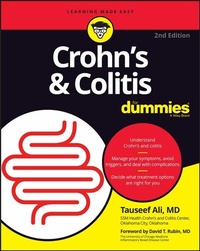
Crohn's and Colitis For Dummies
Description

Crohn's disease and ulcerative colitis are diseases that disrupt your body's ability to digest food, absorb nutrition, and eliminate waste in a healthy manner. Crohn's And Colitis For Dummies is the ultimate reference to these common forms of inflammatory bowel disease (IBD), including tips on how to recognize and control the symptoms, so you can get your life back. Get ideas for keeping disease in check through diet and lifestyle changes, learn about the various medical and surgical treatment options, and discover healthier living with this friendly Dummies guide. This updated edition covers the latest research on IBD and new therapies that are helping today's Crohn's and colitis patients. You'll also find resources that will help and offer hope as you navigate your diagnosis.
* Learn about the different forms of inflammatory bowel disease
* Ask the right questions at the doctor's office
* Make simple changes that will improve your symptoms
* Know that there's hope and that you are not alone
This book is perfect for anyone who has been recently diagnosed with Crohn's or colitis, and for those who suspect they may have an IBD. If you're a caregiver or family member of an IBD sufferer, you'll also love the easy-to-understand information inside.
More details
Other editions
Additional editions
Person
Content
Chapter 1
Crohn's and Colitis One Step at a Time
IN THIS CHAPTER
Finding out about Crohn's disease and ulcerative colitis
Reviewing the treatment options
Taking control of your quality of life
Living a full life with Crohn's and colitis
Looking at issues specific to pregnancy and kids
A better understanding of your disease is the key to a good quality of life. Knowledge is power! While writing this book, I thought about the questions my patients and their family members ask me most often. I answered those questions in these pages just as I do for my patients.
This chapter is an overview of the book as a whole. It gives you a taste of what I elaborate on in the chapters that follow. It defines Crohn's and colitis and helps you understand the difference between the two chronic inflammatory conditions of the gastrointestinal tract. This chapter helps you understand essential management concepts, including medical therapy and surgery to control symptoms and inflammation. Diet and nutrition are important in Crohn's and colitis, and I introduce these vital management components in this chapter. I also provide important information about pregnancy, Crohn's and colitis, and kids suffering from these illnesses.
Defining Crohn's and Colitis
Crohn's and colitis are chronic inflammatory diseases of the intestines. Together, these illnesses are also known as inflammatory bowel disease. So, what exactly are Crohn's and colitis?
When you get a cut on your skin, it hurts, bleeds, swells, and eventually forms a scar. Similarly, Crohn's and colitis cause cuts inside your intestinal wall that are called ulcers. Pain, bleeding, and swelling occur with ulcers, too, but inside your intestinal wall where you can't see them. Eventually, scars form, leading to the formation of strictures (abnormal narrowing) and causing an obstruction. This happens more frequently in Crohn's disease and rarely in ulcerative colitis. In Chapter 2, I offer even more information on what Crohn's and colitis are.
The signs and symptoms of Crohn's and colitis (also covered in Chapter 2) depend on the part of the intestines involved:
- Crohn's disease: Crohn's disease most commonly involves the last part of the small intestine and the beginning of the large intestine. The common symptoms of Crohn's disease are abdominal pain, especially on the lower-right side of the abdomen, diarrhea, and weight loss.
- Colitis: Colitis can involve the whole large intestine or just part of it. The process of inflammation usually starts in the rectum and moves upward to involve other parts of the colon. Bloody diarrhea is a common symptom of colitis. Urgency (the sudden feeling of needing to have a bowel movement) and tenesmus (the sense of incomplete relief after the bowel movement) are also common symptoms. They are caused by the inflammation of the rectum, also known as proctitis.
In both diseases, the process of inflammation can also cause fever, loss of appetite, weight loss, night sweats, and fatigue. Your nutritional status is usually compromised, and if you don't pay attention to your diet and calorie intake, you can easily become malnourished.
If it's been a while since you took a biology class and you need a refresher course on the digestive system, check out Chapter 3.
Who gets Crohn's and colitis? We still don't have the exact answer to this question. Scientists believe that different factors may play a role in causing these illnesses, including malfunctioning of the immune system, genetic defects, and exposure to certain environmental factors. For more information on who gets Crohn's and colitis, turn to Chapter 4.
Getting the Treatment You Need
The first part of getting treated for Crohn's disease is assembling your healthcare team. Crohn's and colitis are lifelong diseases, so you want to choose a doctor you can trust and develop a long-term relationship with. You also need to be familiar with other key players of your healthcare team, such as nurses, nutritionists, psychiatrists, and surgeons. For more information on assembling your team, turn to Chapter 5.
When it comes to getting diagnosed with Crohn's or colitis, most of the time it's symptoms of diarrhea, abdominal pain, and blood in stools that prompt people to go to the doctor's office. Your doctor will run a battery of tests to rule out (or rule in) the diagnosis of Crohn's or colitis. These may include blood tests, stool tests, endoscopic exams, and radiology tests. Chapter 6 covers the different tests used to confirm the diagnosis of Crohn's or colitis.
Currently, Crohn's and colitis have no cure, but medications work in the majority of patients. Several drugs are available for the treatment of these diseases. The drugs help to control symptoms and inflammation and bring the diseases under control. You'll have to take these medications long term - until your doctor changes your prescription or you require surgery. For more information on the various medications used to treat Crohn's and colitis, turn to Chapter 7.
Medications may stop working for some patients, and the side effects of the medications may be intolerable for others. Surgery might be the best option in these cases. Colitis is cured after surgery, but Crohn's disease comes back even after surgery and may require further medications or even more surgeries. For more on the surgical options for treating Crohn's and colitis, check out Chapter 8.
Recognizing That You're Not Powerless
Some people with chronic conditions like Crohn's or colitis get discouraged. It's hard to cope with a disease that has the potential to disrupt your life and cause pain. But the good news is that you can take all kinds of steps to improve your quality of life when you have Crohn's or colitis.
A key part of your health as a person who has Crohn's or colitis is your diet. Eating a well-balanced diet and avoiding trigger foods are important steps toward managing these illnesses. Good nutrition is important for your immune system and your body's ability to heal from the inflammation. Nutrition is also important for kids and pregnant women suffering from Crohn's and colitis because they have increasingly higher demands for calories and because malnutrition can really affect growth and worsen the process of inflammation. On the other hand, your body may be unable to handle sugary, high-fiber, and fatty foods, especially during periods of active disease, and you may want to avoid them. For more information on the role diet has in Crohn's and colitis, check out Chapter 9.
Crohn's and colitis can affect your whole body, not just your digestive system. For example, you may be more prone to a variety of skin conditions, including skin cancer. In addition, Crohn's and colitis can affect the balance of calcium and vitamin D in your body, which can lead to osteoporosis or osteopenia (a precursor to osteoporosis). For more information on whole-body health for people with Crohn's and colitis, turn to Chapter 10.
When you have Crohn's or colitis, you don't have to rely solely on conventional medicine. You can try a variety of alternative and complementary therapies, including exercise, physical therapy, herbal therapy, homeopathy, and traditional Chinese medicine. Chapter 11 has the lowdown on a variety of options that may improve your quality of life.
Discuss all options with your doctor. Taking the right medication at the right time to control symptoms and suppress inflammation is critical to the management of Crohn's and colitis and prevents further damage and complications.
Living a Full Life with the Disease
Handling a diagnosis of Crohn's or colitis is a challenge in itself. Then you have to figure out a way to talk about it to your family and friends because they'll be affected by your diagnosis, too. In Chapter 12, I offer advice on these subjects and more, including planning for the holidays. Chapter 12 is also helpful if it's your family member or friend with the disease, not you.
Part of living and coping with Crohn's and colitis is figuring out how to avoid triggers that cause flares. Common triggers include different drugs or foods, smoking, stress, and lack of sleep. Chapter 13 is all about how to reduce triggers in your life so you can focus on what you'd rather be doing - living!
Work and travel are two big parts of life for many people, and when you have Crohn's or colitis, you need to know how to manage your disease while you do one or both. You may need to talk about your diagnosis with your employer - something that can cause stress in and of itself, depending on your relationship with your boss and how secure you feel in your job. And if you're on the road and find yourself needing a bathroom fast, your anxiety can ramp up. Chapter 14 covers work and travel, offering useful tips for doing both when you have Crohn's or colitis.
Managing Special Cases: Advice for Pregnant Women and Kids
Twenty-five to thirty percent of Crohn's and colitis patients...
