

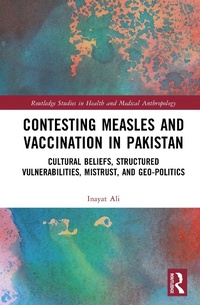
Contesting Measles and Vaccination in Pakistan
Cultural Beliefs, Structured Vulnerabilities, Mistrust, and Geo-Politics
1st Edition
Published on 29. August 2024
304 pages
978-1-000-89918-4 (ISBN)
Description

This book explores issues surrounding measles and vaccination in Pakistan. Drawing on long-term ethnographic research, it focuses on two major outbreaks in Sindh Province and on Pakistan's vaccination campaigns. The chapters examine the responses to outbreaks and vaccination from various stakeholders including local people, the Pakistani government and the WHO. Inayat Ali reflects on the competing agendas, differing conceptualizations of measles and vaccination, and the factors that lie behind these contestations. Situating outbreaks within the institutionalized form of disparities, he analyzes the rituals used to deal with measles and local resistance to vaccines in Pakistan. The distinct imaginaries and practices related to measles and vaccination are considered in national and global context, and the book makes a valuable contribution to the development of an anthropology of vaccination and medical anthropology of Pakistan.
Reviews / Votes
"This exciting ethnographic account of the measles epidemic in Pakistan, focuses on the ultimate causes of vaccination resistance. While biomedical and global public health officials point to 'backward' cultural beliefs and behaviors and the irrational embrace of conspiracy theories (e.g., vaccination is a plot to achieve Muslim sterilization), Inayat Ali reveals the fundamental role of socioeconomic inequality, locally, nationally, and globally, in fueling the measles epidemic in his country. Moreover, Ali mobilizes the social insights of Foucault on the social distribution of power, and the ideas of various medical anthropologists, to affirm measles vaccination avoidance in Pakistan as an expression of resistance." - Merrill Singer, University of Connecticut, USA"A credible research resource, addressing a public health issue through anthropological lens, for public health professionals, practitioners, and policy makers particularly relevant to Pakistan in the COVID-19 pandemic affected health care systems and vaccination programs. Inayat Ali has examined the issues surrounding measles in the larger context of fragile health system and inequitable social structures of Pakistan. He illustrates that the disease outbreaks are indeed the outcome of competing narratives, inequalities, and social conflicts. This dimension is largely missing in the public health professionals' dialogues. His work is guided by theoretical and methodological frameworks that have relevance to other public health problems. The author argues the need for a comprehensive effective governance approach to deal with global Covid 19 pandemic as well as draw upon a deep understanding of vaccine hesitancy to improve the vaccination programs. A must read for public health professionals." - Saima Hamid, Fatima Jinnah Women University, Pakistan
More details
Series
Edition
1. Auflage
Language
English
Place of publication
London
United Kingdom
Publishing group
Taylor & Francis Ltd
Target group
College/higher education
Illustrations
3 Tables, black and white; 2 Halftones, black and white; 2 Illustrations, black and white
ISBN-13
978-1-000-89918-4 (9781000899184)
Copyright in bibliographic data and cover images is held by Nielsen Book Services Limited or by the publishers or by their respective licensors: all rights reserved.
Schweitzer Classification
Other editions
Additional editions
Inayat Ali
Contesting Measles and Vaccination in Pakistan
Cultural Beliefs, Structured Vulnerabilities, Mistrust, and Geo-Politics
Book
approx. 12/2025
1st Edition
Routledge
€69.20
Not yet published
Inayat Ali
Contesting Measles and Vaccination in Pakistan
Cultural Beliefs, Structured Vulnerabilities, Mistrust, and Geo-Politics
Book
08/2024
1st Edition
Routledge
€194.10
Shipment within 10-20 days
Person
Inayat Ali is in charge of the Department of Public Health and Allied Sciences and Assistant Professor in the Department of Anthropology at Fatima Jinnah Women University, Rawalpindi, Pakistan. He is also a Research Fellow in the Department of Social and Cultural Anthropology at the University of Vienna, Austria.
Content
Preface by Merrill Singer
Prologue
Introduction
1 Many Anthropologies: Reflections on Theoretical Threads and the Medical Anthropology of Pakistan
2 Researchlogue: Design, Methodology, and Circumstances of Data collection
3 The Setting: From Sindh Province to the Sindhi Villages
4 Competing Healthcare Systems: Revisiting Medical Pluralism in Pakistan
5 Health and Illness: Socio-cultural Understanding
6 Local Rituals of Containment: Emic Perceptions and Practices around Measles
7 Social Dramas: Two Measles Outbreaks and Multiple Narratives in Pakistan
8 The Critical Geopolitical Events: Making Sense of Anti-Vaccination Sentiment
9 National and Global Rituals of Containment: Controversies, Contestations, and Mistrust Surrounding Vaccination in Pakistan
10 Measles Vaccine: From General to Particular
11 Creating an Anthropology of Vaccination: The International "Anti-Vaxx" Movement and Multiple Narratives
Conclusions: Interrelations between Measle's Sacredness and Systematic Disparities
Epilogue
Bibliography
Prologue
Introduction
1 Many Anthropologies: Reflections on Theoretical Threads and the Medical Anthropology of Pakistan
2 Researchlogue: Design, Methodology, and Circumstances of Data collection
3 The Setting: From Sindh Province to the Sindhi Villages
4 Competing Healthcare Systems: Revisiting Medical Pluralism in Pakistan
5 Health and Illness: Socio-cultural Understanding
6 Local Rituals of Containment: Emic Perceptions and Practices around Measles
7 Social Dramas: Two Measles Outbreaks and Multiple Narratives in Pakistan
8 The Critical Geopolitical Events: Making Sense of Anti-Vaccination Sentiment
9 National and Global Rituals of Containment: Controversies, Contestations, and Mistrust Surrounding Vaccination in Pakistan
10 Measles Vaccine: From General to Particular
11 Creating an Anthropology of Vaccination: The International "Anti-Vaxx" Movement and Multiple Narratives
Conclusions: Interrelations between Measle's Sacredness and Systematic Disparities
Epilogue
Bibliography
