

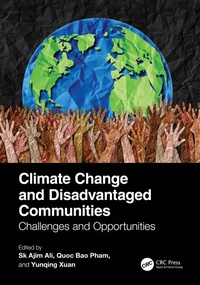
Climate Change and Disadvantaged Communities
Challenges and Opportunities
Published on 9. December 2025
382 pages
978-1-040-55785-3 (ISBN)
Description

As climate change accelerates, so does the urgency to understand and address its unequal impacts. This book explores the uneven impacts of climate change and how it affects the lives and livelihoods of climate-disadvantaged communities by highlighting the specific challenges they face, such as heatwaves, droughts, flooding, health issues, and economic losses. It explains why vulnerable populations are more at risk due to factors such as lack of infrastructure, poverty, and limited access to resources. This book offers insights on conceptual frameworks to help vulnerable communities adapt and become more resilient to climate impacts. Real-life examples with challenges and actionable suggestions aim to inform policymakers and the public about the urgent need for targeted initiatives.
Features:
Provides a comprehensive examination of how marginalized groups, from indigenous populations in the Niyamgiri Hills to urban slum dwellers in Asia, are disproportionately affected by climate change and what can be done to mitigate these impacts.
Includes practical examples from different countries to help understand the intersection between climate change and social inequality.
Utilizes advanced technologies and provides cutting-edge tools such as geospatial maps and diagrams for modelling climate threats and predicting climate-related challenges.
Provides a roadmap for more resilient and inclusive future strategies.
Highlights interdisciplinary discussions and contributions by various stakeholders to reach different audiences and offer regional problem-solving opportunities.
This book serves as a valuable resource for a wide audience, including climate scientists, geographers, ecologists, geologists, urban planners, environmentalists, research scholars, and policymakers engaged in the fields of environmental management, climate justice, and sustainable development. By featuring the voices and experiences of disadvantaged communities, this book contributes meaningfully to the ongoing debates of climate justice, sustainable development, and equitable adaptation pathways.
Features:
Provides a comprehensive examination of how marginalized groups, from indigenous populations in the Niyamgiri Hills to urban slum dwellers in Asia, are disproportionately affected by climate change and what can be done to mitigate these impacts.
Includes practical examples from different countries to help understand the intersection between climate change and social inequality.
Utilizes advanced technologies and provides cutting-edge tools such as geospatial maps and diagrams for modelling climate threats and predicting climate-related challenges.
Provides a roadmap for more resilient and inclusive future strategies.
Highlights interdisciplinary discussions and contributions by various stakeholders to reach different audiences and offer regional problem-solving opportunities.
This book serves as a valuable resource for a wide audience, including climate scientists, geographers, ecologists, geologists, urban planners, environmentalists, research scholars, and policymakers engaged in the fields of environmental management, climate justice, and sustainable development. By featuring the voices and experiences of disadvantaged communities, this book contributes meaningfully to the ongoing debates of climate justice, sustainable development, and equitable adaptation pathways.
More details
Language
English
Place of publication
London
United Kingdom
Publishing group
Taylor & Francis Ltd
Target group
Professional and scholarly
College/higher education
Illustrations
2 Tables, color; 56 Tables, black and white; 37 Line drawings, color; 52 Line drawings, black and white; 63 Halftones, color; 18 Halftones, black and white; 100 Illustrations, color; 70 Illustrations, black and white
File size
147,05 MB
ISBN-13
978-1-040-55785-3 (9781040557853)
Copyright in bibliographic data and cover images is held by Nielsen Book Services Limited or by the publishers or by their respective licensors: all rights reserved.
Schweitzer Classification
Other editions
Additional editions
Sk Ajim Ali | Quoc Bao Pham | Yunqing Xuan
Climate Change and Disadvantaged Communities
Challenges and Opportunities
Book
approx. 12/2025
1st Edition
CRC Press
€260.10
Not yet published
Persons
Sk Ajim Ali was awarded his Ph.D. degree from Aligarh Muslim University, Aligarh. Currently he is working remotely as a Research Associate and affiliated with the Global Development Institute, School of Environment, Education and Development, The University of Manchester, UK. He has more than four years of research experience and contributed more than 50 scientific research papers on geospatial modeling, and geohazards vulnerabilities. His focus areas of research interest include disaster management, climate change, and public health.
Quoc Bao Pham is currently working as an Assistant professor at Faculty of Natural Science, Institute of Earth Science, University of Silesia in Katowice, Poland. He has obtained his Ph.D. degree from the Department of Hydraulic and Ocean Engineering, National Cheng Kung University, Taiwan. He has more than eight years of research experience in hydrology, GIS and Remote Sensing. His research interests are water resources engineering, applied machine learning, climate change, hydrology, remote sensing, GIS and spatial analysis.
Yunqing Xuan is a civil engineer by training but at the same time a hydrometeorologist with a range of interdisciplinary research interests in modelling hydrological processes interfacing with atmosphere and societies. He is currently working as an Associate Professor of Civil Engineering at Swansea University, Swansea, UK. He has over 20 years of research experience and leadership in hydrometeorological modelling and forecasting, numerical weather and climate modelling, predictability, uncertainty, climatic extremes, and computational methods in geosciences. Additionally, he is a founding member and operator of the Welsh Local Centre of the Royal Meteorological Society.
Quoc Bao Pham is currently working as an Assistant professor at Faculty of Natural Science, Institute of Earth Science, University of Silesia in Katowice, Poland. He has obtained his Ph.D. degree from the Department of Hydraulic and Ocean Engineering, National Cheng Kung University, Taiwan. He has more than eight years of research experience in hydrology, GIS and Remote Sensing. His research interests are water resources engineering, applied machine learning, climate change, hydrology, remote sensing, GIS and spatial analysis.
Yunqing Xuan is a civil engineer by training but at the same time a hydrometeorologist with a range of interdisciplinary research interests in modelling hydrological processes interfacing with atmosphere and societies. He is currently working as an Associate Professor of Civil Engineering at Swansea University, Swansea, UK. He has over 20 years of research experience and leadership in hydrometeorological modelling and forecasting, numerical weather and climate modelling, predictability, uncertainty, climatic extremes, and computational methods in geosciences. Additionally, he is a founding member and operator of the Welsh Local Centre of the Royal Meteorological Society.
Content
1. Climate Change and Vulnerability of Disadvantaged Communities: Introduction and Overview. Part 1: Climate Change Vulnerability, Livelihoods, and Resilience of Disadvantaged Communities. 2. Indigenous Resistance and Environmental Justice in the Face of Climate Change. 3. "Fight an uphill battle": Current Challenges of Natural Resource-based Livelihood of Women in Sundarbans (India) in the wake of Climate Change. 4. Climate-Induced Hazards and Agrarian Distress Among Marginal Farmers. 5. Climate Change, Seasonality, and Livelihood Challenges in Ecotourism. 6. Global Research Dynamics on Climate Change and Indigenous Livelihoods. 7. Assessing the Challenges of Coastal Areas of Mousuni Island in the Indian Sundarbans under Climate Change and Sustainable Tourism-based Human Adaptation. Part 2: Urbanization, Public Health, and Microclimate Challenges in a Changing Climate. 8. Climate Change and its Multi-Dimensional Factors. 9. Heat Index in a Warming India. 10. Cities, Urbanization, and Environmental Vulnerable Community. 11. Living with Heat. 12. Navigating the Climate Crisis. 13. Assessing the Impact of Indoor Air Pollution on Self-Reported Health Among Older Adults in India. 14. Climate Change and Health Vulnerability. Part 3: Natural Resources, Ecosystems, and Climate Impact Assessments: Modeling, Mapping, and Risk Assessment. 15. Renewable Energy Transition. 16. Impact of Climate Change on Glacier Ice Volume. 17. Assessing the Household-Level Landslide Adaptation and Mitigation Strategies. 18. Climate Change and Phytoplankton Habitat Suitability in Nainital Lake. 19. Mapping Climate-Driven Persistent Flooding Using Google Earth Engine and its Impacts in the Indo-Gangetic Basin. 20. Unraveling the Vulnerability of Dry Tropical Grassland to Climate Change.
