

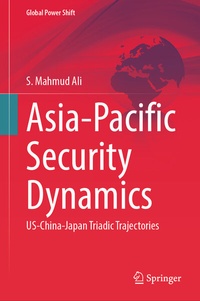
Asia-Pacific Security Dynamics
Description

This book examines the causes and consequences of the dramatic shift in Japanese national security perspectives and mutually exclusive policies toward China and the USA. It sheds new light on the changing trajectories of triadic dynamics shaping U.S.-China-Japan strategic insecurity, their historical roots, its implications for trans-Pacific peace and stability, and their potential influence on emerging regional and systemic security architectures. Against the backdrop of U.S.-proclaimed "great power competition" with China as the defining feature and organizing principle of the U.S.-led coalition's strategic and geopolitical responses to China's "national rejuvenation," with primacy's "displacement anxiety" triggering a "systemic transitional fluidity," the book examines the origins and outcomes of Sino-Japanese insecurity, its polarizing effects on U.S.-China and U.S.-Japan relations, and the wider systemic resonances and dissonances as the post-Cold War unipolar systemic structure gives way to an uncertain, ambiguous, and imprecise successor regime. Finally, historical lessons drawn from primary documents are used to illuminate the prospects for triangular relations in shaping the Asia-Pacific security ecology over the medium term.
More details
Other editions
Additional editions
Person
S. Mahmud Ali was trained at the Pakistan Military Academy and educated at the Royal United Services Institute for Defence Studies (RUSI), London, and King's College London, where he earned graduate and doctoral qualifications in geopolitical and strategic studies. After a two-decade career at the British Broadcasting Corporation, London, he was associated with the LSE IDEAS and has been associated with the ICS, UM, in Kuala Lumpur, Malaysia, since 2017. Ali is the author of eight volumes on the evolution of Sino-US relations.
Content
Chapter 1. Introduction: The post-unipolar triangle.- Chapter 2. Opening Doors and Closing Minds: Empires Collid.- Chapter 3. Wars Hot and Cold: A Turning of Tables.- Chapter 4. Korean War to Nixon shokku : Roles reversed, again!.- Chapter 5. Containment, primacy, flux: Systemic transitional fluidit.- Chapter 6. Conclusions: Prospects beyond Bide.
